Sydney School of Public Health, Faculty of Medicine and Health, The University of Sydney, Sydney, NSW, Australia.
Charles Perkins Centre, The University of Sydney, Sydney, NSW, Australia.
Sci Rep. 2023 Aug 1;13(1):12453. doi: 10.1038/s41598-023-39289-x.
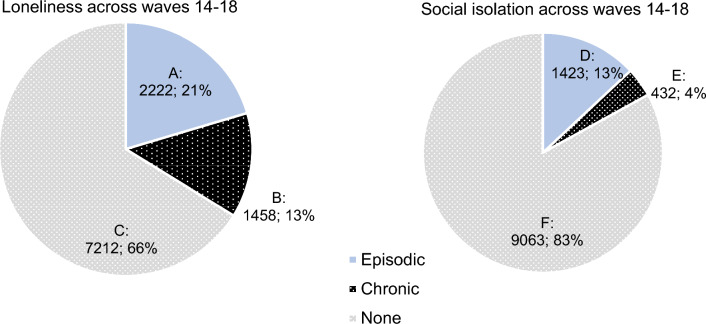
Loneliness and social isolation, experienced more long-term, has been shown to increase mortality and lead to poorer health outcomes in specific cohorts. However, it is unclear what the prevalence of chronic loneliness and social isolation is, and which demographic groups are most at risk of reporting more chronic forms. A psychometrically validated classification system was used to identify people who met criteria for episodic and chronic loneliness and social isolation using the Household Income and Labour Dynamics in Australia (HILDA) survey waves 14-18. The prevalence of loneliness (overall 34%; 21% episodic, 13% chronic) far exceeded that of social isolation (overall 17%; 13% episodic, 4% chronic). There was consistency in the demographic characteristics (from age, sex, household type, income) of those who experienced loneliness and social isolation. However, people with a long-term health condition had an elevated risk of episodic loneliness (AOR 1.24, 95% CI 1.11-1.39) and a markedly higher risk of chronic loneliness (AOR 2.01, 95% CI 1.76-2.29), compared with those without a long-term health condition. Loneliness, both episodic and chronic subtypes, is more prevalent than social isolation. However, both chronic loneliness and social isolation remains neglected and poorly targeted within current practice and policy.
孤独和社会隔离,如果长期存在,已被证明会增加死亡率,并导致特定人群的健康状况恶化。然而,目前尚不清楚慢性孤独和社会隔离的流行程度如何,以及哪些人群最有可能报告更多的慢性形式。本研究使用经过心理测量验证的分类系统,利用澳大利亚家庭收入和劳动力动态调查(HILDA)第 14-18 波次的数据,确定符合偶发性和慢性孤独和社会隔离标准的人群。孤独(总体 34%;21%偶发性,13%慢性)的流行程度远远超过社会隔离(总体 17%;13%偶发性,4%慢性)。那些经历孤独和社会隔离的人的人口统计学特征(从年龄、性别、家庭类型、收入)具有一致性。然而,与没有长期健康状况的人相比,患有长期健康状况的人更容易出现偶发性孤独(AOR 1.24,95%CI 1.11-1.39)和慢性孤独(AOR 2.01,95%CI 1.76-2.29)。与社会隔离相比,偶发性和慢性孤独亚型更为普遍。然而,慢性孤独和社会隔离在当前实践和政策中仍然被忽视和针对性不强。