Department of Psychology, Jeffrey Cheah School of Medicine and Health Sciences and Intelligent Lighting Laboratory, Monash University Malaysia, Jalan Lagoon Selatan, 47500, Bandar Sunway, Selangor Darul Ehsan, Malaysia.
Max Planck Institute for Biological Cybernetics, Translational Sensory & Circadian Neuroscience, Tübingen, Germany.
Sci Rep. 2023 Aug 1;13(1):12425. doi: 10.1038/s41598-023-39636-y.
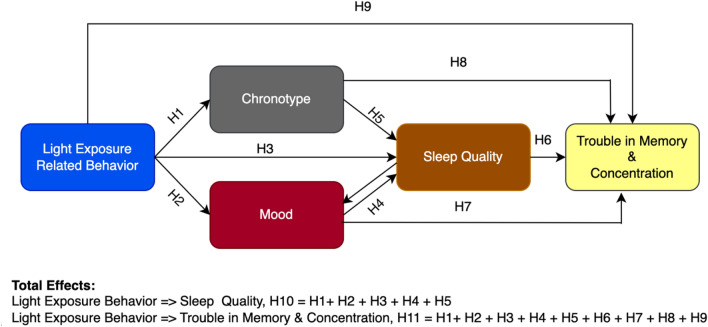
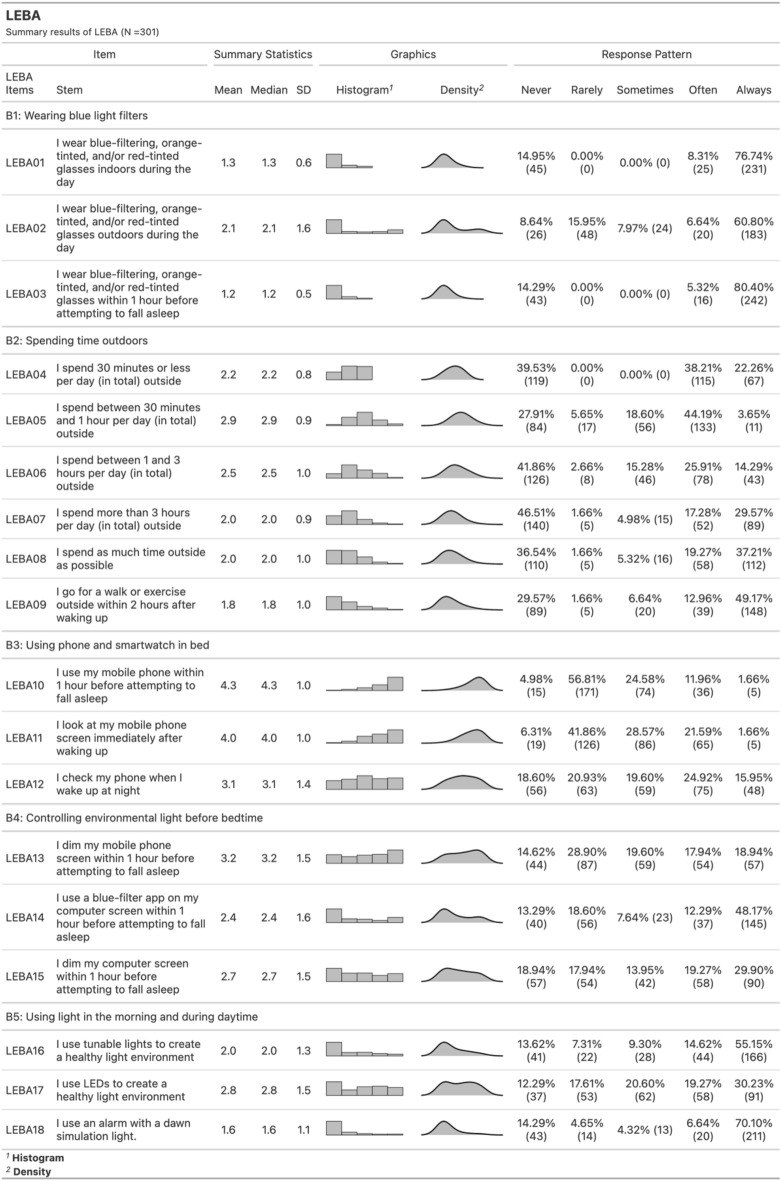
Ample research has shown that light influences our emotions, cognition, and sleep quality. However, little work has examined whether different light exposure-related behaviors, such as daytime exposure to electric light and nighttime usage of gadgets, especially before sleep, influence sleep quality and cognition. Three-hundred-and-one Malaysian adults (Mean = 28 ± 9) completed the Light Exposure Behavior Assessment tool that measured five light exposure behaviors. They also completed the Morningness-Eveningness Questionnaire, Positive and Negative Affect Schedule, Pittsburgh Sleep Quality Index, and single items assessing trouble in memory and concentration. A partial least square structural equation model, showing 72.72% predictive power, revealed that less use of wearable blue filters outdoors during the day and more within one hour before sleep predicted early peak time (direct effect = -0.25). Increased time spent outdoors predicted a positive affect (direct effect = 0.33) and a circadian phase advancement (direct effect: rising time = 0.14, peak time = 0.20, retiring time = 0.17). Increased use of mobile phone before sleep predicted a circadian phase delay (direct effect: retiring time = -0.25; rising time = -0.23; peak time = -0.22; morning affect = -0.12), reduced sleep quality (direct effect = 0.13), and increased trouble in memory and concentration (total effect = 0.20 and 0.23, respectively). Increased use of tunable, LED, or dawn-simulating electric light in the morning and daytime predicted a circadian phase advancement (direct effect: peak time = 0.15, morning affect = 0.14, retiring time = 0.15) and good sleep quality (direct effect = -0.16). The results provide valuable insights into developing a healthy light diet to promote health and wellness.
大量研究表明,光照会影响我们的情绪、认知和睡眠质量。然而,很少有研究探讨不同的与光照相关的行为,如白天暴露在人工光下和晚上在睡前使用小工具,是否会影响睡眠质量和认知。311 名马来西亚成年人(平均年龄 28±9 岁)完成了光照暴露行为评估工具,该工具测量了 5 种光照暴露行为。他们还完成了 Morningness-Eveningness Questionnaire(早-晚型问卷)、Positive and Negative Affect Schedule(正性负性情绪量表)、Pittsburgh Sleep Quality Index(匹兹堡睡眠质量指数)以及关于记忆力和注意力问题的单项评估。一个具有 72.72%预测能力的偏最小二乘结构方程模型显示,白天在户外使用可穿戴的蓝色滤光片的时间减少,且在睡前一小时内使用时间增加,会导致早睡早起(直接效应=−0.25)。更多的时间在户外会预测积极的情绪(直接效应=0.33)和昼夜节律相位提前(直接效应:上升时间=0.14,峰值时间=0.20,休息时间=0.17)。睡前使用手机的时间增加会导致昼夜节律相位延迟(直接效应:休息时间=−0.25;上升时间=−0.23;峰值时间=−0.22;早晨的情绪=−0.12),降低睡眠质量(直接效应=0.13),并增加记忆力和注意力问题(总效应分别为 0.20 和 0.23)。在早上和白天使用可调光的 LED 或模拟黎明的电灯会预测昼夜节律相位提前(直接效应:峰值时间=0.15,早晨的情绪=0.14,休息时间=0.15)和良好的睡眠质量(直接效应=−0.16)。研究结果为制定健康的光照饮食提供了有价值的见解,以促进健康和幸福。