Lee Youngmi, Kwon Sooyoun, Kim Meeyoung
Department of Food and Nutrition, Myongji University, Yongin 17058, Korea.
Department of Food and Nutrition, Shingu University, Seongnam 13174, Korea.
Nutr Res Pract. 2023 Aug;17(4):812-825. doi: 10.4162/nrp.2023.17.4.812. Epub 2023 Apr 5.
BACKGROUND/OBJECTIVES: This study investigated the importance and performance level of sodium reduction practices in school meal service by school nutrition teachers and dietitians, and compared them according to school level and placement of the school nutrition teacher.
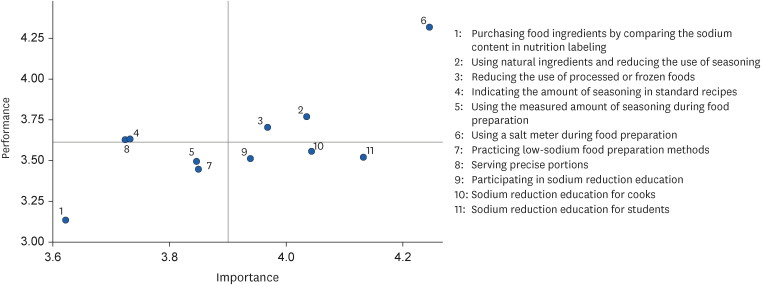
SUBJECTS/METHODS: An online survey was conducted with 608 nutrition teachers and dietitians in schools in the Republic of Korea from September 28 to November 12, 2021 (response rate: 57%). The questionnaire comprised 11 items related to sodium reduction practices (purchasing, food preparation and serving, and education). The importance and performance level of each item was rated on a 5-point scale. The mean differences were analyzed using t-tests or one-way analyses of variance and Duncan's post-hoc tests. An importance-performance analysis was performed on sodium reduction practices.
Participating in sodium reduction education, sodium reduction education for cooks, and sodium reduction education for students were assessed to have high importance but low performance. Overall, the higher the school level, the lower was the importance level of sodium reduction practices. The performance in kindergartens and elementary schools was higher than that in middle and high schools. The importance in the purchasing category perceived by dietitians was lower as compared to nutrition teachers. In addition, the performance in the purchasing, food preparation and serving, and education categories perceived by dietitians was lower than those of nutrition teachers.
Sodium reduction education for nutrition teachers and dietitians, cooks, and students should prioritize practicing sodium reduction in school meal service. Specific guidelines for managing sodium reduction at all stages-purchasing, food preparation, and serving-should also be developed. The results could be used as basic data to reduce the sodium content in school meals.
背景/目的:本研究调查了学校营养教师和营养师在学校餐饮服务中减少钠摄入措施的重要性和执行水平,并根据学校级别和学校营养教师的职位进行了比较。
对象/方法:2021年9月28日至11月12日,对韩国学校的608名营养教师和营养师进行了在线调查(回复率:57%)。问卷包括11项与减少钠摄入措施相关的内容(采购、食物制备与供应以及教育)。每项内容的重要性和执行水平采用5分制评分。使用t检验或单因素方差分析以及邓肯事后检验分析均值差异。对减少钠摄入措施进行了重要性-表现分析。
参与减少钠摄入教育、对厨师进行减少钠摄入教育以及对学生进行减少钠摄入教育被认为具有较高的重要性但执行水平较低。总体而言,学校级别越高,减少钠摄入措施的重要性水平越低。幼儿园和小学的执行情况高于初中和高中。与营养教师相比,营养师认为采购类别的重要性较低。此外,营养师认为采购、食物制备与供应以及教育类别的执行情况低于营养教师。
应对营养教师、营养师、厨师和学生开展减少钠摄入教育,优先在学校餐饮服务中践行减少钠摄入。还应制定在采购、食物制备和供应等所有阶段管理减少钠摄入的具体指南。这些结果可作为降低学校膳食钠含量的基础数据。