Department of Biology, San Diego State University , San Diego, California, USA.
Center for Marine Biotechnology and Biomedicine, Scripps Institution of Oceanography, University of California , San Diego, California, USA.
mBio. 2023 Aug 31;14(4):e0150223. doi: 10.1128/mbio.01502-23. Epub 2023 Aug 2.
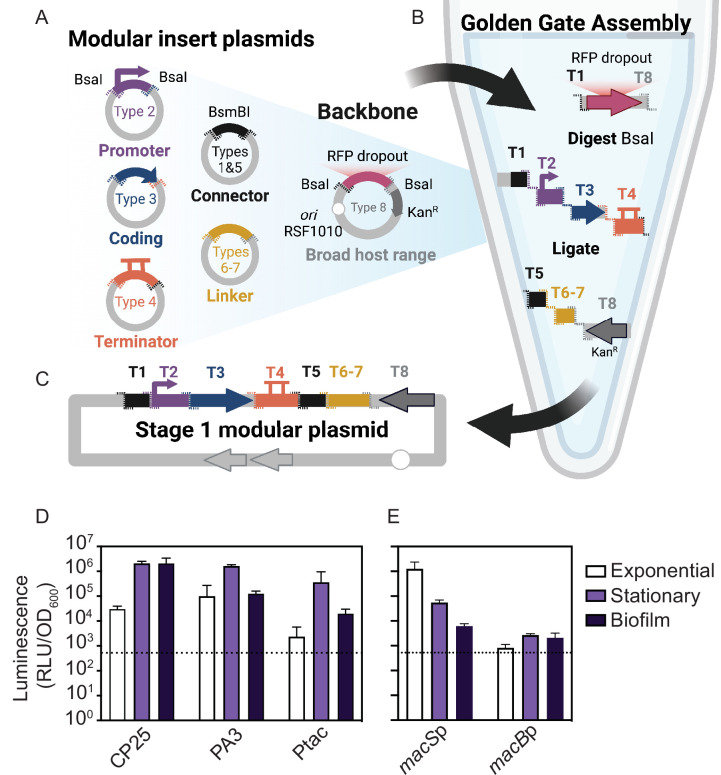
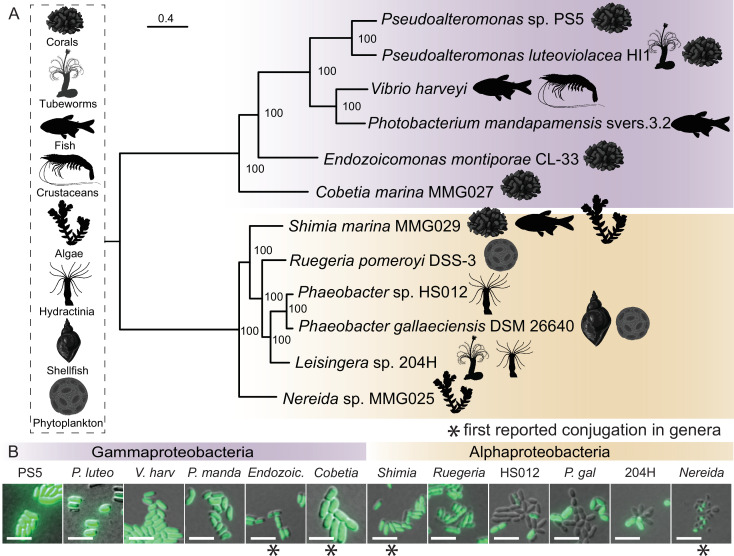
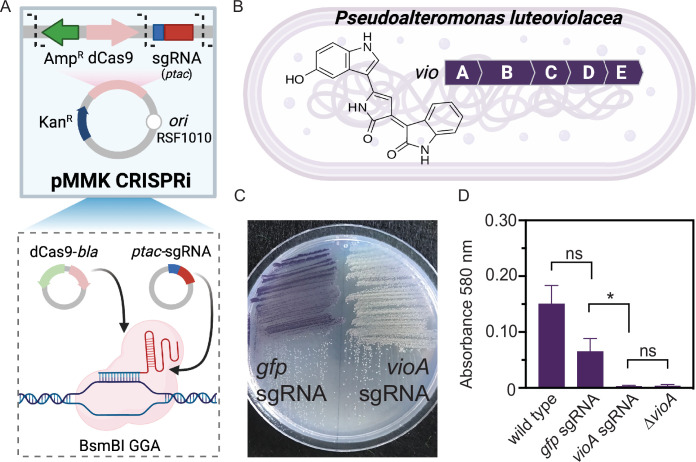
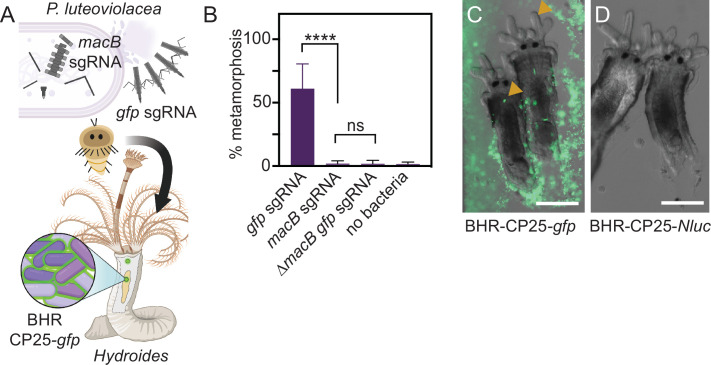
A conspicuous roadblock to studying marine bacteria for fundamental research and biotechnology is a lack of modular synthetic biology tools for their genetic manipulation. Here, we applied, and generated new parts for, a modular plasmid toolkit to study marine bacteria in the context of symbioses and host-microbe interactions. To demonstrate the utility of this plasmid system, we genetically manipulated the marine bacterium , which stimulates the metamorphosis of the model tubeworm, . Using these tools, we quantified constitutive and native promoter expression, developed reporter strains that enable the imaging of host-bacteria interactions, and used CRISPR interference (CRISPRi) to knock down a secondary metabolite and a host-associated gene. We demonstrate the broader utility of this modular system for testing the genetic tractability of marine bacteria that are known to be associated with diverse host-microbe symbioses. These efforts resulted in the successful conjugation of 12 marine strains from the Alphaproteobacteria and Gammaproteobacteria classes. Altogether, the present study demonstrates how synthetic biology strategies enable the investigation of marine microbes and marine host-microbe symbioses with potential implications for environmental restoration and biotechnology. IMPORTANCE Marine Proteobacteria are attractive targets for genetic engineering due to their ability to produce a diversity of bioactive metabolites and their involvement in host-microbe symbioses. Modular cloning toolkits have become a standard for engineering model microbes, such as , because they enable innumerable mix-and-match DNA assembly and engineering options. However, such modular tools have not yet been applied to most marine bacterial species. In this work, we adapt a modular plasmid toolkit for use in a set of 12 marine bacteria from the Gammaproteobacteria and Alphaproteobacteria classes. We demonstrate the utility of this genetic toolkit by engineering a marine bacterium to study their association with its host animal . This work provides a proof of concept that modular genetic tools can be applied to diverse marine bacteria to address basic science questions and for biotechnology innovations.
研究海洋细菌的基础研究和生物技术的一个明显障碍是缺乏用于其遗传操作的模块化合成生物学工具。在这里,我们应用并生成了模块化质粒工具包的新部分,以在共生和宿主-微生物相互作用的背景下研究海洋细菌。为了证明这个质粒系统的实用性,我们对海洋细菌 进行了遗传操作,该细菌刺激模型管蠕虫的变态。使用这些工具,我们量化了组成型和天然启动子的表达,开发了能够对宿主-细菌相互作用进行成像的报告菌株,并使用 CRISPR 干扰(CRISPRi)敲低了一种次生代谢物和一种与宿主相关的基因。我们展示了这个模块化系统在测试与各种宿主-微生物共生体相关的已知具有遗传可操作性的海洋细菌方面的更广泛的应用。这些努力导致了从 Alpha 变形菌和 Gamma 变形菌类的 12 种海洋菌株的成功共轭。总之,本研究展示了合成生物学策略如何使海洋微生物和海洋宿主-微生物共生体的研究成为可能,这对环境修复和生物技术具有潜在意义。
重要性
海洋 Proteobacteria 由于其产生多种生物活性代谢物的能力及其在宿主-微生物共生体中的参与而成为遗传工程的有吸引力的目标。模块化克隆工具包已成为工程模型微生物(如 )的标准,因为它们能够实现无数的混合和匹配 DNA 组装和工程选项。然而,这种模块化工具尚未应用于大多数海洋细菌物种。在这项工作中,我们改编了一个模块化质粒工具包,用于来自 Gamma 变形菌和 Alpha 变形菌类的 12 种海洋细菌。我们通过工程化一种海洋细菌来研究其与宿主动物的关联来证明这种遗传工具包的实用性。这项工作提供了一个概念验证,即模块化遗传工具可以应用于不同的海洋细菌,以解决基础科学问题和进行生物技术创新。