Department of Psychosomatics and Psychiatry, and Children's Research Center, University Children's Hospital Zurich, Steinwiesstrasse 75, 8032, Zurich, Switzerland.
Division of Child and Adolescent Health Psychology, Department of Psychology, University of Zurich, Zurich, Switzerland.
Eur Child Adolesc Psychiatry. 2024 May;33(5):1573-1581. doi: 10.1007/s00787-023-02266-w. Epub 2023 Aug 2.
This study aims to provide a better understanding of the individual impact of the Diagnostic and Statistical Manual of Mental Disorders, Fifth Edition (DSM-5) post-traumatic stress symptoms (PTSS) on functional impairment in trauma-exposed children and adolescents. Identifying PTSS that have the most impact on functional impairment can broaden our understanding of post-trauma reactions and guide the selection of treatment components and techniques required to help patients to restore functioning following trauma exposure.
Utilizing relative importance analyses, unique shared variance of each DSM-5 PTSS with functional impairment were estimated in clinical samples of 3400 Norwegian (M = 14.18, SD = 2.49, range = 7-17) and 747 US (M = 10.76, SD = 3.10, range = 7-17) children and adolescents from naturalistic settings.
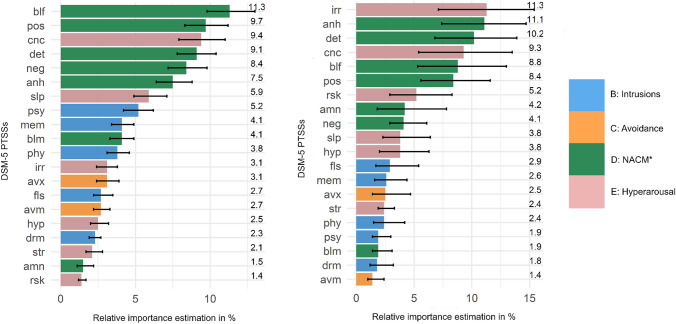
Negative beliefs, detachment from others, inability to experience positive emotions, and diminished interest in activities within the symptom cluster negative alterations in cognitions and mood, and the hyperarousal symptom concentration problems accounted for the largest proportions of unique variance explained in functional impairment in both samples. Further, the hyperarousal symptom irritability showed a unique high association with functional impairment in the US sample.
As negative beliefs, emotional numbing symptoms, concentration problems and irritability may be especially related to functional impairment in traumatized children and adolescents, monitoring and targeting these symptoms throughout therapy might be of particular importance to restore functioning as early as possible and to facilitate overall recovery.
本研究旨在更好地理解《精神疾病诊断与统计手册》第五版(DSM-5)创伤后应激症状(PTSS)对创伤暴露儿童和青少年功能障碍的个体影响。确定对功能障碍影响最大的 PTSD 症状,可以拓宽我们对创伤后反应的理解,并指导选择治疗成分和技术,以帮助患者在创伤暴露后恢复功能。
利用相对重要性分析,在挪威的 3400 名(M=14.18,SD=2.49,范围 7-17)和美国的 747 名(M=10.76,SD=3.10,范围 7-17)自然环境下的临床样本中,估计了 DSM-5 每个 PTSD 症状与功能障碍的独特共享方差。
在两个样本中,负性认知和情绪改变、与他人疏远、无法体验正性情绪以及对活动兴趣降低这一症状群内的负性改变症状、警觉性增高症状内的注意力集中问题,解释了功能障碍的最大比例的独特方差。此外,警觉性增高症状内的易激惹与美国样本的功能障碍有独特的高度关联。
由于负性信念、情绪麻木症状、注意力集中问题和易激惹可能与创伤后儿童和青少年的功能障碍特别相关,因此在治疗过程中监测和针对这些症状可能尤其重要,以便尽早恢复功能,促进整体康复。