Department of General Psychology, University of Padova, Via Venezia 8, 35131, Padua, Italy.
Interuniversity Research Center in Environmental Psychology (CIRPA), Rome, Italy.
Cogn Res Princ Implic. 2023 Aug 2;8(1):50. doi: 10.1186/s41235-023-00506-w.
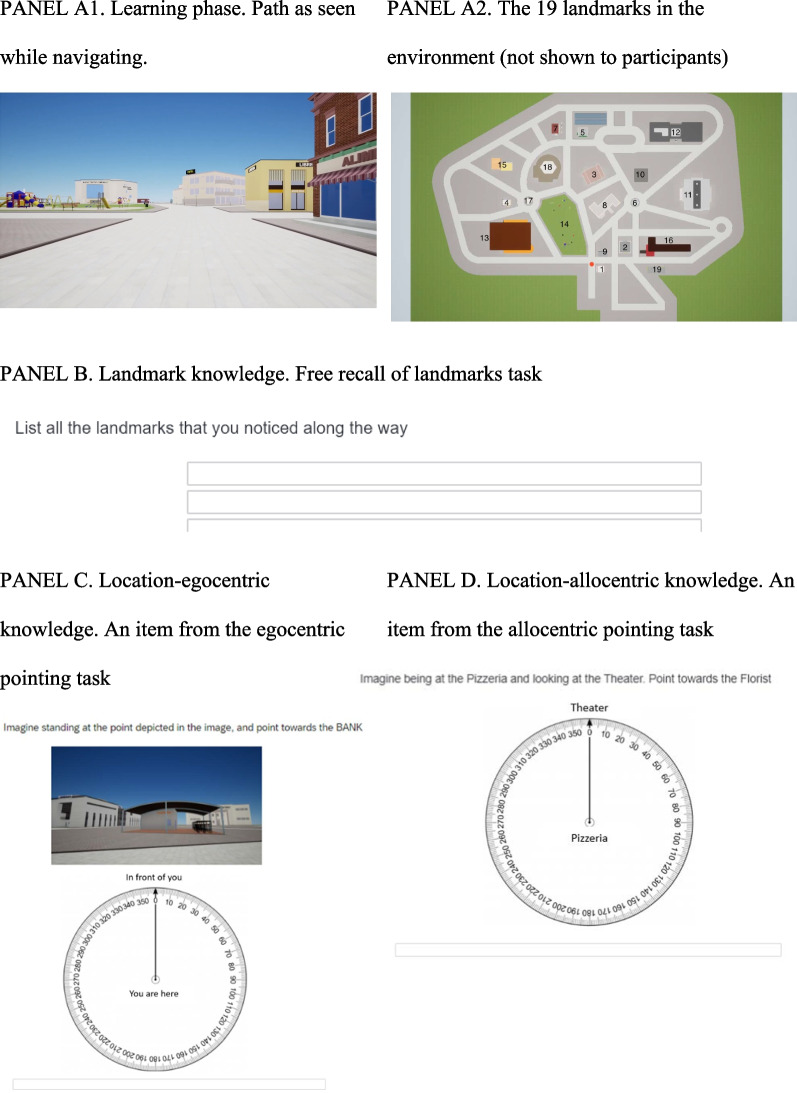
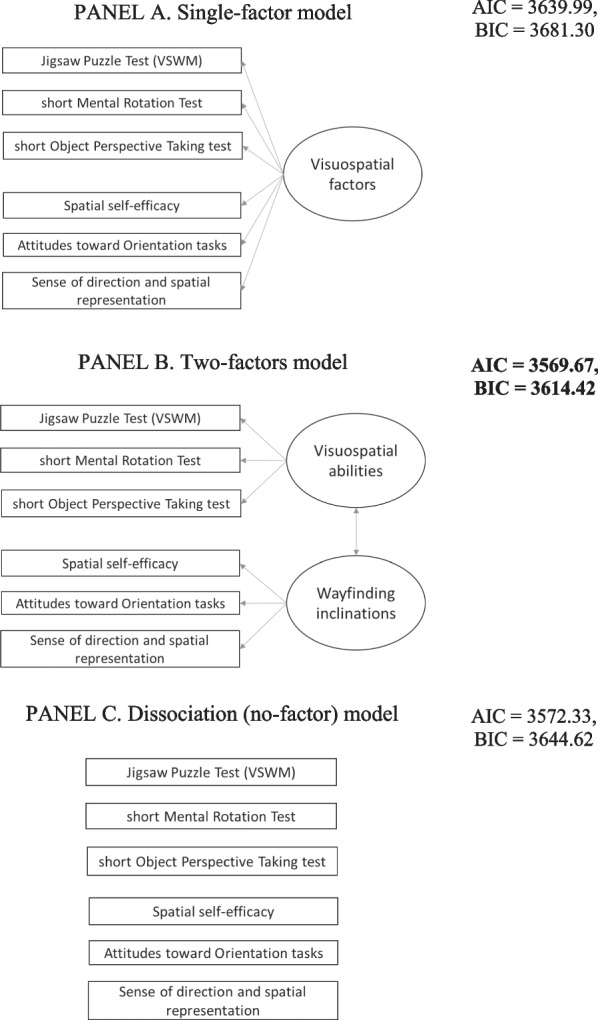
When learning an environment from virtual navigation people gain knowledge about landmarks, their locations, and the paths that connect them. The present study newly aimed to investigate all these domains of knowledge and how cognitive factors such as visuospatial abilities and wayfinding inclinations might support virtual passive navigation. A total of 270 participants (145 women) were tested online. They: (i) completed visuospatial tasks and answered questionnaires on their wayfinding inclinations; and (ii) learnt a virtual path. The environmental knowledge they gained was assessed on their free recall of landmarks, their egocentric and allocentric pointing accuracy (location knowledge), and their performance in route direction and landmark location tasks (path knowledge). Visuospatial abilities and wayfinding inclinations emerged as two separate factors, and environmental knowledge as a single factor. The SEM model showed that both visuospatial abilities and wayfinding inclinations support the environmental knowledge factor, with similar pattern of relationships in men and women. Overall, factors related to the individual are relevant to the environmental knowledge gained from an online virtual passive navigation.
当人们通过虚拟导航学习环境时,他们会获得有关地标、位置和连接它们的路径的知识。本研究旨在调查所有这些知识领域,以及视觉空间能力和寻路倾向等认知因素如何支持虚拟被动导航。共有 270 名参与者(145 名女性)在线接受测试。他们:(i)完成视觉空间任务并回答寻路倾向问卷;以及(ii)学习虚拟路径。他们在自由回忆地标、自我中心和以自我为中心的指向准确性(位置知识)以及在路线方向和地标位置任务中的表现(路径知识)上评估他们获得的环境知识。视觉空间能力和寻路倾向是两个独立的因素,而环境知识是一个单一的因素。SEM 模型表明,视觉空间能力和寻路倾向都支持环境知识因素,男女的关系模式相似。总的来说,与个体相关的因素与从在线虚拟被动导航中获得的环境知识有关。