School of Psychology, Victoria University of Wellington, Wellington, New Zealand.
School of Chemical and Physical Sciences, Victoria University of Wellington, Wellington, New Zealand.
Metabolomics. 2023 Aug 2;19(8):69. doi: 10.1007/s11306-023-02034-6.
Metabolomics produces vast quantities of data but determining which metabolites are the most relevant to the disease or disorder of interest can be challenging.
This study sought to demonstrate how behavioral models of psychiatric disorders can be combined with metabolomics research to overcome this limitation.
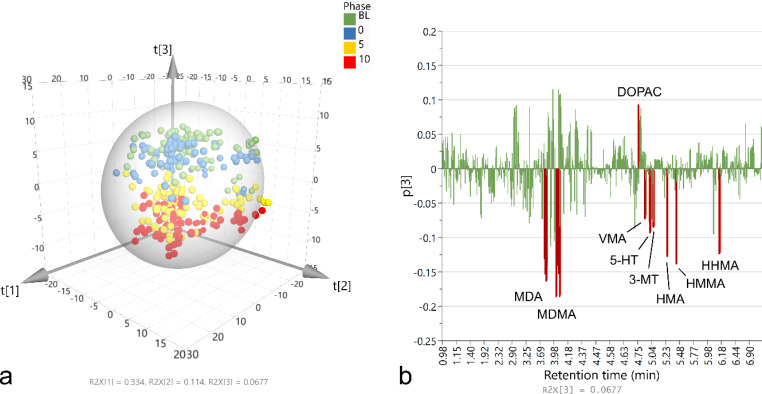
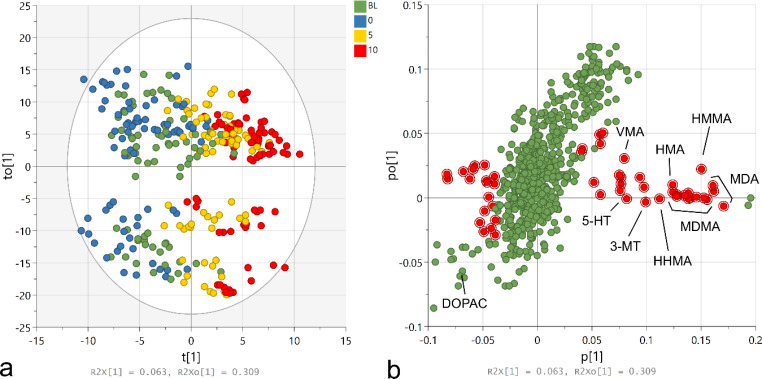
We designed a preclinical, untargeted metabolomics procedure, that focuses on the determination of central metabolites relevant to substance use disorders that are (a) associated with changes in behavior produced by acute drug exposure and (b) impacted by repeated drug exposure. Untargeted metabolomics analysis was carried out on liquid chromatography-mass spectrometry data obtained from 336 microdialysis samples. Samples were collected from the medial striatum of male Sprague-Dawley (N = 21) rats whilst behavioral data were simultaneously collected as part of a (±)-3,4-methylenedioxymethamphetamine (MDMA)-induced behavioral sensitization experiment. Analysis was conducted by orthogonal partial least squares, where the Y variable was the behavioral data, and the X variables were the relative concentrations of the 737 detected features.
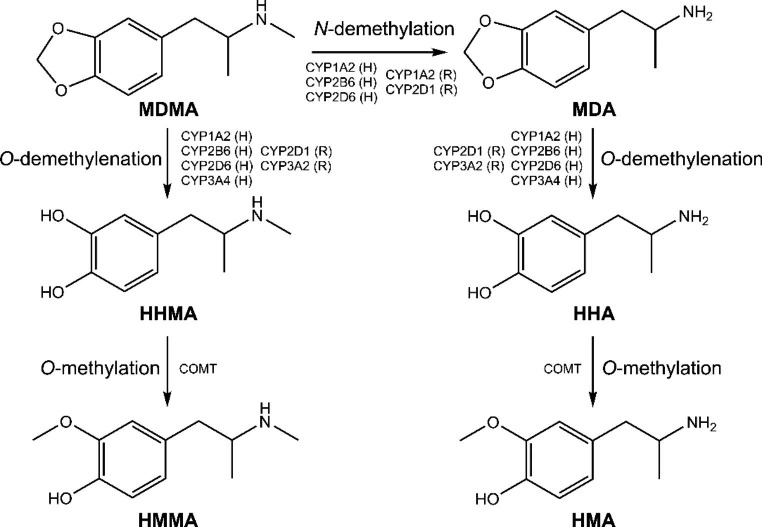
MDMA and its derivatives, serotonin, and several dopamine/norepinephrine metabolites were the greatest predictors of acute MDMA-produced behavior. Subsequent univariate analyses showed that repeated MDMA exposure produced significant changes in MDMA metabolism, which may contribute to the increased abuse liability of the drug as a function of repeated exposure.
These findings highlight how the inclusion of behavioral data can guide metabolomics data analysis and increase the relevance of the results to the phenotype of interest.
代谢组学产生了大量的数据,但确定哪些代谢物与所关注的疾病或障碍最相关可能具有挑战性。
本研究旨在展示如何将精神疾病的行为模型与代谢组学研究相结合,以克服这一限制。
我们设计了一种临床前的、非靶向的代谢组学程序,该程序侧重于确定与物质使用障碍相关的中枢代谢物,这些代谢物(a)与急性药物暴露引起的行为变化有关,(b)受重复药物暴露的影响。非靶向代谢组学分析是在液相色谱-质谱数据上进行的,这些数据来自 336 个微透析样本。样本取自雄性 Sprague-Dawley(N=21)大鼠的内侧纹状体,同时收集行为数据,作为(±)-3,4-亚甲基二氧甲基苯丙胺(MDMA)诱导的行为敏感化实验的一部分。分析采用正交偏最小二乘法进行,其中 Y 变量是行为数据,X 变量是 737 个检测到的特征的相对浓度。
MDMA 及其衍生物、血清素和几种多巴胺/去甲肾上腺素代谢物是急性 MDMA 产生行为的最大预测因子。随后的单变量分析表明,重复 MDMA 暴露会导致 MDMA 代谢发生显著变化,这可能是由于药物重复暴露导致药物滥用倾向增加的原因之一。
这些发现强调了如何将行为数据纳入代谢组学数据分析中,并增加结果与感兴趣表型的相关性。