Fung Winston Wing-Shing, Cheng Phyllis Mei-Shan, Ng Jack Kit-Chung, Chan Gordon Chun-Kau, Chow Kai Ming, Li Philip Kam-Tao, Szeto Cheuk Chun
Department of Medicine & Therapeutics, Prince of Wales Hospital, Shatin, Hong Kong, China.
Li Ka Shing Institute of Health Sciences (LiHS), The Chinese University of Hong Kong, Shatin, Hong Kong, China.
Kidney Med. 2023 May 2;5(8):100646. doi: 10.1016/j.xkme.2023.100646. eCollection 2023 Aug.
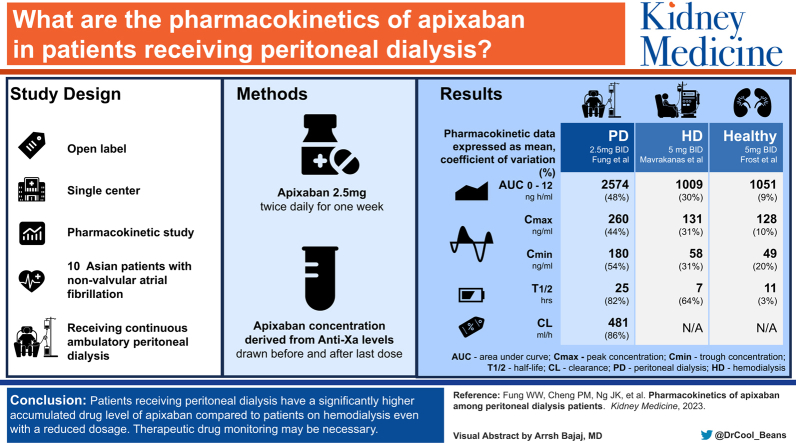
RATIONALE & OBJECTIVE: The efficacy and safety profile of apixaban remains uncertain in patients receiving peritoneal dialysis (PD) despite increasing use in this population. Accordingly, we assessed the pharmacokinetics of apixaban among patients receiving PD.
A pharmacokinetics study in a single center. Patients recruited received 1 week of apixaban at 2.5 mg twice a day to reach steady state. Serial blood samples were then taken before and after the last dose for pharmacokinetics analysis of apixaban.
SETTING & PARTICIPANTS: Ten stable PD patients with atrial fibrillation in an outpatient setting.
ANALYTICAL APPROACH/OUTCOMES: Pharmacokinetic parameters including the area under the concentration-time curve from time 0 to 12 hours after the last dose of apixaban (AUC0-12), peak concentration, trough level, time to peak apixaban concentration, half-life, and drug clearance were analyzed.
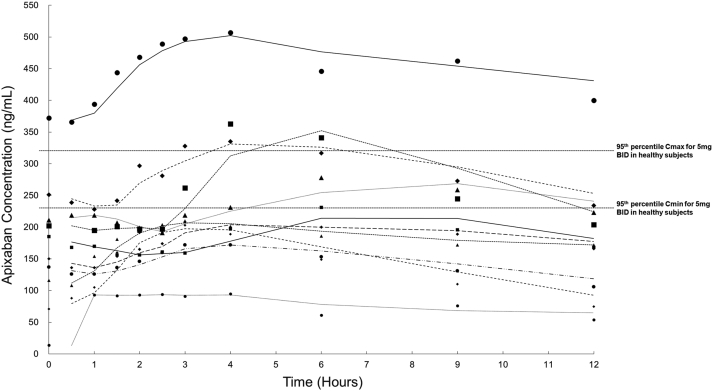
There was a wide variation in the range of apixaban concentration across the 10 patients. The AUC for the PD group was significantly higher than those reported previously for hemodialysis patients or healthy individuals. Three patients had a supratherapeutic peak concentration whereas 2 patients had a supratherapeutic trough level as compared with the pharmacokinetic parameter in healthy individuals taking equivalent therapeutic dosage.
Small sample size with short study duration limits the ability to ascertain the true bleeding risk and to detect any clinical outcomes. Results may be limited to Asian populations only.
A proportion of PD patients had supratherapeutic levels even when the reduced dosage 2.5 mg twice a day was used. Given the large interindividual variation in the drug level, therapeutic drug monitoring should be done if available. Otherwise, one should start the drug at reduced doses with caution and with more frequent clinical monitoring for any signs of bleeding.
尽管接受腹膜透析(PD)的患者中阿哌沙班的使用日益增加,但其疗效和安全性仍不确定。因此,我们评估了接受PD治疗的患者中阿哌沙班的药代动力学。
在单一中心进行的药代动力学研究。招募的患者每天两次服用2.5毫克阿哌沙班,持续1周以达到稳态。然后在最后一剂之前和之后采集系列血样,用于阿哌沙班的药代动力学分析。
门诊环境中10名稳定的房颤PD患者。
分析方法/结果:分析药代动力学参数,包括末次服用阿哌沙班后0至12小时的浓度-时间曲线下面积(AUC0-12)、峰浓度、谷浓度、阿哌沙班达到峰浓度的时间、半衰期和药物清除率。
10名患者的阿哌沙班浓度范围差异很大。PD组的AUC显著高于先前报道的血液透析患者或健康个体。与服用等效治疗剂量的健康个体的药代动力学参数相比,3名患者的峰浓度高于治疗水平,而2名患者的谷浓度高于治疗水平。
样本量小且研究持续时间短,限制了确定真正出血风险和检测任何临床结局的能力。结果可能仅局限于亚洲人群。
即使每天两次使用2.5毫克的降低剂量,仍有一部分PD患者的药物水平高于治疗水平。鉴于药物水平存在较大个体差异,如有条件应进行治疗药物监测。否则,应谨慎以降低剂量开始用药,并更频繁地进行临床监测以观察任何出血迹象。