Department of Biology, Advanced Facility for Avian Research, Western University, London, ON, Canada, N6A 3K7.
J Exp Biol. 2023 Sep 1;226(17). doi: 10.1242/jeb.245975. Epub 2023 Aug 29.
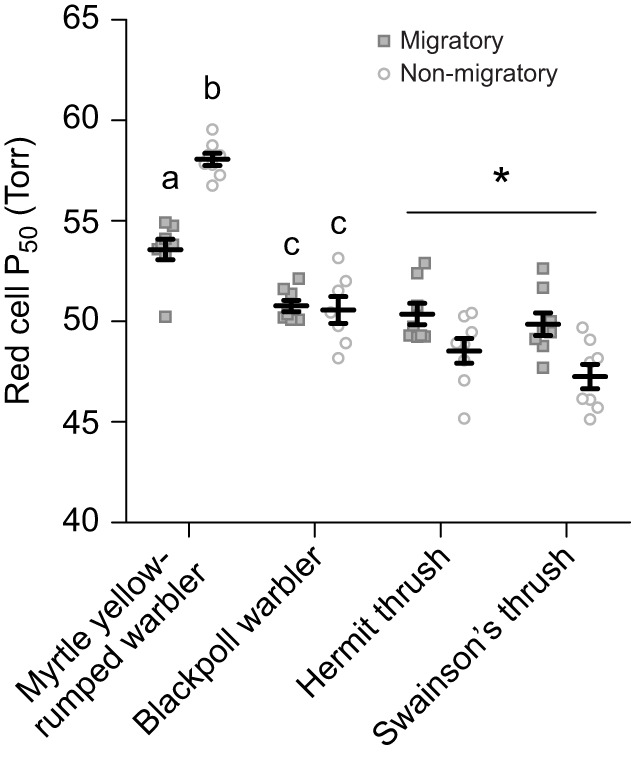
Migratory flight requires birds to maintain intensive aerobic exercise for many hours or days. Maintaining O2 supply to flight muscles is therefore important during migration, especially since migratory songbirds have been documented flying at altitudes greater than 5000 m above sea level, where O2 is limited. Whether songbirds exhibit seasonal plasticity of the O2 cascade to maintain O2 uptake and transport during migratory flight is not well understood. We investigated changes in the hypoxic ventilatory response, haematology and pectoralis (flight) muscle phenotype of 6 songbird species from 3 families during migratory and non-migratory conditions. Songbirds were captured during southbound migration in southern Ontario, Canada. Half of the birds were assessed during migration, and the rest were transitioned onto a winter photoperiod to induce a non-migratory phenotype and measured. All species exhibited seasonal plasticity at various stages along the O2 cascade, but not all species exhibited the same responses. Songbirds tended to be more hypoxia tolerant during migration, withstanding 5 kPa O2 and breathed more effectively through slower, deeper breaths. Warblers had a stronger haemoglobin-O2 affinity during autumn migration (decrease of ∼4.7 Torr), while the opposite was observed in thrushes (increase of ∼2.6 Torr). In the flight muscle there was an ∼1.2-fold increase in the abundance of muscle fibres with smaller fibre transverse areas during autumn migration, but no changes in capillary:fibre ratio. These adjustments would enhance O2 uptake and transport to the flight muscle. Our findings demonstrate that in the O2 cascade there is no ideal migratory phenotype for all songbirds.
迁徙飞行需要鸟类维持数小时或数天的高强度有氧运动。因此,在迁徙过程中保持向飞行肌肉供氧非常重要,尤其是因为已经有记录表明迁徙鸣禽在海拔 5000 米以上的高空飞行,而那里氧气有限。鸣禽在迁徙飞行中是否表现出 O2 级联的季节性可塑性以维持 O2 摄取和运输尚不清楚。我们研究了来自 3 个科的 6 种鸣禽在迁徙和非迁徙条件下低氧通气反应、血液学和胸肌(飞行)表型的变化。鸣禽在加拿大安大略省南部的南向迁徙中被捕获。一半的鸟类在迁徙时进行评估,其余的则过渡到冬季光照周期以诱导非迁徙表型并进行测量。所有物种在 O2 级联的各个阶段都表现出季节性可塑性,但并非所有物种都表现出相同的反应。鸣禽在迁徙期间往往更能耐受缺氧,能够承受 5 kPa 的 O2,并通过更慢、更深的呼吸更有效地呼吸。在秋季迁徙期间,鸣禽的血红蛋白-O2 亲和力更强(下降约 4.7 托),而在鸫科鸟类中则相反(增加约 2.6 托)。在飞行肌肉中,秋季迁徙时,较小横截面积的肌纤维数量增加了约 1.2 倍,但毛细血管:纤维比没有变化。这些调整将增强 O2 摄取和向飞行肌肉的运输。我们的研究结果表明,在 O2 级联中,并非所有鸣禽都存在理想的迁徙表型。