NASA Johnson Space Center, Houston, United States.
University of British Columbia, Vancouver, Canada.
Elife. 2019 Sep 3;8:e44986. doi: 10.7554/eLife.44986.
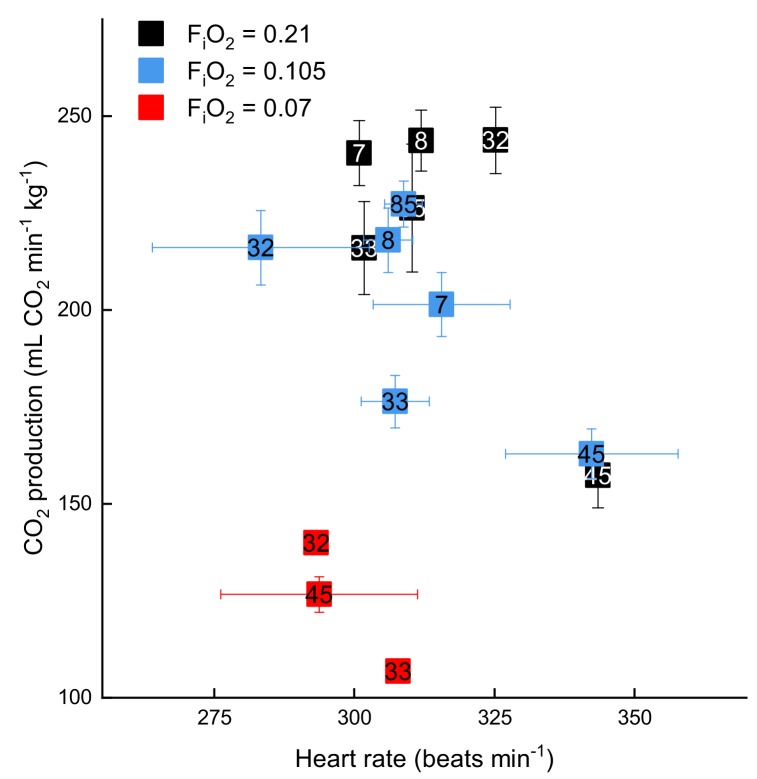
The bar-headed goose is famed for migratory flight at extreme altitude. To better understand the physiology underlying this remarkable behavior, we imprinted and trained geese, collecting the first cardiorespiratory measurements of bar-headed geese flying at simulated altitude in a wind tunnel. Metabolic rate during flight increased 16-fold from rest, supported by an increase in the estimated amount of O transported per heartbeat and a modest increase in heart rate. The geese appear to have ample cardiac reserves, as heart rate during hypoxic flights was not higher than in normoxic flights. We conclude that flight in hypoxia is largely achieved the reduction in metabolic rate compared to normoxia. Arterial [Formula: see text] was maintained throughout flights. Mixed venous P decreased during the initial portion of flights in hypoxia, indicative of increased tissue O extraction. We also discovered that mixed venous temperature decreased during flight, which may significantly increase oxygen loading to hemoglobin.
斑头雁以在极高海拔迁徙飞行而闻名。为了更好地了解这一非凡行为的生理学基础,我们对斑头雁进行了印记和训练,在风洞中对模拟海拔高度飞行的斑头雁进行了首次心肺测量。飞行过程中的代谢率比休息时增加了 16 倍,这得益于每搏输送的 O 估计量增加和心率适度增加。这些大雁似乎有充足的心脏储备,因为在低氧飞行过程中心率并没有高于常氧飞行。我们的结论是,低氧飞行主要是通过降低代谢率来实现的,与常氧相比。整个飞行过程中动脉[公式:见文本]得以维持。在低氧飞行的初始阶段,混合静脉 P 下降,表明组织 O 提取增加。我们还发现,混合静脉温度在飞行过程中下降,这可能会显著增加血红蛋白对氧的负荷。