Broad Institute, Cambridge, MA, USA.
Department of Biology, Massachusetts Institute of Technology, Cambridge, MA, USA.
Science. 2023 Aug 4;381(6657):508-514. doi: 10.1126/science.adf8974. Epub 2023 Aug 3.
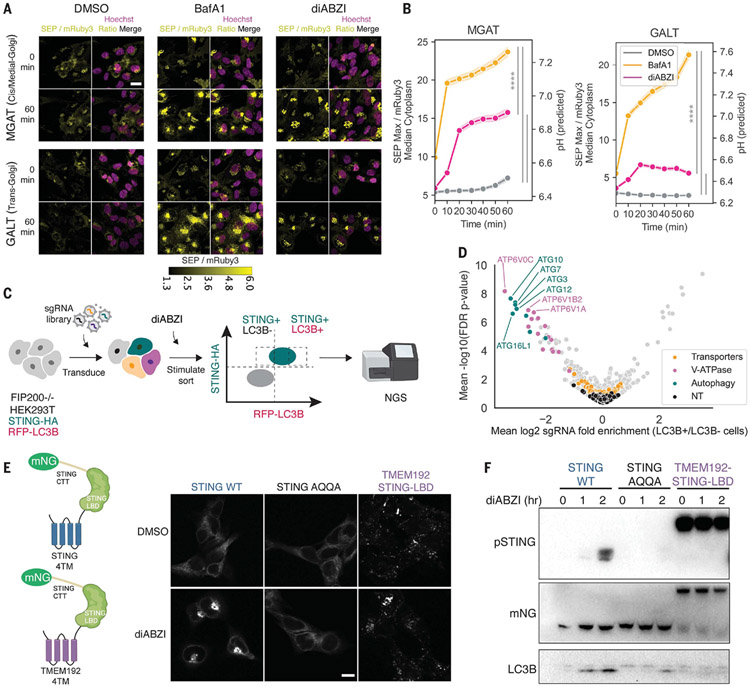
Proton leakage from organelles is a common signal for noncanonical light chain 3B (LC3B) lipidation and inflammasome activation, processes induced upon stimulator of interferon genes (STING) activation. On the basis of structural analysis, we hypothesized that human STING is a proton channel. Indeed, we found that STING activation induced a pH increase in the Golgi and that STING reconstituted in liposomes enabled transmembrane proton transport. Compound 53 (C53), a STING agonist that binds the putative channel interface, blocked STING-induced proton flux in the Golgi and in liposomes. STING-induced LC3B lipidation and inflammasome activation were also inhibited by C53, suggesting that STING's channel activity is critical for these two processes. Thus, STING's interferon-induction function can be decoupled from its roles in LC3B lipidation and inflammasome activation.
细胞器的质子泄漏是一种常见的非典型轻链 3B(LC3B)脂质化和炎症小体激活的信号,这种过程是在干扰素基因刺激物(STING)激活时发生的。基于结构分析,我们假设人类 STING 是一种质子通道。事实上,我们发现 STING 激活诱导了高尔基体中的 pH 值增加,并且在脂质体中重建的 STING 能够进行跨膜质子转运。化合物 53(C53)是一种 STING 激动剂,它结合了假定的通道界面,可阻断 STING 在高尔基体和脂质体中诱导的质子流。C53 还抑制了 STING 诱导的 LC3B 脂质化和炎症小体激活,表明 STING 的通道活性对于这两个过程至关重要。因此,STING 的干扰素诱导功能可以与其在 LC3B 脂质化和炎症小体激活中的作用分离。