Department of Nuclear Medicine, LMU University Hospital, LMU Munich, Munich, Germany.
German Cancer Consortium, Partner Site Munich, German Cancer Research Center, Munich, Germany.
J Nucl Med. 2023 Oct;64(10):1519-1525. doi: 10.2967/jnumed.122.265247. Epub 2023 Aug 3.
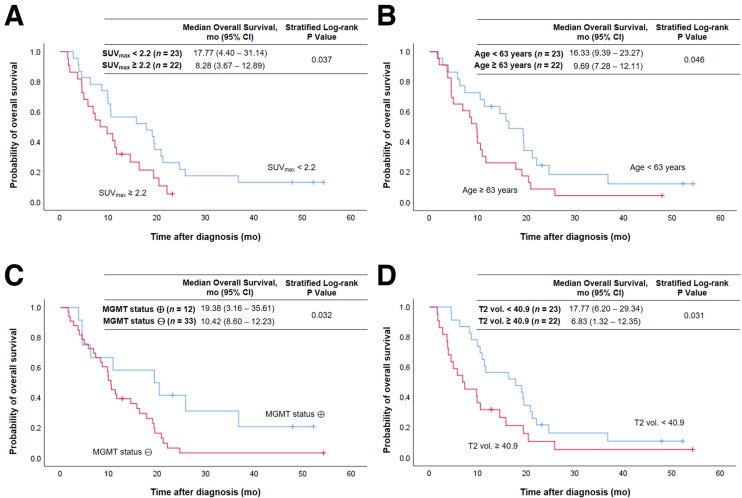
The 18-kDa translocator protein (TSPO) is gaining recognition as a relevant target in glioblastoma imaging. However, data on the potential prognostic value of TSPO PET imaging in glioblastoma are lacking. Therefore, we investigated the association of TSPO PET imaging results with survival outcome in a homogeneous cohort of glioblastoma patients. Patients were included who had newly diagnosed, histologically confirmed isocitrate dehydrogenase (IDH)-wild-type glioblastoma with available TSPO PET before either normofractionated radiotherapy combined with temozolomide or hypofractionated radiotherapy. SUV on TSPO PET, TSPO binding affinity status, tumor volumes on MRI, and further clinical data, such as -alkylguanine DNA methyltransferase () and telomerase reverse transcriptase () gene promoter mutation status, were correlated with patient survival. Forty-five patients (median age, 63.3 y) were included. Median SUV was 2.2 (range, 1.0-4.7). A TSPO PET signal was associated with survival: High uptake intensity (SUV > 2.2) was related to significantly shorter overall survival (OS; 8.3 vs. 17.8 mo, = 0.037). Besides SUV, prognostic factors for OS were age ( = 0.046), promoter methylation status ( = 0.032), and T2-weighted MRI volume ( = 0.031). In the multivariate survival analysis, SUV in TSPO PET remained an independent prognostic factor for OS ( = 0.023), with a hazard ratio of 2.212 (95% CI, 1.115-4.386) for death in cases with a high TSPO PET signal (SUV > 2.2). A high TSPO PET signal before radiotherapy is associated with significantly shorter survival in patients with newly diagnosed IDH-wild-type glioblastoma. TSPO PET seems to add prognostic insights beyond established clinical parameters and might serve as an informative tool as clinicians make survival predictions for patients with glioblastoma.
18kDa 转位蛋白(TSPO)作为胶质母细胞瘤成像的一个相关靶点,其重要性日益凸显。然而,关于 TSPO PET 成像在胶质母细胞瘤中潜在预后价值的数据尚缺乏。因此,我们旨在通过对同质队列的胶质母细胞瘤患者的研究,探讨 TSPO PET 成像结果与生存结局的相关性。
纳入标准为新诊断的、组织学证实 IDH 野生型胶质母细胞瘤患者,在接受标准分割放疗联合替莫唑胺或低分割放疗前,有 TSPO PET 检查结果。TSPO PET 上的 SUV、TSPO 结合亲和力状态、MRI 上的肿瘤体积以及其他临床数据,如 -烷基鸟嘌呤 DNA 甲基转移酶(MGMT)和端粒酶逆转录酶(TERT)基因启动子突变状态,与患者的生存情况相关。
共纳入 45 例患者(中位年龄为 63.3 岁)。中位 SUV 为 2.2(范围为 1.0-4.7)。TSPO PET 信号与生存相关:高摄取强度(SUV>2.2)与总生存期(OS)显著缩短相关(8.3 个月与 17.8 个月, = 0.037)。除 SUV 外,OS 的预后因素还包括年龄( = 0.046)、MGMT 启动子甲基化状态( = 0.032)和 T2 加权 MRI 体积( = 0.031)。在多变量生存分析中,TSPO PET 的 SUV 仍然是 OS 的独立预后因素( = 0.023),高 TSPO PET 信号(SUV>2.2)的患者死亡风险比为 2.212(95%CI:1.115-4.386)。
放疗前 TSPO PET 高信号与 IDH 野生型胶质母细胞瘤患者的生存期显著缩短相关。TSPO PET 似乎在既定的临床参数之外提供了预后信息,并且可能成为一种有用的工具,为临床医生预测胶质母细胞瘤患者的生存情况提供信息。