Flourishing Oceans Initiative, Minderoo Foundation, Perth, WA, Australia.
Centre for Marine Socioecology, University of Tasmania, Hobart, TAS, Australia.
Sci Rep. 2023 Aug 3;13(1):10146. doi: 10.1038/s41598-023-37066-4.
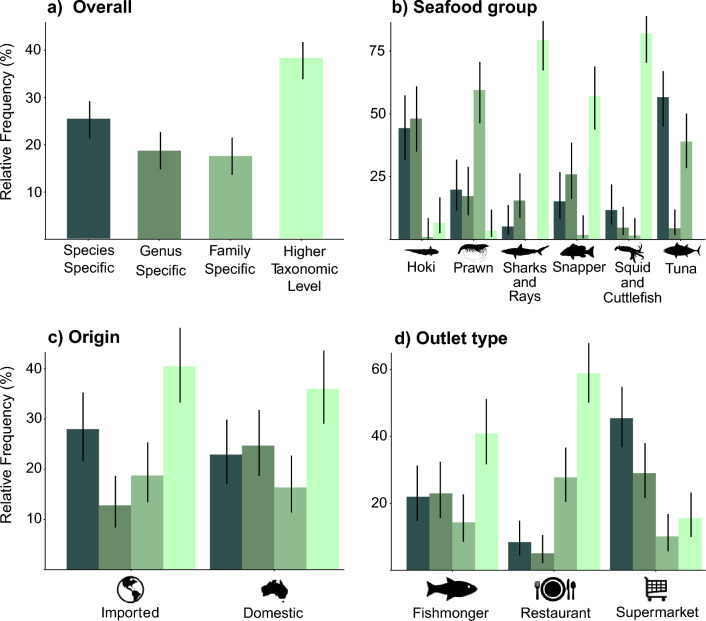
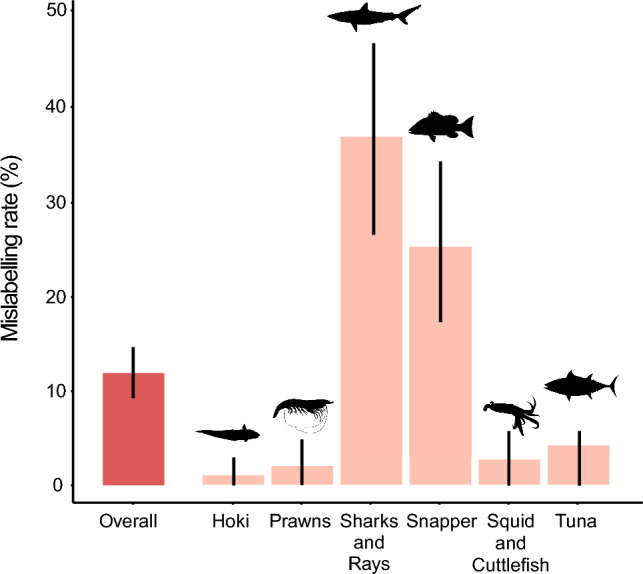
Seafood mislabelling and species substitution, compounded by a convoluted seafood supply chain with significant traceability challenges, hinder efforts towards more sustainable, responsible, and ethical fishing and business practices. We conducted the largest evaluation of the quality and accuracy of labels for 672 seafood products sold in Australia, assessing six seafood groups (i.e., hoki, prawns, sharks and rays, snapper, squid and cuttlefish, and tuna) from fishmongers, restaurants, and supermarkets, including domestically caught and imported products. DNA barcoding revealed 11.8% of seafood tested did not match their label with sharks and rays, and snappers, having the highest mislabelling rate. Moreover, only 25.5% of products were labelled at a species-level, while most labels used vague common names or umbrella terms such as 'flake' and 'snapper'. These poor-quality labels had higher rates of mislabelling than species-specific labels and concealed the sale of threatened or overfished taxa, as well as products with lower nutritional quality, reduced economic value, or potential health risks. Our results highlight Australia's weak seafood labelling regulations and ambiguous non-mandatory naming conventions, which impede consumer choice for accurately represented, sustainable, and responsibly sourced seafood. We recommend strengthening labelling regulations to mitigate seafood mislabelling and substitution, ultimately improving consumer confidence when purchasing seafood.
海鲜标签造假和品种替换,加上复杂的海鲜供应链存在严重的可追溯性挑战,这阻碍了更可持续、负责任和合乎道德的渔业和商业实践的发展。我们对澳大利亚销售的 672 种海鲜产品的标签质量和准确性进行了最大规模的评估,评估了从鱼贩、餐馆和超市购买的六个海鲜品种(即鳕鱼、对虾、鲨鱼和鳐鱼、鲷鱼、鱿鱼和墨鱼以及金枪鱼),包括国产和进口产品。DNA 条码检测显示,11.8%的海鲜与其标签不符,其中鲨鱼和鳐鱼以及鲷鱼的标签造假率最高。此外,只有 25.5%的产品在物种级别进行了标签标注,而大多数标签使用了模糊的通用名称或笼统术语,如“鱼片”和“鲷鱼”。这些低质量的标签比特定物种的标签具有更高的标签造假率,掩盖了受威胁或过度捕捞物种的销售,以及营养价值较低、经济价值降低或潜在健康风险的产品。我们的研究结果突显了澳大利亚海鲜标签法规薄弱和非强制性命名约定不明确的问题,这阻碍了消费者对准确代表、可持续和负责任来源的海鲜的选择。我们建议加强标签法规,以减轻海鲜标签造假和替换问题,最终提高消费者购买海鲜时的信心。