Department of Psychology and Collaborative Program in Neuroscience, University of Guelph, Guelph, ON, N1G 2W1, Canada.
Sci Rep. 2023 Aug 3;13(1):12614. doi: 10.1038/s41598-023-39380-3.
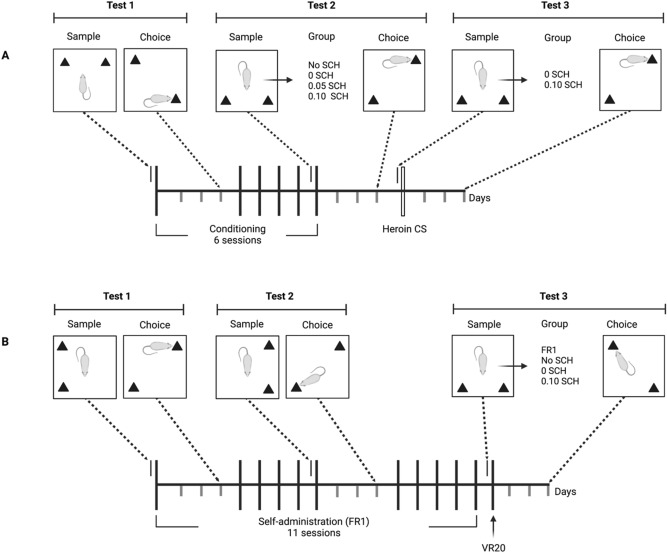
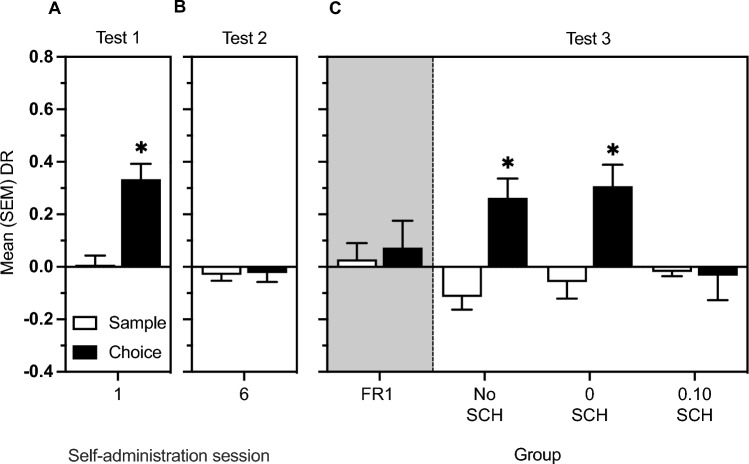
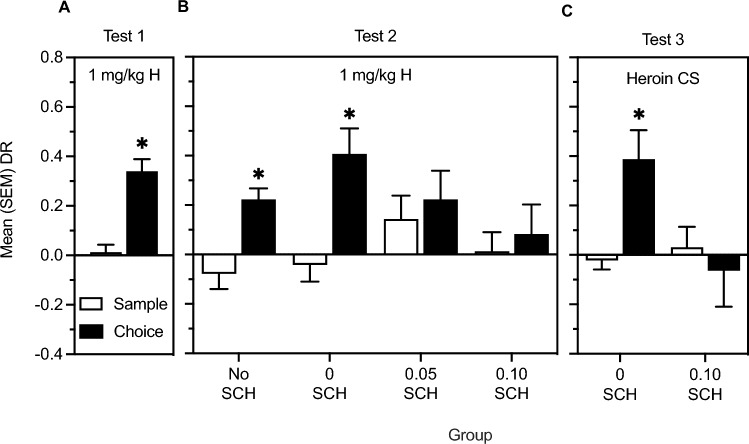
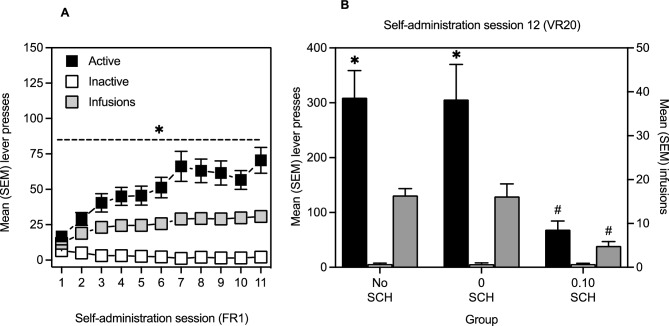
It has been proposed that opiates modulate memory consolidation, but recent work has indicated that this effect may be mediated by how the drug is experienced (i.e., passive injections vs. self-administration). Because the dopamine (DA) D1 receptor is involved in processing of learning signals and attribution of salience to events experienced by an organism, two studies in male Sprague-Dawley rats tested the effect of blocking this receptor on modulation of memory consolidation by passive and self-administered heroin, in addition to conditioned memory modulation by heroin-paired cues. Using the object location memory task, Study 1 employed SCH23390 (0, 0.05, 0.10 mg/kg, SC) to modulate enhancement of memory consolidation induced by post-training injections of heroin (1 mg/kg, SC) as well as by exposure to the environment paired with heroin injections (6 pairings, 1 h each, 1 mg/kg). Study 2 was conducted in rats that could self-administer heroin (0.05 mg/kg/infusion, IV) and tested whether SCH23390 (0 and 0.1 mg/kg, SC) could prevent memory modulation induced by a change in schedule of self-administration (from fixed to variable ratio). It was found that while repeated passive injections of heroin retained their enhancing effect on memory, when self-administered, heroin enhanced consolidation of object location memory only at the beginning of self-administration and after a change in schedule. Importantly, SCH23390 blocked memory modulation by heroin when passively administered and when the drug was self-administered on a novel schedule. SCH23390 also blocked conditioned memory modulation induced by post-training exposure to heroin-paired cues. Taken together, these results suggest that modulation of memory consolidation by unconditioned and conditioned opiate reinforcers involve a D1-dependent mechanism of salience attribution linked to the anticipation of drug effects.
有人提出阿片类药物可以调节记忆巩固,但最近的研究表明,这种效应可能与其被体验的方式有关(即被动注射与自我给药)。由于多巴胺(DA)D1 受体参与了学习信号的处理以及生物体对所经历事件的显著程度的归因,因此两项在雄性 Sprague-Dawley 大鼠中进行的研究测试了阻断该受体对被动和自我给予海洛因以及海洛因配对线索引起的条件记忆调节对记忆巩固的调节作用。在物体位置记忆任务中,研究 1 使用 SCH23390(0、0.05、0.10mg/kg,SC)来调节海洛因(1mg/kg,SC)训练后注射以及暴露于与海洛因注射配对的环境对记忆巩固的增强作用(6 次配对,每次 1 小时,1mg/kg)。研究 2 在可以自我给予海洛因的大鼠中进行(0.05mg/kg/次,IV),并测试 SCH23390(0 和 0.1mg/kg,SC)是否可以防止自我给药时间表变化(从固定到可变比例)引起的记忆调节。结果发现,虽然重复的海洛因被动注射仍然增强了记忆,但当自我给药时,海洛因仅在自我给药开始时和在时间表改变后增强物体位置记忆的巩固。重要的是,SCH23390 阻断了被动给予和在新时间表上自我给予时海洛因引起的记忆调节。SCH23390 还阻断了训练后暴露于海洛因配对线索引起的条件记忆调节。总之,这些结果表明,未条件和条件阿片类药物强化物对记忆巩固的调节涉及与药物效应预期相关的多巴胺 D1 依赖性显著归因机制。