Department of Paediatric Cardiology, University Hospital Bonn, Bonn, Germany.
Fraunhofer IBMT, Institute for Biomedical Engineering, Sulzbach, Germany.
Sci Rep. 2023 Aug 3;13(1):12628. doi: 10.1038/s41598-023-39468-w.
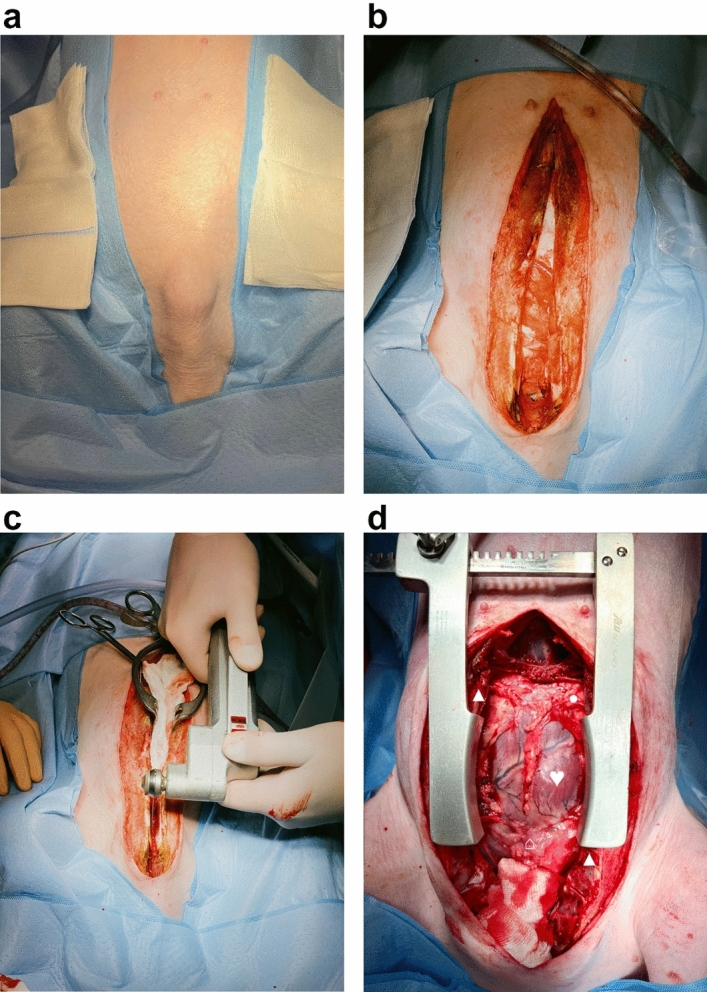
Unilateral phrenic nerve damage is a dreaded complication in congenital heart surgery. It has deleterious effects in neonates and children with uni-ventricular circulation. Diaphragmatic palsy, caused by phrenic nerve damage, impairs respiratory function, especially in new-borns, because their respiration depends on diaphragmatic contractions. Furthermore, Fontan patients with passive pulmonary perfusion are seriously affected by phrenic nerve injury, because diaphragmatic contraction augments pulmonary blood flow. Diaphragmatic plication is currently employed to ameliorate the negative effects of diaphragmatic palsy on pulmonary perfusion and respiratory mechanics. This procedure attenuates pulmonary compression by the abdominal contents. However, there is no contraction of the plicated diaphragm and consequently no contribution to the pulmonary blood flow. Hence, we developed a porcine model of unilateral diaphragmatic palsy in order to evaluate a diaphragmatic pacemaker. Our illustrated step-by-step description of the model generation enables others to replicate and use our model for future studies. Thereby, it might contribute to investigation and advancement of potential improvements for these patients.
单侧膈神经损伤是先天性心脏病手术中一种可怕的并发症。它对单心室循环的新生儿和儿童有不良影响。膈神经损伤引起的膈神经麻痹会损害呼吸功能,尤其是在新生儿中,因为他们的呼吸依赖于膈的收缩。此外,由于肺灌注被动,Fontan 患者膈神经损伤严重,因为膈的收缩增加肺血流量。膈折叠术目前用于改善膈神经麻痹对肺灌注和呼吸力学的负面影响。该手术减轻了腹部内容物对肺的压迫。然而,折叠的膈没有收缩,因此对肺血流没有贡献。因此,我们建立了单侧膈神经麻痹的猪模型,以评估膈起搏器。我们对模型生成的分步描述可以使其他人复制并在未来的研究中使用我们的模型。因此,它可能有助于为这些患者的调查和潜在改进做出贡献。