Structural Biology Laboratory, Elettra-Sincrotrone Trieste S.C.p.A, 34149, Trieste, Italy.
Department of Pharmacy, University of Naples Federico II, 80131, Naples, Italy.
Sci Rep. 2023 Aug 3;13(1):12610. doi: 10.1038/s41598-023-39675-5.
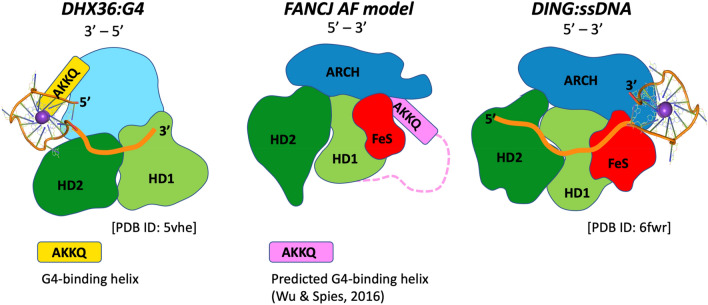
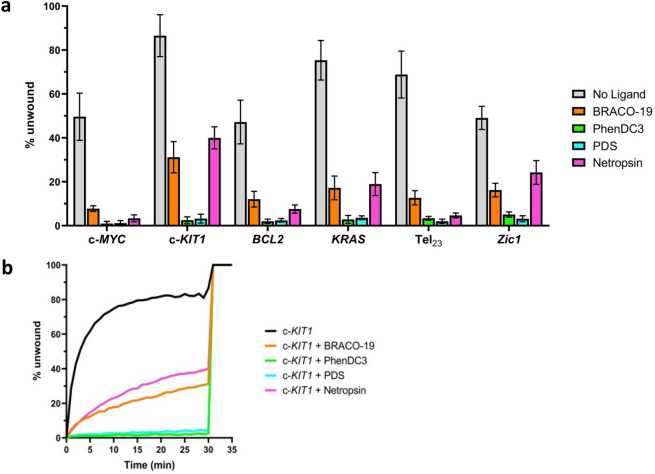
Despite numerous reports on the interactions of G-quadruplexes (G4s) with helicases, systematic analysis addressing the selectivity and specificity of each helicase towards a variety of G4 topologies are scarce. Among the helicases able to unwind G4s are those containing an iron-sulphur (FeS) cluster, including both the bacterial DinG (found in E. coli and several pathogenic bacteria) and the medically important eukaryotic homologues (XPD, FancJ, DDX11 and RTEL1). We carried out a detailed study of the interactions between the E. coli DinG and a variety of G4s, by employing physicochemical and biochemical methodologies. A series of G4-rich sequences from different genomic locations (promoter and telomeric regions), able to form unimolecular G4 structures with diverse topologies, were analyzed (c-KIT1, KRAS, c-MYC, BCL2, Tel, T30695, Zic1). DinG binds to most of the investigated G4s with little discrimination, while it exhibits a clear degree of unwinding specificity towards different G4 topologies. Whereas previous reports suggested that DinG was active only on bimolecular G4s, here we show that it is also able to bind to and resolve the more physiologically relevant unimolecular G4s. In addition, when the G4 structures were stabilized by ligands (Pyridostatin, PhenDC3, BRACO-19 or Netropsin), the DinG unwinding activity decreased and in most cases was abolished, with a pattern that is not simply explained by a change in binding affinity. Overall, these results have important implications for the biochemistry of helicases, strongly suggesting that when analysing the G4 unwinding property of an enzyme, it is necessary to investigate a variety of G4 substrates.
尽管有大量关于 G-四链体 (G4s) 与解旋酶相互作用的报道,但系统分析每种解旋酶对各种 G4 拓扑结构的选择性和特异性的研究还很少。能够解开 G4 的解旋酶中,包括含有铁硫 (FeS) 簇的解旋酶,包括细菌中的 DinG(存在于大肠杆菌和几种致病菌中)和医学上重要的真核同源物(XPD、FancJ、DDX11 和 RTEL1)。我们通过运用物理化学和生化方法,对大肠杆菌 DinG 与各种 G4 之间的相互作用进行了详细研究。分析了一系列来自不同基因组位置(启动子和端粒区域)的富含 G4 的序列,这些序列能够形成具有不同拓扑结构的单分子 G4 结构(c-KIT1、KRAS、c-MYC、BCL2、Tel、T30695、Zic1)。DinG 与大多数研究中的 G4 结合的区分度很小,但它对不同的 G4 拓扑结构表现出明显的解旋特异性。虽然之前的报道表明 DinG 仅在双分子 G4 上活跃,但我们在这里表明,它也能够结合和解开更具生理相关性的单分子 G4。此外,当 G4 结构被配体(Pyridostatin、PhenDC3、BRACO-19 或 Netropsin)稳定时,DinG 的解旋活性降低,在大多数情况下被完全抑制,这种模式不能简单地用结合亲和力的变化来解释。总的来说,这些结果对解旋酶的生物化学具有重要意义,强烈表明在分析酶的 G4 解旋特性时,有必要研究各种 G4 底物。