Molano-Franco Daniel, Arevalo-Rodriguez Ingrid, Muriel Alfonso, Del Campo-Albendea Laura, Fernández-García Silvia, Alvarez-Méndez Ana, Simancas-Racines Daniel, Viteri Andres, Sanchez Guillermo, Fernandez-Felix Borja, Lopez-Alcalde Jesus, Solà Ivan, Osorio Dimelza, Khan Khalid Saeed, Nuvials Xavier, Ferrer Ricard, Zamora Javier
Hospital San José, Fundación Universitaria de Ciencias de la Salud (FUCS), CIMCA Research Group, Bogotá, Colombia.
Clinical Biostatistics Unit, Hospital Universitario Ramón y Cajal, IRYCIS, CIBER of Epidemiology and Public Health (CIBERESP), Madrid, Spain.
Diagn Progn Res. 2023 Aug 3;7(1):15. doi: 10.1186/s41512-023-00152-2.
Numerous biomarkers have been proposed for diagnosis, therapeutic, and prognosis in sepsis. Previous evaluations of the value of biomarkers for predicting mortality due to this life-threatening condition fail to address the complexity of this condition and the risk of bias associated with prognostic studies. We evaluate the predictive performance of four of these biomarkers in the prognosis of mortality through a methodologically sound evaluation.
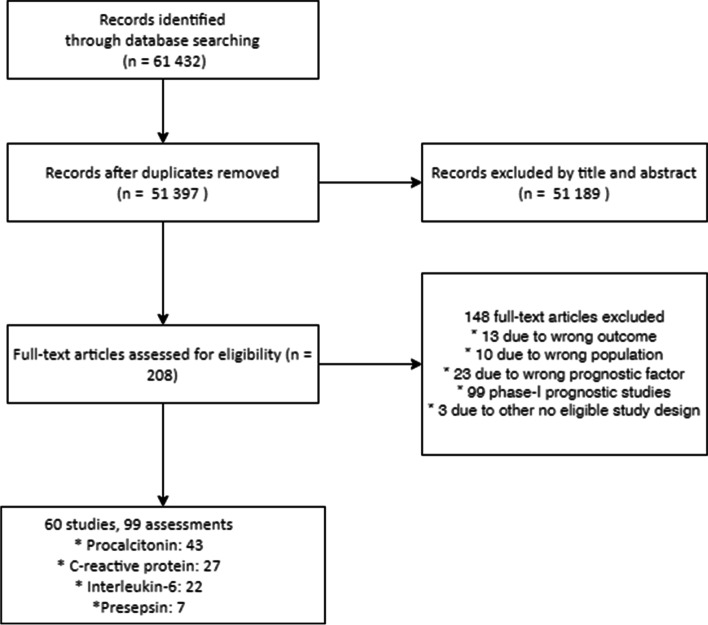
We conducted a systematic review a systematic review and meta-analysis to determine, in critically ill adults with sepsis, whether procalcitonin (PCT), C-reactive protein (CRP), interleukin-6 (IL-6), and presepsin (sCD14) are independent prognostic factors for mortality. We searched MEDLINE, EMBASE, and the Cochrane Central Register of Controlled Trials up to March 2023. Only Phase-2 confirmatory prognostic factor studies among critically ill septic adults were included. Random effects meta-analyses pooled the prognostic association estimates.
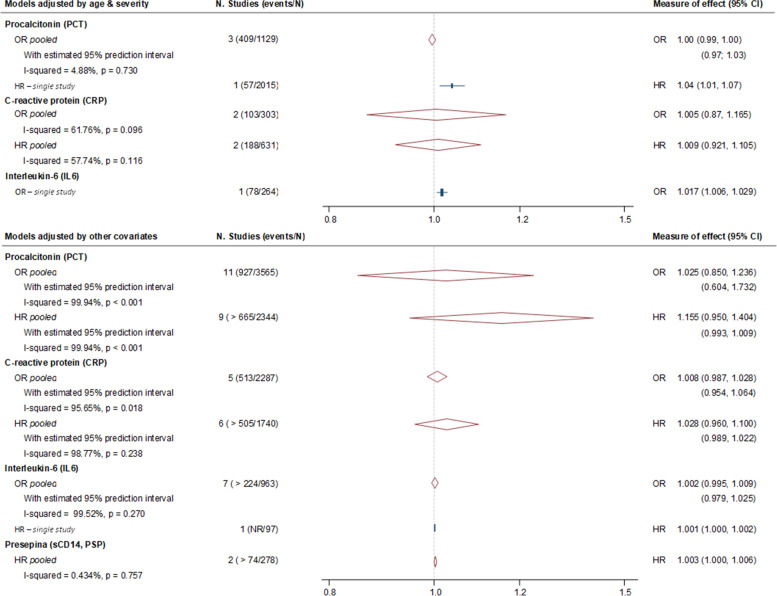
We included 60 studies (15,681 patients) with 99 biomarker assessments. Quality of the statistical analysis and reporting domains using the QUIPS tool showed high risk of bias in > 60% assessments. The biomarker measurement as a continuous variable in models adjusted by key covariates (age and severity score) for predicting mortality at 28-30 days showed a null or near to null association for basal PCT (pooled OR = 0.99, 95% CI = 0.99-1.003), CRP (OR = 1.01, 95% CI = 0.87 to 1.17), and IL-6 (OR = 1.02, 95% CI = 1.01-1.03) and sCD14 (pooled HR = 1.003, 95% CI = 1.000 to 1.006). Additional meta-analyses accounting for other prognostic covariates had similarly null findings.
Baseline, isolated measurement of PCT, CRP, IL-6, and sCD14 has not been shown to help predict mortality in critically ill patients with sepsis. The role of these biomarkers should be evaluated in new studies where the patient selection would be standardized and the measurement of biomarker results.
PROSPERO (CRD42019128790).
众多生物标志物已被提出用于脓毒症的诊断、治疗和预后评估。先前对生物标志物预测这种危及生命状况所致死亡率价值的评估未能解决该状况的复杂性以及与预后研究相关的偏倚风险。我们通过方法严谨的评估来评价其中四种生物标志物在死亡率预后方面的预测性能。
我们进行了一项系统评价和荟萃分析,以确定在患有脓毒症的重症成年患者中,降钙素原(PCT)、C反应蛋白(CRP)、白细胞介素-6(IL-6)和可溶性髓系细胞触发受体-1(sCD14)是否为死亡率的独立预后因素。我们检索了截至2023年3月的MEDLINE、EMBASE和Cochrane对照试验中央注册库。仅纳入重症脓毒症成年患者中的2期确证性预后因素研究。随机效应荟萃分析汇总了预后关联估计值。
我们纳入了60项研究(15681例患者),有99次生物标志物评估。使用QUIPS工具对统计分析和报告领域的质量评估显示,超过60%的评估存在高偏倚风险。在由关键协变量(年龄和严重程度评分)调整的模型中,将生物标志物测量作为连续变量来预测28至30天死亡率时,基础PCT(合并比值比[OR]=0.99,95%置信区间[CI]=0.99 - 1.003)、CRP(OR = 1.01,95% CI = 0.87至1.17)、IL-6(OR = 1.02,95% CI = 1.01 - 1.03)和sCD14(合并风险比[HR]=1.003,95% CI = 1.000至1.006)显示出无效或近乎无效的关联。考虑其他预后协变量的额外荟萃分析也有类似的无效结果。
尚未证明基线时单独测量PCT、CRP、IL-6和sCD14有助于预测重症脓毒症患者的死亡率。应在新的研究中评估这些生物标志物的作用,在这些研究中患者选择将标准化且生物标志物结果的测量也将标准化。
PROSPERO(CRD42019128790)