Li Zhao, Li Kewei, Liu Ying, Gong Mingliang, Shang Junchen, Liu Wen, Liu Yangtao, Jiang Zhongqing
School of Psychology, Liaoning Normal University, Dalian, China.
Tianjin Vocational College of Sports, Tianjin, China.
Heliyon. 2023 Jul 14;9(7):e18341. doi: 10.1016/j.heliyon.2023.e18341. eCollection 2023 Jul.
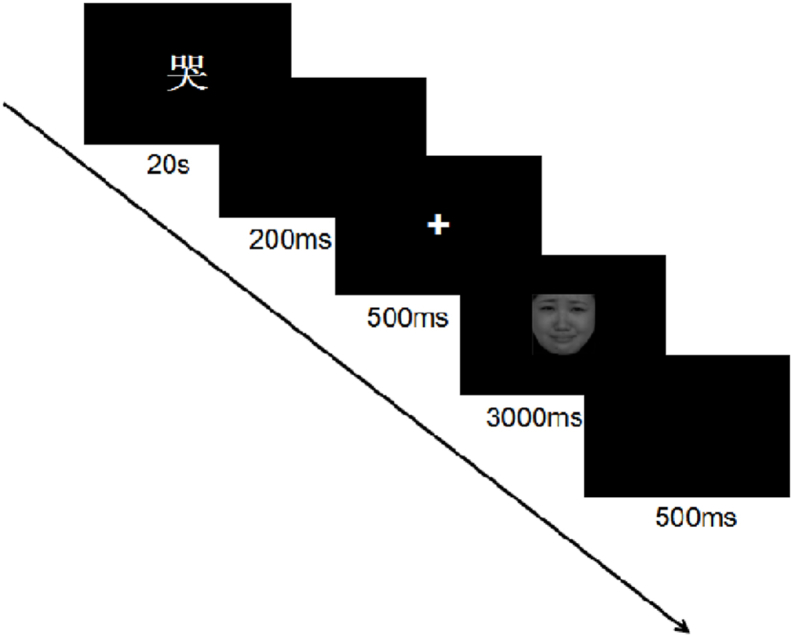
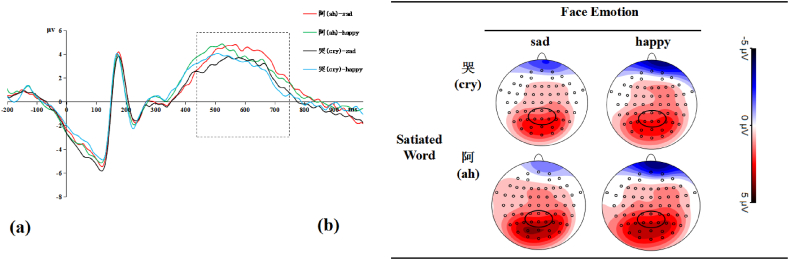
To explore the mechanism of emotional words semantic satiation effect on facial expression processing, participants were asked to judge the facial expression (happiness or sadness) after an emotional word ((cry) or (smile)) or a neutral word ((Ah), baseline condition) was presented for 20 s. The results revealed that participants were slower in judging valence-congruent facial expressions and reported a more enlarged (Experiment 1) and prolonged (Experiment 2) N170 component than the baseline condition. No significant difference in behavior and N170 appeared between the valence-incongruent and the baseline condition. However, the amplitude of LPC (Late Positive Complex) under both valence-congruent/incongruent conditions was smaller than the baseline condition. It indicates that, in the early stage, the impeding effect of satiated emotional words is specifically constrained to facial expressions with the same emotional valence; in the late stage, such an impeding effect might spread to facial expressions with the opposite valence of the satiated emotional word.
为探究情绪词语义饱和效应对面部表情加工的影响机制,研究要求参与者在呈现一个情绪词((哭泣)或(微笑))或一个中性词((啊),基线条件)20秒后,判断面部表情(开心或悲伤)。结果显示,与基线条件相比,参与者判断效价一致的面部表情时反应更慢,且N170成分波幅更大(实验1)、潜伏期更长(实验2)。效价不一致条件与基线条件在行为表现和N170上无显著差异。然而,在效价一致/不一致条件下,晚期正复合体(LPC)的波幅均小于基线条件。这表明,在早期阶段,语义饱和的情绪词的阻碍作用特定地局限于具有相同情绪效价的面部表情;在后期阶段,这种阻碍作用可能会扩展到与语义饱和情绪词效价相反的面部表情。