Xu Qiang, Yang Yaping, Tan Qun, Zhang Lin
Department of Psychology, Ningbo University, Ningbo, China.
Front Psychol. 2017 Dec 12;8:2175. doi: 10.3389/fpsyg.2017.02175. eCollection 2017.
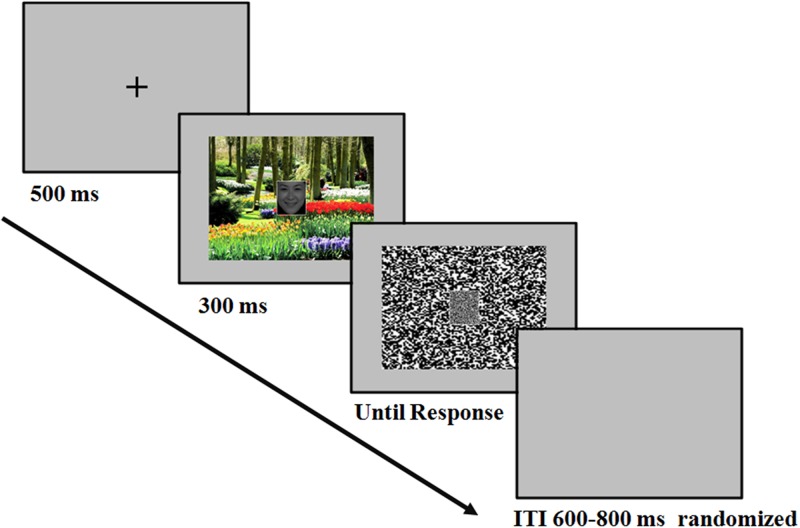
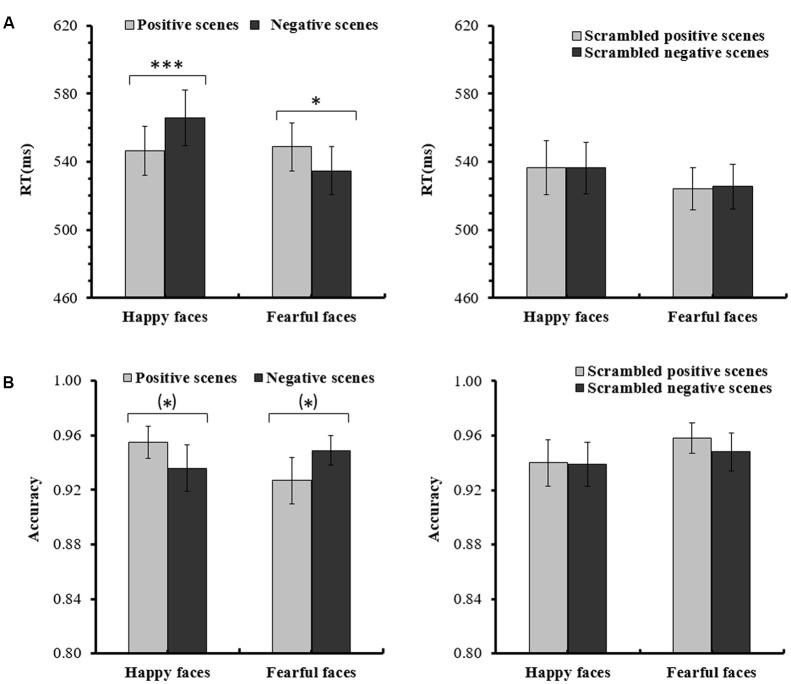
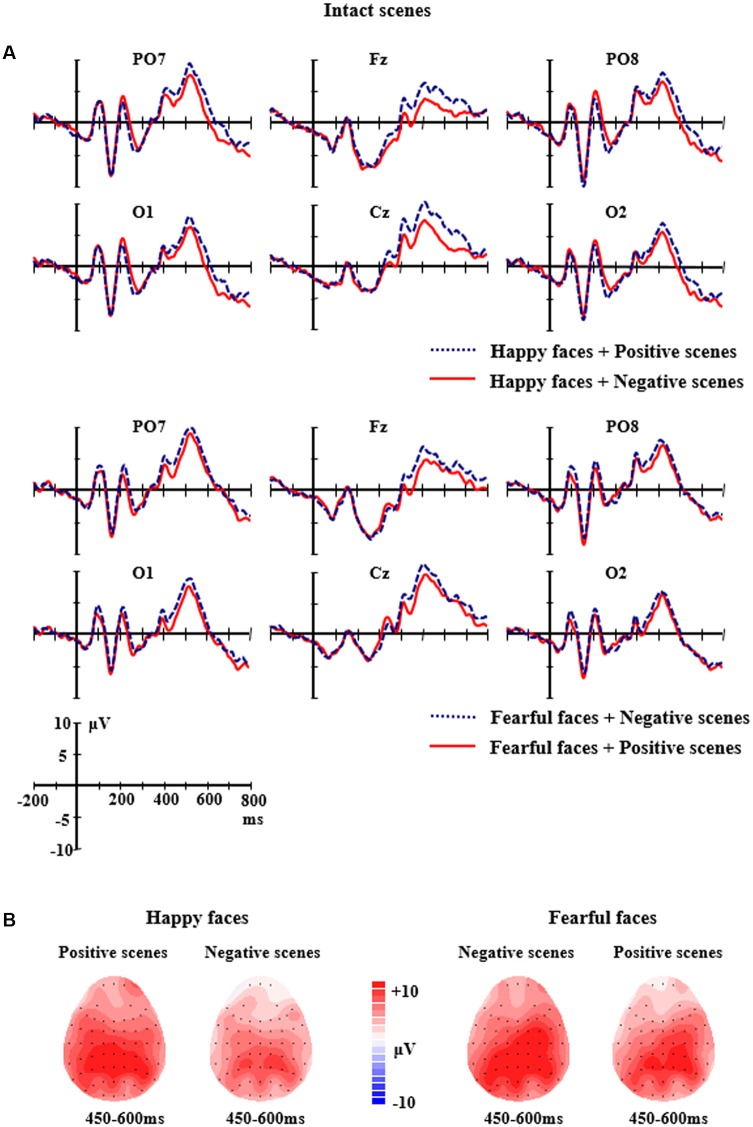
Facial expressions can display personal emotions and indicate an individual's intentions within a social situation. They are extremely important to the social interaction of individuals. Background scenes in which faces are perceived provide important contextual information for facial expression processing. The purpose of this study was to explore the time course of emotional congruency effects in processing faces and scenes simultaneously by recording event-related potentials (ERPs). The behavioral results found that the categorization of facial expression was faster and more accurate when the face was emotionally congruent than incongruent with the emotion displayed by the scene. In ERPs the late positive potential (LPP) amplitudes were modulated by the emotional congruency between faces and scenes. Specifically, happy faces elicited larger LPP amplitudes within positive than within negative scenes and fearful faces within negative scenes elicited larger LPP amplitudes than within positive scenes. The results did not find the scene effects on the P1 and N170 components. These findings indicate that emotional congruency effects could occur in late stages of facial expression processing, reflecting motivated attention allocation.
面部表情可以展现个人情感,并在社交情境中表明个体的意图。它们对个体的社交互动极为重要。人们感知面部时所处的背景场景为面部表情处理提供了重要的情境信息。本研究的目的是通过记录事件相关电位(ERP)来探究在同时处理面部和场景时情绪一致性效应的时间进程。行为结果发现,当面部表情与场景所显示的情绪在情感上一致而非不一致时,面部表情的分类更快且更准确。在ERP中,晚期正电位(LPP)的振幅受到面部和场景之间情感一致性的调节。具体而言,在积极场景中,开心的面部引发的LPP振幅比消极场景中更大;而在消极场景中,恐惧的面部引发的LPP振幅比积极场景中更大。结果未发现场景对P1和N170成分有影响。这些发现表明,情绪一致性效应可能出现在面部表情处理的后期阶段,反映了动机性注意分配。