Division of Infectious Diseases, Massachusetts General Hospital, Boston.
Harvard Medical School, Boston, Massachusetts.
JAMA Health Forum. 2023 Aug 4;4(8):e232310. doi: 10.1001/jamahealthforum.2023.2310.
School-associated SARS-CoV-2 transmission is described as uncommon, although the true transmission rate is unknown.
To identify the SARS-CoV-2 secondary attack rate (SAR) in schools and factors associated with transmission.
DESIGN, SETTING, AND PARTICIPANTS: This cohort study examined the risk of school-based transmission of SARS-CoV-2 among kindergarten through grade 12 students and staff in 10 Massachusetts school districts during 2 periods: fall 2020/spring 2021 (F20/S21) and fall 2021 (F21). School staff collected data on SARS-CoV-2 index cases and school-based contacts, and SAR was defined as the proportion of contacts acquiring SARS-CoV-2 infection.
SARS-CoV-2.
Potential factors associated with transmission, including grade level, masking, exposure location, vaccination history, and Social Vulnerability Index (SVI), were analyzed using univariable and multivariable logistic regression models.
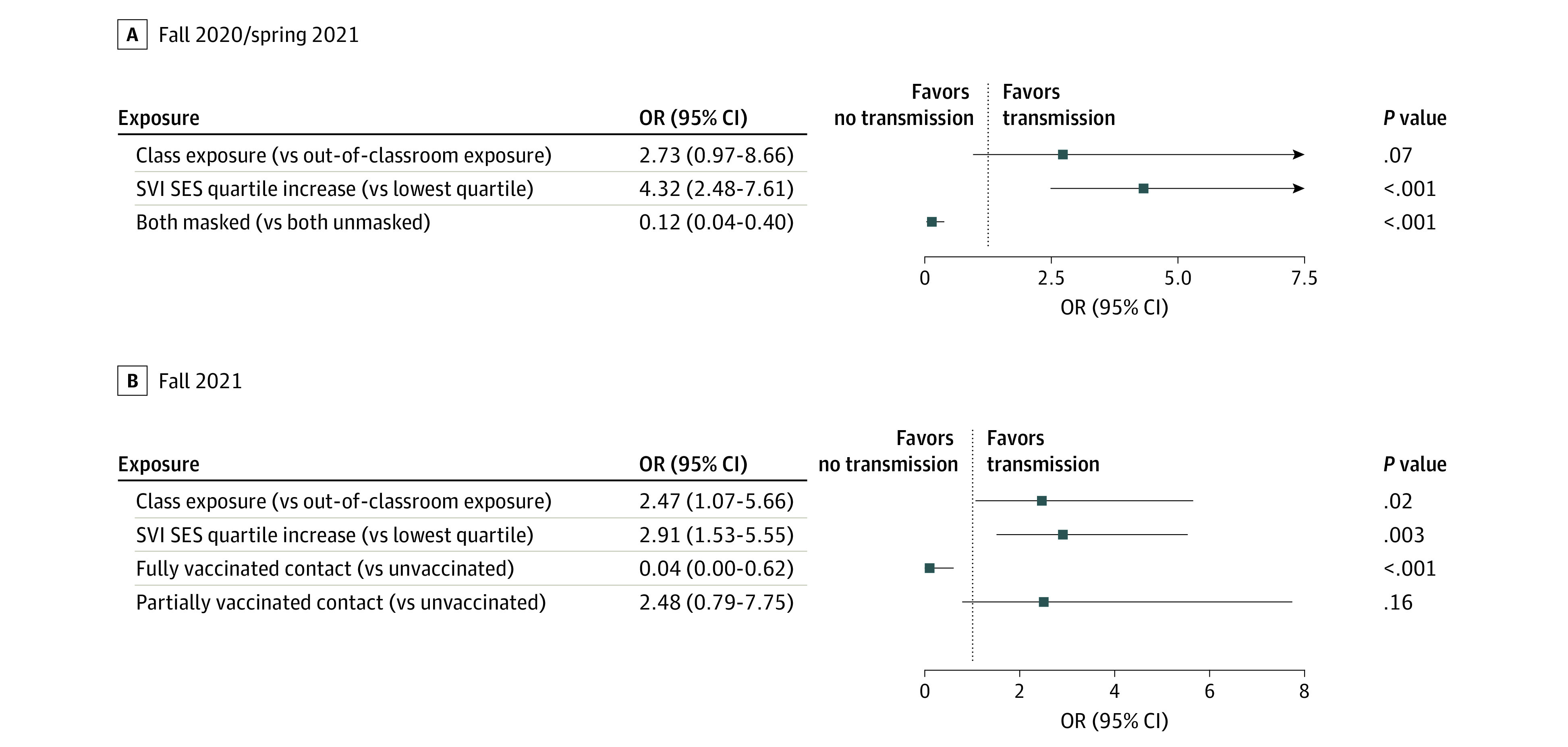
For F20/S21, 8 school districts (70 schools, >33 000 students) were included and reported 435 index cases (151 staff, 216 students, and 68 missing role) with 1771 school-based contacts (278 staff, 1492 students, and 1 missing role). For F21, 5 districts (34 schools, >18 000 students) participated and reported 309 index cases (37 staff, 207 students, and 65 missing role) with 1673 school-based contacts (107 staff and 1566 students). The F20/S21 SAR was 2.2% (lower bound, 1.6%; upper bound, 26.7%), and the F21 SAR was 2.8% (lower bound, 2.6%; upper bound, 7.4%). In multivariable analysis, during F20/S21, masking was associated with a lower odds of transmission compared with not masking (odds radio [OR], 0.12; 95% CI, 0.04-0.40; P < .001). In F21, classroom exposure vs out-of-classroom exposure was associated with increased odds of transmission (OR, 2.47; 95% CI, 1.07-5.66; P = .02); a fully vaccinated vs unvaccinated contact was associated with a lower odds of transmission (OR, 0.04; 95% CI, 0.00-0.62; P < .001). In both periods, a higher SVI was associated with a greater odds of transmission.
In this study of Massachusetts schools, the SAR for SARS-CoV-2 among school-based contacts was low during 2 periods, and factors associated with transmission risk varied over time. These findings suggest that ongoing surveillance efforts may be essential to ensure that both targeted resources and mitigation practices remain optimal and relevant for disease prevention.
虽然未知 SARS-CoV-2 的真实传播率,但学校相关的 SARS-CoV-2 传播被描述为罕见。
确定学校环境中 SARS-CoV-2 的二次攻击率(SAR)以及与传播相关的因素。
设计、地点和参与者:本队列研究调查了马萨诸塞州 10 个学区的幼儿园至 12 年级学生和教职员工在 2020 年秋季/2021 年春季(F20/S21)和 2021 年秋季(F21)期间的 SARS-CoV-2 校内传播风险。学校工作人员收集了 SARS-CoV-2 索引病例和校内接触者的数据,SAR 定义为接触者感染 SARS-CoV-2 的比例。
SARS-CoV-2。
使用单变量和多变量逻辑回归模型分析了与传播相关的潜在因素,包括年级、戴口罩、暴露地点、疫苗接种史和社会脆弱性指数(SVI)。
在 F20/S21 期间,有 8 个学区(70 所学校,超过 33000 名学生)参与并报告了 435 例索引病例(151 名工作人员、216 名学生和 68 名缺失角色)和 1771 名校内接触者(278 名工作人员、1492 名学生和 1 名缺失角色)。在 F21 期间,有 5 个学区(34 所学校,超过 18000 名学生)参与并报告了 309 例索引病例(37 名工作人员、207 名学生和 65 名缺失角色)和 1673 名校内接触者(107 名工作人员和 1566 名学生)。F20/S21 的 SAR 为 2.2%(下限为 1.6%;上限为 26.7%),F21 的 SAR 为 2.8%(下限为 2.6%;上限为 7.4%)。在多变量分析中,在 F20/S21 期间,与不戴口罩相比,戴口罩与传播几率降低相关(比值比[OR],0.12;95%置信区间[CI],0.04-0.40;P<0.001)。在 F21 中,与教室暴露相比,教室外暴露与传播几率增加相关(OR,2.47;95%CI,1.07-5.66;P=0.02);与未接种疫苗的接触者相比,完全接种疫苗的接触者与传播几率降低相关(OR,0.04;95%CI,0.00-0.62;P<0.001)。在两个时期,SVI 越高,传播的几率越大。
在这项对马萨诸塞州学校的研究中,在两个时期内,校内接触者中 SARS-CoV-2 的 SAR 都很低,与传播风险相关的因素随时间而变化。这些发现表明,持续的监测工作可能是必要的,以确保有针对性的资源和缓解措施仍然是预防疾病的最佳和相关措施。