Günther Florian, Schober Fabian, Hunger Sandra, Schellnock Julia, Derlien Steffen, Schleifenbaum Stefan, Drossel Welf-Guntram, Heyde Christoph-Eckhard
Department of Biomechatronics, Fraunhofer Institute for Machine Tools and Forming Technology IWU, Dresden, Germany.
Center for Research on Musculoskeletal Systems (ZESBO), Faculty of Medicine, Hospital of Orthopaedic Surgery, Traumatology and Plastic Surgery, University of Leipzig Medical Center, Leipzig, Germany.
JMIR Rehabil Assist Technol. 2023 Aug 4;10:e46217. doi: 10.2196/46217.
Conservative scoliosis therapy in the form of assisted physiotherapeutic scoliosis exercises is supplemented by self-contained training at home, depending on the approach (eg, Schroth, the Scientific Exercises Approach to Scoliosis). Complex exercises, lack of awareness of the importance of training, and missing supervision by therapists often lead to uncertainty and reduced motivation, which in turn reduces the success of home-based therapy. Increasing digitalization in the health care sector offers opportunities to close this gap. However, research is needed to analyze the requirements and translate the potential of digital tools into concrete solution concepts.
The aim of this study is to evaluate the potential for optimizing home-based scoliosis therapy in terms of motivation, assistive devices, and digital tools.
In collaboration with the Institute of Physiotherapy at the Jena University Hospital, a survey was initiated to address patients with scoliosis and physical therapists. A digital questionnaire was created for each target group and distributed via physiotherapies, scoliosis forums, the Bundesverband für Skoliose Selbsthilfe e. V. newsletter via a link, and a quick response code. The survey collected data on demographics, therapy, exercise habits, motivation, assistive devices, and digital tools. Descriptive statistics were used for evaluation.
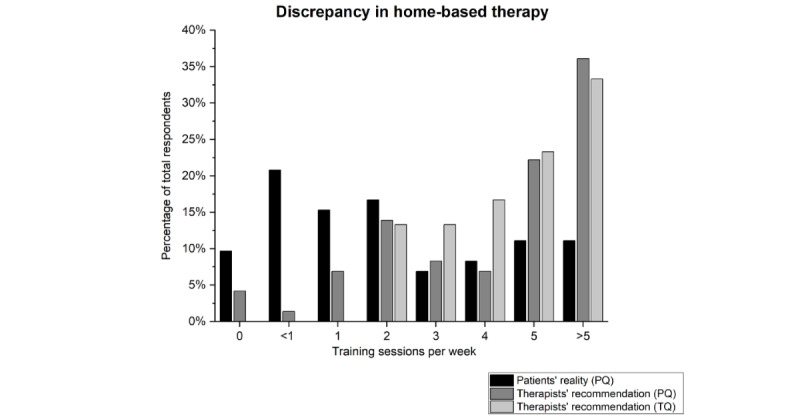
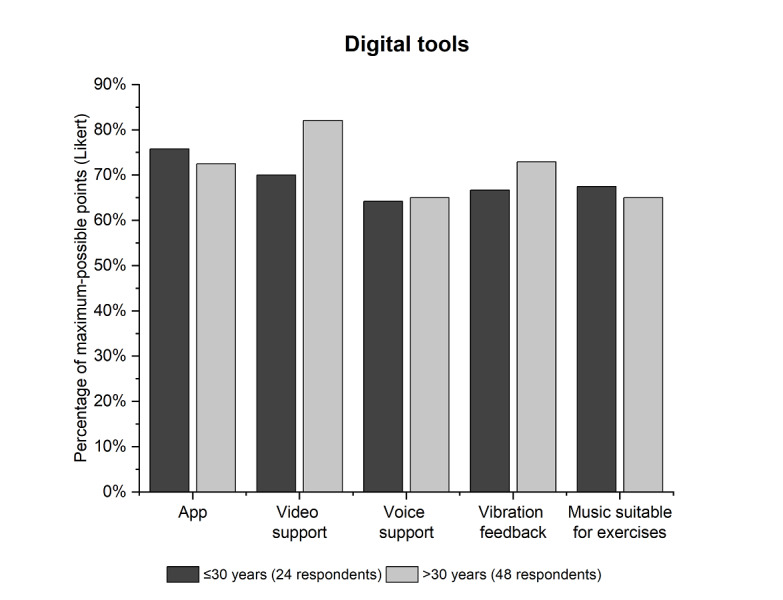
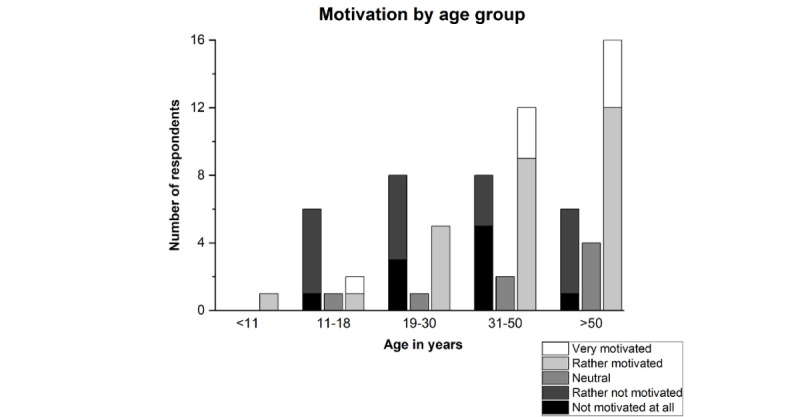
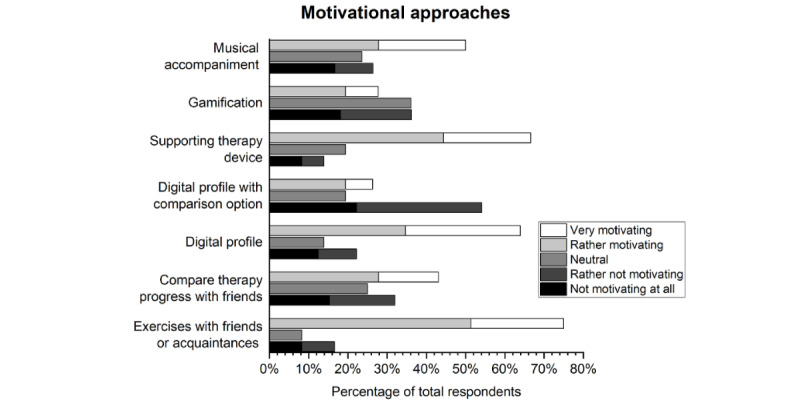
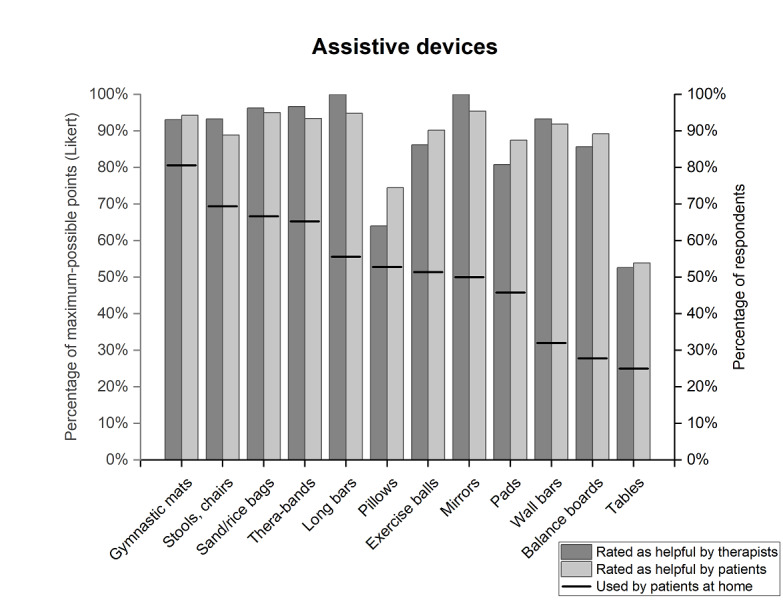
Of 141 survey participants, 72 (51.1%; n=62, 86.1%, female; n=10, 13.9%, male) patients with scoliosis with an average age of 40 (SD 17.08) years and 30 scoliosis therapists completed the respective questionnaires. The analysis of home-based therapy showed that patients with scoliosis exercise less per week (2 times or less; 45/72, 62.5%) than they are recommended to do by therapists (at least 3 times; 53/72, 73.6%). Patients indicated that their motivation could be increased by practicing together with friends and acquaintances (54/72, 75%), a supporting therapy device (48/72, 66.7%), or a digital profile (46/72, 63.9%). The most important assistive devices, which are comparatively rarely used in home-based therapy, included balance boards (20/72, 27.8%), wall bars (23/72, 31.9%), mirrors (36/72, 50%), and long bars (40/72, 55.6%). Therapists saw the greatest benefit of digital tools for scoliosis therapy in increasing motivation (26/30, 87%), improving home therapy (25/30, 83%), monitoring therapy progress (25/30, 83%), and demonstrating exercise instructions (24/30, 80%).
In this study, we investigated whether there is any potential for improvement in home-based scoliosis therapy. For this purpose, using online questionnaires, we asked patients with scoliosis and therapists questions about the following topics: exercise habits, outpatient and home-based therapy, motivation, supportive devices, and digital tools. The results showed that a lack of motivation, suitable training equipment, and tools for self-control leads to a low training workload. From the perspective of the patients surveyed, this problem can be addressed through community training with friends or acquaintances, a supportive therapy device, and digital elements, such as apps, with training instructions and user profiles.
辅助物理治疗性脊柱侧弯锻炼形式的保守性脊柱侧弯治疗,需辅以在家中进行的自主训练,具体取决于治疗方法(例如施罗斯疗法,即脊柱侧弯科学锻炼法)。复杂的锻炼动作、对训练重要性缺乏认识以及缺乏治疗师的监督,常常导致患者产生不确定性并降低积极性,进而影响家庭治疗的效果。医疗保健领域数字化程度的不断提高为弥补这一差距提供了契机。然而,需要开展研究来分析相关需求,并将数字工具的潜力转化为具体的解决方案概念。
本研究旨在评估在动机、辅助设备和数字工具方面优化家庭脊柱侧弯治疗的潜力。
与耶拿大学医院物理治疗研究所合作,针对脊柱侧弯患者和物理治疗师开展了一项调查。为每个目标群体创建了一份数字问卷,并通过物理治疗机构、脊柱侧弯论坛、德国脊柱侧弯自助协会时事通讯中的链接以及二维码进行分发。该调查收集了有关人口统计学、治疗、锻炼习惯、动机、辅助设备和数字工具的数据。采用描述性统计进行评估。
在141名调查参与者中,72名(51.1%;n = 62,86.1%为女性;n = 10,13.9%为男性)平均年龄40岁(标准差17.08)的脊柱侧弯患者和30名脊柱侧弯治疗师完成了各自的问卷。对家庭治疗的分析表明,脊柱侧弯患者每周锻炼次数(2次及以下;45/72,62.5%)少于治疗师建议的次数(至少3次;53/72,73.6%)。患者表示,与朋友和熟人一起锻炼(54/72,75%)、使用辅助治疗设备(48/72,66.7%)或数字档案(46/72,63.9%)可以提高他们的积极性。在家庭治疗中相对较少使用的最重要辅助设备包括平衡板(20/72,27.8%)、肋木(23/72,31.9%)、镜子(36/72,50%)和长杆(40/72,55.6%)。治疗师认为数字工具对脊柱侧弯治疗的最大益处在于提高积极性(26/30,87%)、改善家庭治疗(25/30,83%)、监测治疗进展(25/30,83%)以及演示锻炼指导(24/30,80%)。
在本研究中,我们调查了家庭脊柱侧弯治疗是否存在改进潜力。为此,我们通过在线问卷向脊柱侧弯患者和治疗师询问了以下主题的问题:锻炼习惯、门诊和家庭治疗、动机、支持性设备以及数字工具。结果表明,缺乏动机、合适的训练设备和自我控制工具导致训练量较低。从接受调查的患者角度来看,这个问题可以通过与朋友或熟人进行团体训练、使用辅助治疗设备以及数字元素(如带有训练指导和用户档案的应用程序)来解决。