Boston Attention and Learning Laboratory (BALLAB), VA Boston Healthcare System, Boston, MA, USA.
National Center for PTSD, VA Boston Healthcare System, Boston, MA, USA.
Cogn Res Princ Implic. 2023 Aug 4;8(1):51. doi: 10.1186/s41235-023-00504-y.
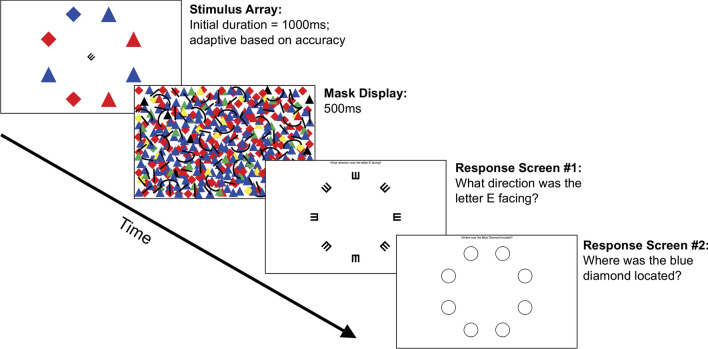
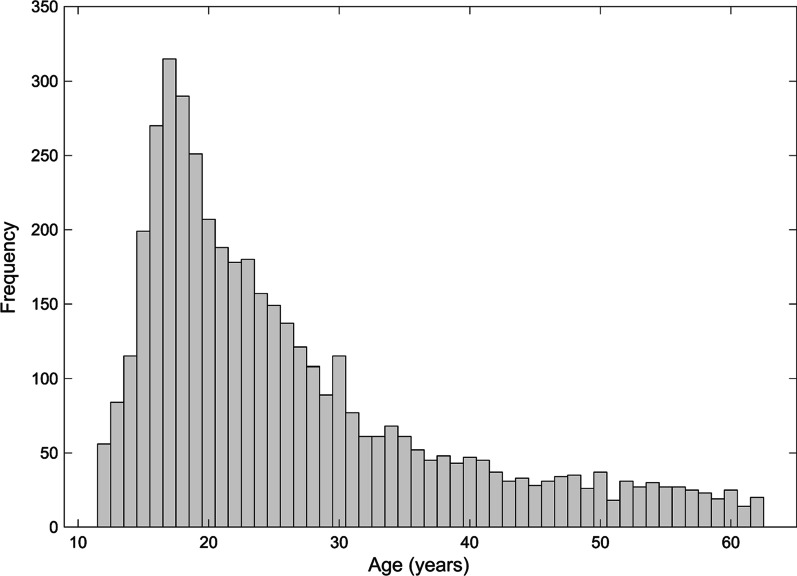
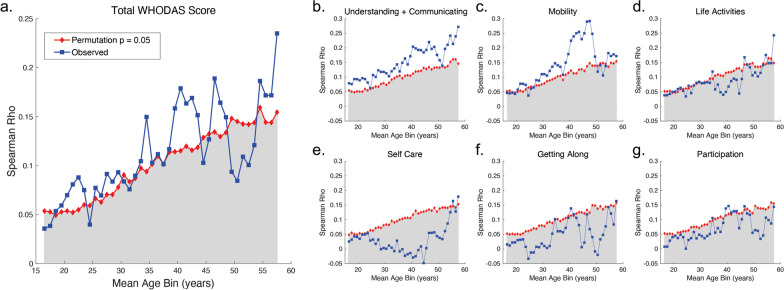
Visuospatial processing speed underlies several cognitive functions critical for successful completion of everyday tasks, including driving and walking. While it is widely accepted that visuospatial processing speed peaks in early adulthood, performance across the lifespan remains incompletely characterized. Additionally, there remains a lack of paradigms available to assess visuospatial processing speed in unsupervised web-based testing environments. To address these gaps, we developed a novel visuospatial processing speed (VIPS) task adapted from two tests sensitive to visuospatial processing speed declines in older adults, the Useful Field of View paradigm and the PERformance CEntered Portable Test. The VIPS task requires participants to make a central orientation discrimination and complete a simultaneous peripheral visual search task. Data were collected from 86 in-lab volunteers (18-30 years) to compare performance to traditional neuropsychological measures. Consistent with previous literature, performance on the novel VIPS task significantly correlated with measures of selective attention, executive functioning, visual speed, and working memory. An additional 4395 volunteers (12-62 years) were recruited on TestMyBrain.org to establish lifespan trajectories of visuospatial processing speed and associations with functional disability. VIPS task performance peaked in the early 20's, and steadily decreased such that thresholds doubled in 60-year-olds relative to 20-year-olds (817 ms vs. 412 ms). VIPS task performance significantly correlated with self-reported cognitive functioning deficits broadly across the lifespan but was specifically related to mobility issues in middle-age. These findings have important implications for early detection of cognitive decline and provide insights into potential early intervention targets for younger and middle-aged adults.
视空间处理速度是完成日常任务(包括驾驶和行走)所需的几种关键认知功能的基础。虽然人们普遍认为视空间处理速度在成年早期达到峰值,但整个生命周期的表现仍未完全描述。此外,仍然缺乏可用于评估非监督网络测试环境中的视空间处理速度的范式。为了解决这些差距,我们开发了一种新的视空间处理速度(VIPS)任务,该任务改编自两个对老年人视空间处理速度下降敏感的测试,即有用视野范式和 PERformance CEntered 便携式测试。VIPS 任务要求参与者进行中央定向辨别,并同时完成外围视觉搜索任务。从 86 名实验室志愿者(18-30 岁)收集数据,以将表现与传统神经心理学测量进行比较。与先前的文献一致,新的 VIPS 任务的表现与选择性注意、执行功能、视觉速度和工作记忆的测量显著相关。另外在 TestMyBrain.org 上招募了 4395 名志愿者(12-62 岁),以建立视空间处理速度的寿命轨迹及其与功能障碍的关联。VIPS 任务的表现峰值出现在 20 岁出头,然后稳步下降,以至于 60 岁的人相对于 20 岁的人,阈值增加了一倍(817 毫秒对 412 毫秒)。VIPS 任务的表现与自我报告的认知功能缺陷广泛相关,但与中年的移动问题特别相关。这些发现对视空间处理速度认知下降的早期检测具有重要意义,并为年轻和中年成年人提供了潜在的早期干预目标的见解。