Oncologia Medica A, Policlinico Umberto 1, La Sapienza Università Di Roma, Rome, Italy.
Section of Medical Oncology, Department of Surgical, Oncological and Oral Sciences, University of Palermo, Palermo, Italy.
J Exp Clin Cancer Res. 2023 Aug 4;42(1):193. doi: 10.1186/s13046-023-02743-9.
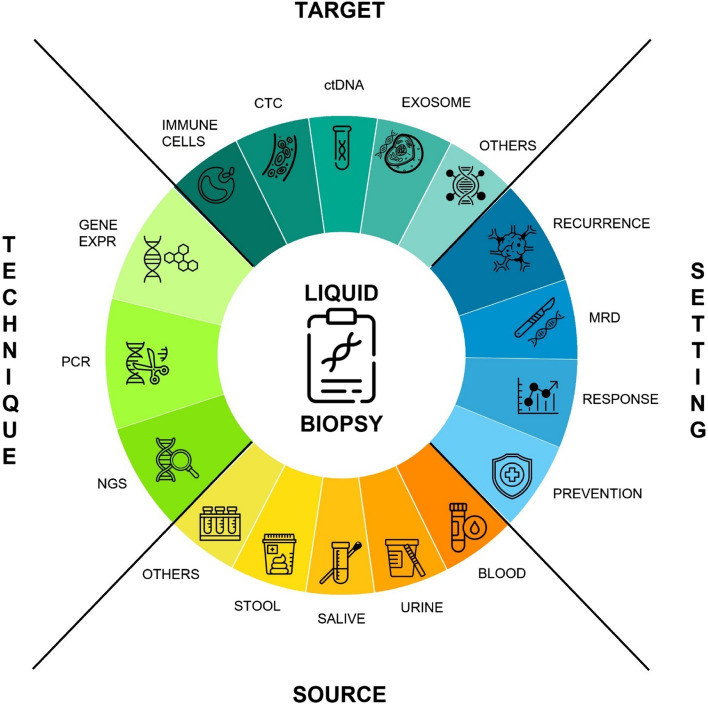
Tissue-based biopsy is the present main tool to explore the molecular landscape of cancer, but it also has many limits to be frequently executed, being too invasive with the risk of side effects. These limits and the ability of cancer to constantly evolve its genomic profile, have recently led to the need of a less invasive and more accurate alternative, such as liquid biopsy. By searching Circulating Tumor Cells and residues of their nucleic acids or other tumor products in body fluids, especially in blood, but also in urine, stools and saliva, liquid biopsy is becoming the future of clinical oncology. Despite the current lack of a standardization for its workflows, that makes it hard to be reproduced, liquid biopsy has already obtained promising results for cancer screening, diagnosis, prognosis, and risk of recurrence.Through a more accessible molecular profiling of tumors, it could become easier to identify biomarkers predictive of response to treatment, such as EGFR mutations in non-small cell lung cancer and KRAS mutations in colorectal cancer, or Microsatellite Instability and Mismatch Repair as predictive markers of pembrolizumab response.By monitoring circulating tumor DNA in longitudinal repeated sampling of blood we could also predict Minimal Residual Disease and the risk of recurrence in already radically resected patients.In this review we will discuss about the current knowledge of limitations and strengths of the different forms of liquid biopsies for its inclusion in normal cancer management, with a brief nod to their newest biomarkers and its future implications.
基于组织的活检是目前探索癌症分子图谱的主要工具,但由于其具有较高的侵袭性和副作用风险,因此也存在许多限制,无法频繁进行。这些限制以及癌症不断演变其基因组特征的能力,最近导致人们需要一种侵袭性更小、更准确的替代方法,例如液体活检。通过在体液(尤其是血液中)中寻找循环肿瘤细胞及其核酸或其他肿瘤产物的残留,液体活检正在成为临床肿瘤学的未来。尽管目前其工作流程缺乏标准化,难以复制,但液体活检已经在癌症筛查、诊断、预后和复发风险方面取得了有希望的结果。通过对肿瘤进行更易于获得的分子分析,可以更容易地识别预测治疗反应的生物标志物,例如非小细胞肺癌中的 EGFR 突变和结直肠癌中的 KRAS 突变,或微卫星不稳定性和错配修复作为 pembrolizumab 反应的预测标志物。通过对血液进行纵向重复采样来监测循环肿瘤 DNA,我们还可以预测已接受根治性切除的患者的微小残留疾病和复发风险。在这篇综述中,我们将讨论不同形式的液体活检的当前局限性和优势,及其在癌症常规管理中的应用,简要介绍其最新的生物标志物及其未来的影响。