Lee Jaehwan, Shin Seokwon, Lee Jaeho, Han Young-Kyu, Lee Woojin, Son Youngdoo
Department of Industrial and Systems Engineering, Dongguk University-Seoul, Seoul, 04620, South Korea.
Data Science Laboratory (DSLAB), Dongguk University-Seoul, Seoul, 04620, South Korea.
Sci Rep. 2023 Aug 5;13(1):12729. doi: 10.1038/s41598-023-39696-0.
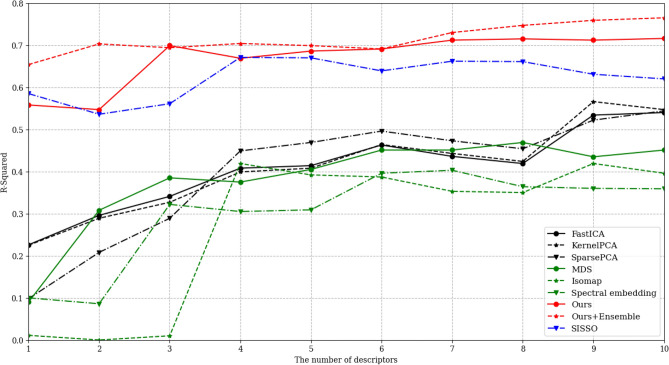
Transition metal dichalcogenides (TMDs) have emerged as a promising alternative to noble metals in the field of electrocatalysts for the hydrogen evolution reaction. However, previous attempts using machine learning to predict TMD properties, such as catalytic activity, have been shown to have limitations in their dependence on large amounts of training data and massive computations. Herein, we propose a genetic descriptor search that efficiently identifies a set of descriptors through a genetic algorithm, without requiring intensive calculations. We conducted both quantitative and qualitative experiments on a total of 70 TMDs to predict hydrogen adsorption free energy ([Formula: see text]) with the generated descriptors. The results demonstrate that the proposed method significantly outperformed the feature extraction methods that are currently widely used in machine learning applications.
过渡金属二硫属化物(TMDs)已成为析氢反应电催化剂领域中贵金属的一种有前景的替代品。然而,先前使用机器学习预测TMD性质(如催化活性)的尝试已表明,它们在依赖大量训练数据和大量计算方面存在局限性。在此,我们提出一种遗传描述符搜索方法,该方法通过遗传算法有效地识别一组描述符,而无需进行密集计算。我们对总共70种TMD进行了定量和定性实验,以使用生成的描述符预测氢吸附自由能([公式:见正文])。结果表明,所提出的方法明显优于目前在机器学习应用中广泛使用的特征提取方法。