Institute for Cancer and Genomic Science, the Medical School, University of Birmingham, Birmingham, UK.
Virulence. 2023 Dec;14(1):2242544. doi: 10.1080/21505594.2023.2242544.
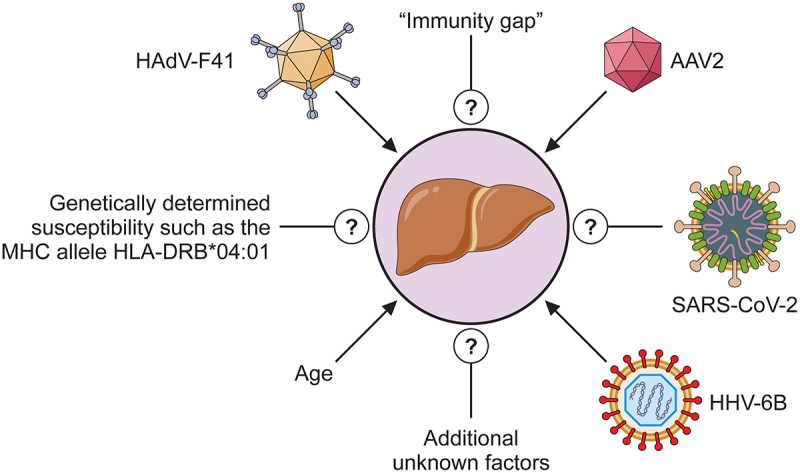
Over 100 human adenoviruses (HAdVs) have been isolated and allocated to seven species, A-G. Species F comprises two members-HAdV-F40 and HAdV-F41. As their primary site of infection is the gastrointestinal tract they have been termed, with species A, enteric adenoviruses. HAdV-F40 and HAdV-F41 are a common cause of gastroenteritis and diarrhoea in children. Partly because of difficulties in propagating the viruses in the laboratory, due to their restrictions on growth in many cell lines, our knowledge of the properties of individual viral proteins is limited. However, the structure of HAdV-F41 has recently been determined by cryo-electron microscopy. The overall structure is similar to those of HAdV-C5 and HAdV-D26 although with some differences. The sequence and arrangement of the hexon hypervariable region 1 (HVR1) and the arrangement of the C-terminal region of protein IX differ. Variations in the penton base and hexon HVR1 may play a role in facilitating infection of intestinal cells by HAdV-F41. A unique feature of HAdV-F40 and F41, among human adenoviruses, is the presence and expression of two fibre genes, giving long and short fibre proteins. This may also contribute to the tropism of these viruses. HAdV-F41 has been linked to a recent outbreak of severe acute hepatitis "of unknown origin" in young children. Further investigation has shown a very high prevalence of adeno-associated virus-2 in the liver and/or plasma of some cohorts of patients. These observations have proved controversial as HAdV-F41 had not been reported to infect the liver and AAV-2 has generally been considered harmless.
已分离出超过 100 种人类腺病毒(HAdV),并将其分配到七个种,A-G。种 F 包括两个成员-HAdV-F40 和 HAdV-F41。由于其主要感染部位是胃肠道,因此被称为 A 种肠道腺病毒。HAdV-F40 和 HAdV-F41 是儿童胃肠炎和腹泻的常见病因。部分由于这些病毒在实验室中难以繁殖,由于它们在许多细胞系中的生长限制,我们对单个病毒蛋白特性的了解有限。然而,HAdV-F41 的结构最近已通过冷冻电子显微镜确定。尽管存在一些差异,但整体结构与 HAdV-C5 和 HAdV-D26 相似。HVR1 的结构和排列以及蛋白 IX 的 C 末端区域的排列不同。五邻体基和六邻体 HVR1 的变异可能在促进 HAdV-F41 感染肠道细胞方面发挥作用。HAdV-F40 和 F41 在人类腺病毒中的一个独特特征是存在和表达两个纤维基因,分别产生长纤维蛋白和短纤维蛋白。这也可能有助于这些病毒的嗜性。HAdV-F41 与近期在幼儿中爆发的不明原因严重急性肝炎有关。进一步的研究表明,在一些患者队列的肝脏和/或血浆中腺相关病毒-2 的患病率非常高。这些观察结果引起了争议,因为据报道 HAdV-F41 不会感染肝脏,而 AAV-2 通常被认为是无害的。