Rafie K, Lenman A, Fuchs J, Rajan A, Arnberg N, Carlson L-A
Department of Medical Biochemistry and Biophysics, Umeå University, Umeå, Sweden.
Wallenberg Centre for Molecular Medicine, Umeå University, Umeå, Sweden.
Sci Adv. 2021 Jan 8;7(2). doi: 10.1126/sciadv.abe0974. Print 2021 Jan.
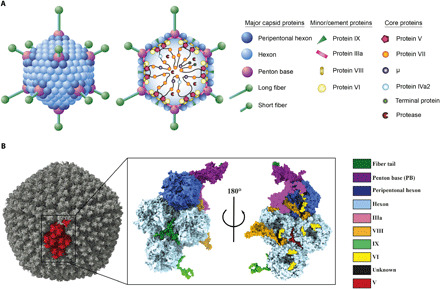
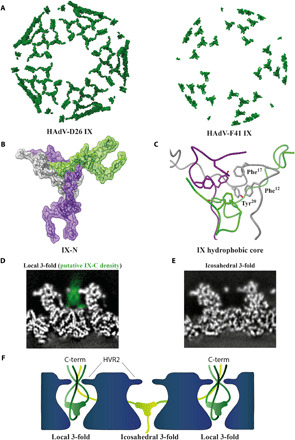
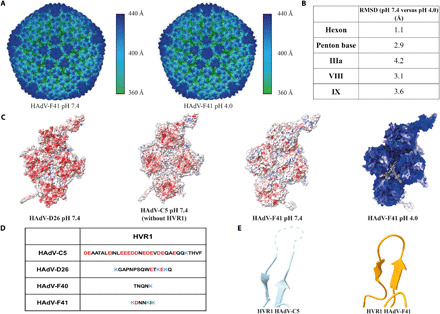
Human adenovirus (HAdV) types F40 and F41 are a prominent cause of diarrhea and diarrhea-associated mortality in young children worldwide. These enteric HAdVs differ notably in tissue tropism and pathogenicity from respiratory and ocular adenoviruses, but the structural basis for this divergence has been unknown. Here, we present the first structure of an enteric HAdV-HAdV-F41-determined by cryo-electron microscopy to a resolution of 3.8 Å. The structure reveals extensive alterations to the virion exterior as compared to nonenteric HAdVs, including a unique arrangement of capsid protein IX. The structure also provides new insights into conserved aspects of HAdV architecture such as a proposed location of core protein V, which links the viral DNA to the capsid, and assembly-induced conformational changes in the penton base protein. Our findings provide the structural basis for adaptation of enteric HAdVs to a fundamentally different tissue tropism.
人类腺病毒F40型和F41型是全球幼儿腹泻及腹泻相关死亡的主要原因。这些肠道腺病毒在组织嗜性和致病性方面与呼吸道和眼部腺病毒显著不同,但这种差异的结构基础尚不清楚。在此,我们展示了通过冷冻电子显微镜确定的肠道腺病毒——腺病毒F41型的首个结构,分辨率为3.8埃。与非肠道腺病毒相比,该结构揭示了病毒粒子外部的广泛改变,包括衣壳蛋白IX的独特排列。该结构还为腺病毒结构的保守方面提供了新见解,比如连接病毒DNA与衣壳的核心蛋白V的假定位置,以及五聚体基质蛋白中组装诱导的构象变化。我们的研究结果为肠道腺病毒适应根本不同的组织嗜性提供了结构基础。