Emergency Intensive Care Unit, Affiliated Hospital of Qingdao University, Qingdao, Shandong, China (mainland).
Supersonic Room, Affiliated Hospital of Qingdao University, Qingdao, Shandong, China (mainland).
Med Sci Monit. 2023 Aug 7;29:e940783. doi: 10.12659/MSM.940783.
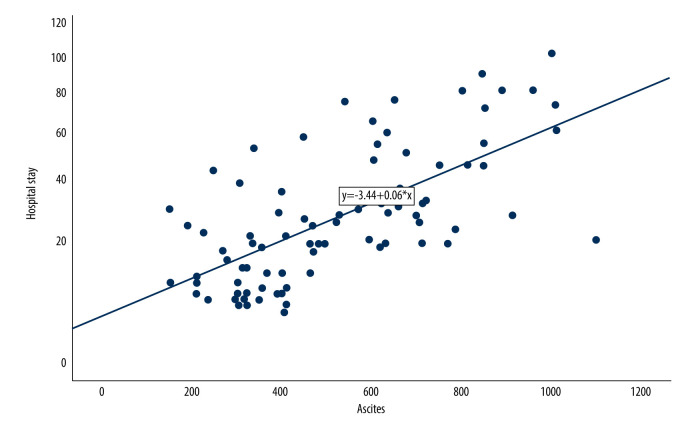
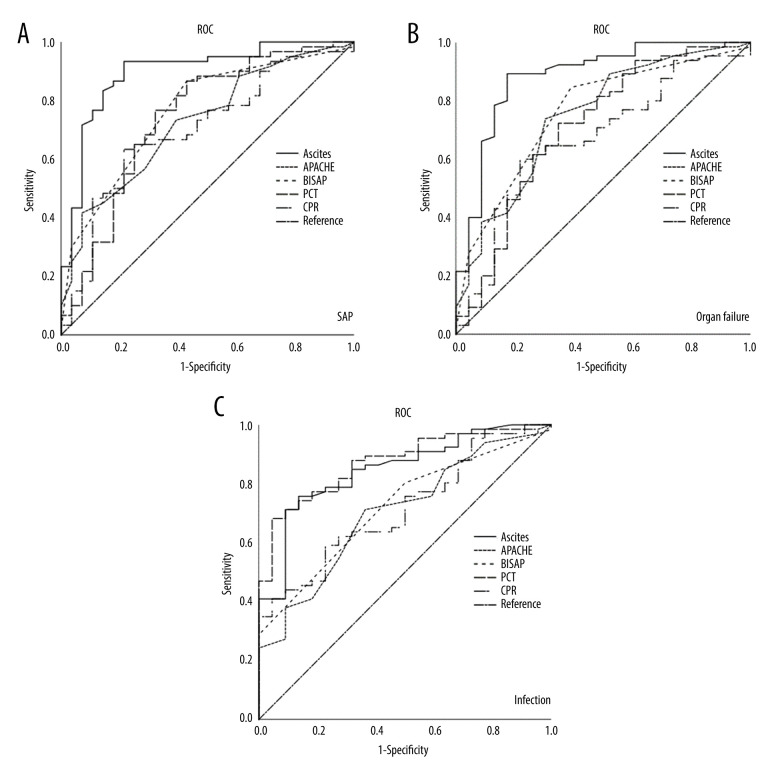
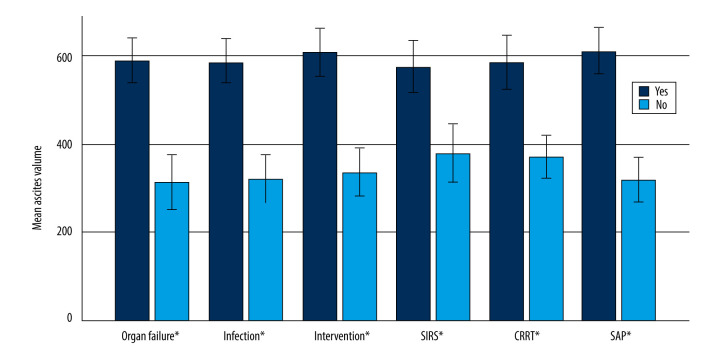
BACKGROUND Acute pancreatitis, a sudden inflammation of the pancreas, can result in severe complications. The presence and volume of ascites, an abnormal accumulation of fluid in the abdomen, has been linked to disease severity. Our study investigates ascites volume, quantified via abdominal CT scans, as a potential predictive tool for disease severity. MATERIAL AND METHODS In this retrospective analysis, patients diagnosed with acute pancreatitis were evaluated. Patients were categorized into groups with and without ascites, with comparisons made regarding clinical characteristics. We further compared the mean ascitic volume against various outcome parameters in patients with ascites. Ascites volume and other predictive systems were assessed through receiver operating characteristic (ROC) curves, with the area under the ROC curve (AUC) for different predictive systems being analyzed. RESULTS The ascites group had higher severity scores and related serological indexes (P<0.05 for all). Among patients with ascites, a significant correlation was observed between ascites volume and outcome parameters (P<0.05 for all). The area under the ROC curve for predicting severe acute pancreatitis was 0.896, with 93% sensitivity and 79% specificity. Ascites volume yielded the highest diagnostic odds ratio (53.1; 95% confidence interval: 13.2,199.6). CONCLUSIONS Early-stage acute pancreatitis patients with ascites are indicative of severe illness and poor prognosis. An increase in ascites volume correlates with adverse clinical outcomes, thus highlighting the significance of ascites volume as a prognostic marker. This underscores the importance of abdominal CT in measuring ascites volume to predict disease severity.
急性胰腺炎是胰腺的突然炎症,可导致严重并发症。腹水的存在和量与疾病严重程度有关,腹水是腹部异常积液。我们的研究通过腹部 CT 扫描来评估腹水体积,以将其作为疾病严重程度的潜在预测工具。
在这项回顾性分析中,评估了被诊断为急性胰腺炎的患者。将患者分为有腹水和无腹水组,并比较了两组的临床特征。我们进一步比较了有腹水患者的平均腹水体积与各种转归参数。通过接受者操作特征(ROC)曲线评估腹水体积和其他预测系统,分析不同预测系统的 ROC 曲线下面积(AUC)。
腹水组的严重程度评分和相关血清学指标较高(所有 P<0.05)。在有腹水的患者中,腹水体积与转归参数之间存在显著相关性(所有 P<0.05)。预测重症急性胰腺炎的 ROC 曲线下面积为 0.896,灵敏度为 93%,特异性为 79%。腹水体积的诊断优势比最高(53.1;95%置信区间:13.2,199.6)。
早期出现腹水的急性胰腺炎患者提示病情严重且预后不良。腹水体积的增加与不良临床结局相关,这突出了腹水体积作为预后标志物的重要性。这强调了腹部 CT 测量腹水体积以预测疾病严重程度的重要性。