Ekiti State Ministry of Health & Human Services, Ado-Ekiti, Nigeria.
Department of Community Medicine, Federal Teaching Hospital, Ido-Ekiti, Nigeria.
J Mother Child. 2023 Aug 7;27(1):42-51. doi: 10.34763/jmotherandchild.20232701.d-22-00067. eCollection 2023 Jun 1.
An increase in correct usage of modern contraception is vital in reducing the maternal mortality ratio and Under-5 mortality, leading towards the achievement of Sustainable Development Goal 3. Our study examined the trends and factors affecting non-utilization of modern contraceptives over a 10-year period in Ekiti State, Nigeria.
This study used data from three consecutive National Demographic Health Surveys (NDHS) - 2008, 2013, and 2018 - with a weighted sample size of 1,357 women of reproductive age (15-49 years). Data on contraceptive use on these women, provided by the NDHS, were extracted and analysed using IBM SPSS version 25. The sample was weighted to adjust for disproportionate sampling and non-response. Pearson's chi-square and binary logistic regression were used to assess the factors associated with non-utilization of modern contraceptives.
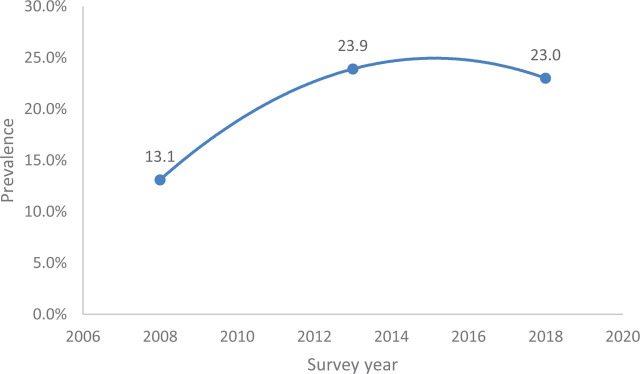
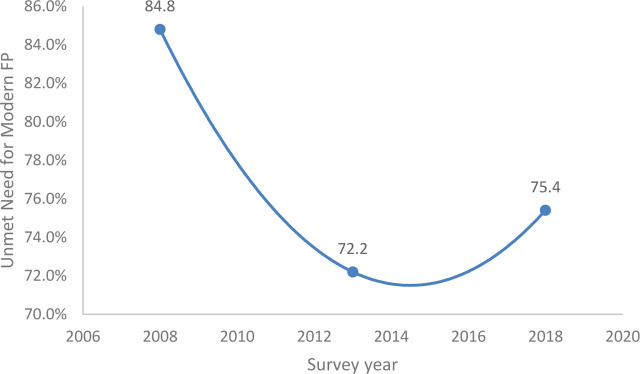
The mean age of the women was 30 years. Modern contraceptive use increased from 13.1% in 2008 to 23.0% in 2018, while unmet need for modern contraceptives decreased from 84.8% in 2008 to 75.4% in 2018. Identified predictors of non-utilization of modern contraceptive were age 20-24 years [aOR=0.33, 95%CI=0.19-0.59], 25-29 years [aOR=0.34, 95%CI=0.18-0.64], 30-34 years [aOR=0.46, 95%CI=0.22-0.94], 35-39 years [aOR=0.29, 95%CI=0.14-0.61] and 40-44 years [aOR=0.37, 95%CI=0.17-0.80] compared to age 15-19 years; living in urban areas [aOR=0.72, 95%CI=0.53-0.98] compared to in rural areas; higher level of education [aOR=0.46, 95%CI=0.21-0.98] compared to no education; and desire for more children [aOR=0.48, 95%CI=0.32-0.73] compared to not wanting more children.
Although contraceptive usage increased over time, the factors associated with non-utilization were being an adolescent, living in a rural area, lower level of education, and desire for more children.
提高现代避孕方法的正确使用率对于降低孕产妇死亡率和五岁以下儿童死亡率至关重要,这有助于实现可持续发展目标 3。我们的研究调查了在过去 10 年里,尼日利亚埃基提州现代避孕方法未使用率的趋势和影响因素。
本研究使用了连续三次全国人口健康调查(NDHS)-2008 年、2013 年和 2018 年的数据,样本量为 1357 名育龄妇女(15-49 岁),这些妇女的避孕使用数据由 NDHS 提供,使用 IBM SPSS 版本 25 进行提取和分析。对样本进行了加权处理,以调整不均衡抽样和无应答的影响。采用皮尔逊卡方检验和二元逻辑回归评估与现代避孕方法未使用率相关的因素。
妇女的平均年龄为 30 岁。现代避孕方法的使用率从 2008 年的 13.1%上升到 2018 年的 23.0%,而现代避孕方法的未满足需求从 2008 年的 84.8%下降到 2018 年的 75.4%。未使用现代避孕方法的预测因素包括年龄 20-24 岁(aOR=0.33,95%CI=0.19-0.59)、25-29 岁(aOR=0.34,95%CI=0.18-0.64)、30-34 岁(aOR=0.46,95%CI=0.22-0.94)、35-39 岁(aOR=0.29,95%CI=0.14-0.61)和 40-44 岁(aOR=0.37,95%CI=0.17-0.80)与 15-19 岁相比;居住在城市地区(aOR=0.72,95%CI=0.53-0.98)与农村地区相比;受教育程度较高(aOR=0.46,95%CI=0.21-0.98)与未受教育相比;以及希望生育更多子女(aOR=0.48,95%CI=0.32-0.73)与不希望生育更多子女相比。
尽管避孕方法的使用率随着时间的推移有所增加,但与未使用率相关的因素包括青少年、居住在农村地区、教育水平较低以及希望生育更多子女。