Translational and Clinical Research Institute, Faculty of Medical Sciences, Newcastle University, Newcastle upon Tyne, UK.
Janssen Research & Development, High Wycombe, UK.
J Parkinsons Dis. 2023;13(6):999-1009. doi: 10.3233/JPD-230044.
Real-world walking speed (RWS) measured using wearable devices has the potential to complement the Movement Disorder Society-Unified Parkinson's Disease Rating Scale (MDS-UPDRS III) for motor assessment in Parkinson's disease (PD).
Explore cross-sectional and longitudinal differences in RWS between PD and older adults (OAs), and whether RWS was related to motor disease severity cross-sectionally, and if MDS-UPDRS III was related to RWS, longitudinally.
88 PD and 111 OA participants from ICICLE-GAIT (UK) were included. RWS was evaluated using an accelerometer at four time points. RWS was aggregated within walking bout (WB) duration thresholds. Between-group-comparisons in RWS between PD and OAs were conducted cross-sectionally, and longitudinally with mixed effects models (MEMs). Cross-sectional association between RWS and MDS-UPDRS III was explored using linear regression, and longitudinal association explored with MEMs.
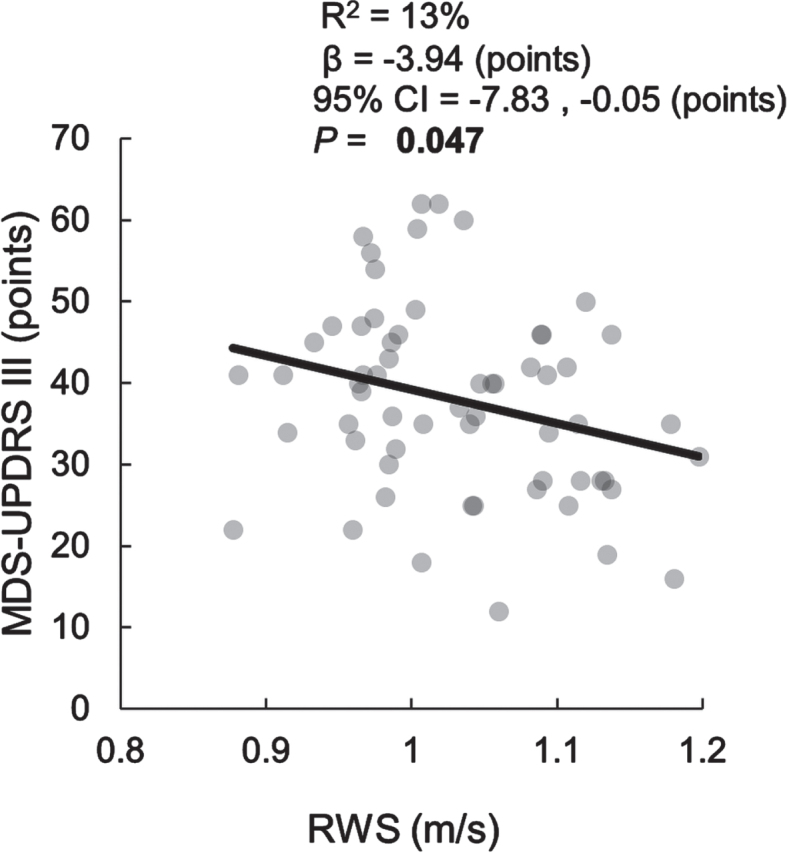
RWS was significantly lower in PD (1.04 m/s) in comparison to OAs (1.10 m/s) cross-sectionally. RWS significantly decreased over time for both cohorts and decline was more rapid in PD by 0.02 m/s per year. Significant negative relationship between RWS and the MDS-UPDRS III only existed at a specific WB threshold (30 to 60 s, β= - 3.94 points, p = 0.047). MDS-UPDRS III increased significantly by 1.84 points per year, which was not related to change in RWS.
Digital mobility assessment of gait may add unique information to quantify disease progression remotely, but further validation in research and clinical settings is needed.
使用可穿戴设备测量的实际行走速度(RWS)有可能补充运动障碍协会统一帕金森病评定量表(MDS-UPDRS III),用于评估帕金森病(PD)的运动功能。
探讨 PD 患者与老年人(OA)之间 RWS 的横断面和纵向差异,以及 RWS 是否与运动疾病严重程度存在横断面关系,以及 MDS-UPDRS III 是否与 RWS 存在纵向关系。
共纳入来自 ICICLE-GAIT(英国)的 88 名 PD 和 111 名 OA 参与者。使用加速度计在四个时间点评估 RWS。RWS 在行走阶段(WB)持续时间阈值内进行汇总。使用混合效应模型(MEMs)对 PD 和 OA 之间的 RWS 进行横断面和纵向比较。使用线性回归探索 RWS 与 MDS-UPDRS III 的横断面相关性,使用 MEMs 探索纵向相关性。
与 OA 相比,PD 患者的 RWS 在横断面显著降低(1.04m/s 比 1.10m/s)。两个队列的 RWS 随时间显著下降,PD 每年下降速度更快,为 0.02m/s。仅在特定的 WB 阈值(30 至 60 秒)下,RWS 与 MDS-UPDRS III 之间存在显著负相关关系(β=-3.94 分,p=0.047)。MDS-UPDRS III 每年增加 1.84 分,与 RWS 的变化无关。
步态数字化移动评估可能会提供独特的信息,以远程量化疾病进展,但需要在研究和临床环境中进一步验证。