Department of Clinical Gerontology, Robert-Bosch-Hospital, Stuttgart, Germany.
Translational and Clinical Research Institute, Faculty of Medical Sciences, Newcastle University, Newcastle upon Tyne, United Kingdom.
PLoS One. 2022 Oct 6;17(10):e0269615. doi: 10.1371/journal.pone.0269615. eCollection 2022.
The development of optimal strategies to treat impaired mobility related to ageing and chronic disease requires better ways to detect and measure it. Digital health technology, including body worn sensors, has the potential to directly and accurately capture real-world mobility. Mobilise-D consists of 34 partners from 13 countries who are working together to jointly develop and implement a digital mobility assessment solution to demonstrate that real-world digital mobility outcomes have the potential to provide a better, safer, and quicker way to assess, monitor, and predict the efficacy of new interventions on impaired mobility. The overarching objective of the study is to establish the clinical validity of digital outcomes in patient populations impacted by mobility challenges, and to support engagement with regulatory and health technology agencies towards acceptance of digital mobility assessment in regulatory and health technology assessment decisions.
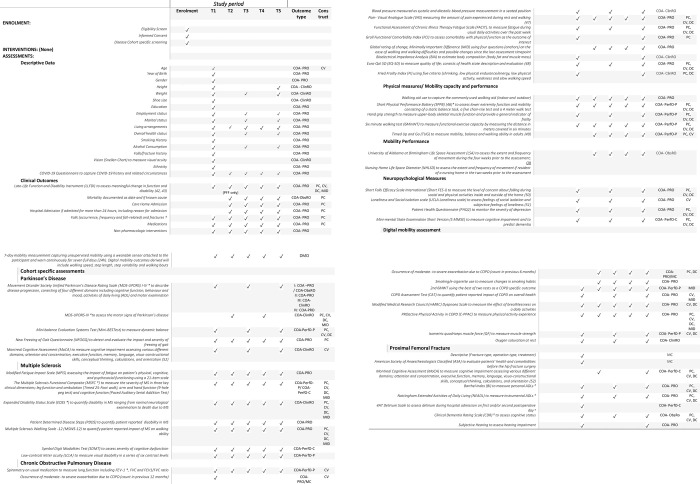
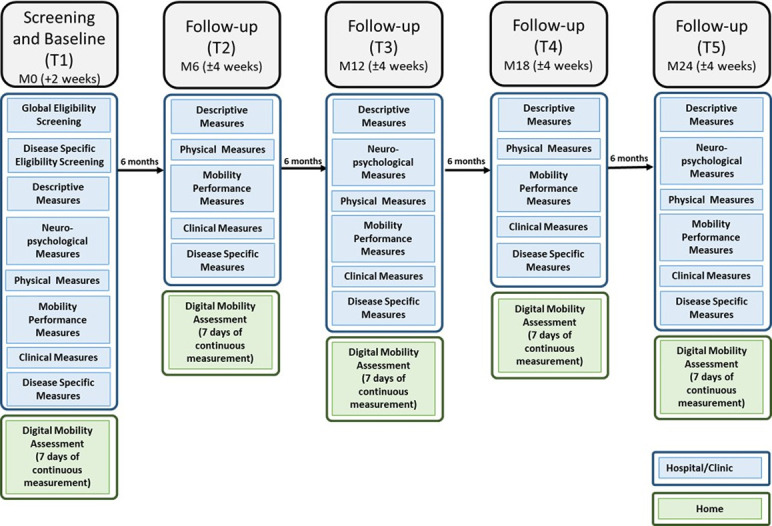
METHODS/DESIGN: The Mobilise-D clinical validation study is a longitudinal observational cohort study that will recruit 2400 participants from four clinical cohorts. The populations of the Innovative Medicine Initiative-Joint Undertaking represent neurodegenerative conditions (Parkinson's Disease), respiratory disease (Chronic Obstructive Pulmonary Disease), neuro-inflammatory disorder (Multiple Sclerosis), fall-related injuries, osteoporosis, sarcopenia, and frailty (Proximal Femoral Fracture). In total, 17 clinical sites in ten countries will recruit participants who will be evaluated every six months over a period of two years. A wide range of core and cohort specific outcome measures will be collected, spanning patient-reported, observer-reported, and clinician-reported outcomes as well as performance-based outcomes (physical measures and cognitive/mental measures). Daily-living mobility and physical capacity will be assessed directly using a wearable device. These four clinical cohorts were chosen to obtain generalizable clinical findings, including diverse clinical, cultural, geographical, and age representation. The disease cohorts include a broad and heterogeneous range of subject characteristics with varying chronic care needs, and represent different trajectories of mobility disability.
The results of Mobilise-D will provide longitudinal data on the use of digital mobility outcomes to identify, stratify, and monitor disability. This will support the development of widespread, cost-effective access to optimal clinical mobility management through personalised healthcare. Further, Mobilise-D will provide evidence-based, direct measures which can be endorsed by regulatory agencies and health technology assessment bodies to quantify the impact of disease-modifying interventions on mobility.
ISRCTN12051706.
为了制定针对与衰老和慢性病相关的行动不便的最佳治疗策略,我们需要更好的方法来发现和测量这些问题。数字健康技术,包括可穿戴式传感器,具有直接、准确地捕捉真实世界中行动能力的潜力。Mobilise-D 由来自 13 个国家的 34 个合作伙伴组成,他们共同开发和实施一种数字移动评估解决方案,以证明真实世界中的数字移动结果有可能提供一种更好、更安全、更快的方法来评估、监测和预测新干预措施对行动不便的疗效。该研究的总体目标是在受移动挑战影响的患者人群中确定数字结果的临床有效性,并支持与监管和健康技术机构合作,以接受数字移动评估在监管和健康技术评估决策中的应用。
方法/设计:Mobilise-D 临床验证研究是一项纵向观察队列研究,将从四个临床队列中招募 2400 名参与者。创新药物倡议联合企业代表的人群包括神经退行性疾病(帕金森病)、呼吸疾病(慢性阻塞性肺疾病)、神经炎症性疾病(多发性硬化症)、跌倒相关损伤、骨质疏松症、肌肉减少症和虚弱(股骨近端骨折)。共有来自十个国家的 17 个临床站点将招募参与者,他们将在两年的时间内每六个月接受一次评估。将收集广泛的核心和队列特定的结果测量,包括患者报告、观察者报告和临床医生报告的结果以及基于表现的结果(身体测量和认知/心理测量)。日常移动能力和身体能力将直接使用可穿戴设备进行评估。选择这四个临床队列是为了获得具有普遍性的临床发现,包括不同的临床、文化、地理和年龄代表性。这些疾病队列包括具有不同慢性护理需求的广泛和异质的患者特征,代表了不同的移动障碍轨迹。
Mobilise-D 的结果将提供关于使用数字移动结果来识别、分层和监测残疾的纵向数据。这将支持通过个性化医疗实现广泛、具有成本效益的最佳临床移动管理。此外,Mobilise-D 将提供基于证据的、直接的措施,这些措施可以得到监管机构和健康技术评估机构的认可,以量化疾病修饰干预对移动能力的影响。
ISRCTN85251167。