Andrade Jason G
University of British Columbia Vancouver, Canada.
Centre for Cardiovascular Innovation Vancouver, Canada.
Eur Cardiol. 2023 Jul 27;18:e46. doi: 10.15420/ecr.2023.04. eCollection 2023.
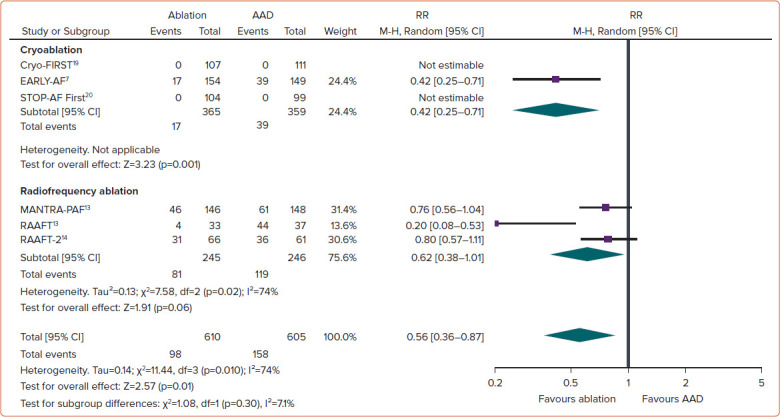
AF is a chronic and progressive heart rhythm disorder characterised by exacerbations and remissions. Contemporary guidelines recommend antiarrhythmic drugs (AADs) as the initial therapy for the maintenance of sinus rhythm. However, these medications have modest efficacy and are associated with significant adverse effects. Several recent trials have evaluated catheter ablation as an initial therapy for AF, demonstrating that cryoballoon catheter ablation significantly improves arrhythmia outcomes (e.g. atrial tachyarrhythmia recurrence and arrhythmia burden), produces clinically meaningful improvements in patient-reported outcomes (e.g. symptoms and quality of life), and significantly decreases healthcare resource usage (e.g. hospitalisation), without increasing the risk of serious adverse events. Moreover, in contrast to antiarrhythmic drugs, catheter ablation appears to be disease-modifying, significantly reducing the progression of disease. These findings are relevant to patients, providers, and healthcare systems, helping inform the initial choice of rhythm-control therapy in patients with treatment-naïve AF.
房颤是一种慢性进行性心律失常疾病,其特点是病情有加重和缓解。当代指南推荐抗心律失常药物(AADs)作为维持窦性心律的初始治疗方法。然而,这些药物疗效一般,且伴有显著的不良反应。最近的几项试验评估了导管消融作为房颤的初始治疗方法,结果表明冷冻球囊导管消融显著改善心律失常结局(如房性快速性心律失常复发和心律失常负荷),在患者报告的结局(如症状和生活质量)方面产生具有临床意义的改善,并显著减少医疗资源使用(如住院),且不会增加严重不良事件的风险。此外,与抗心律失常药物不同,导管消融似乎具有疾病改善作用,能显著减缓疾病进展。这些发现与患者、医疗服务提供者和医疗系统相关,有助于为初治房颤患者的节律控制治疗初始选择提供参考。