Stoner David C, McDonald Zara, Coon Courtney A C
Department of Wildland Resources Utah State University Logan Utah USA.
Felidae Conservation Fund Mill Valley California USA.
Ecol Evol. 2023 Aug 4;13(8):e10381. doi: 10.1002/ece3.10381. eCollection 2023 Aug.
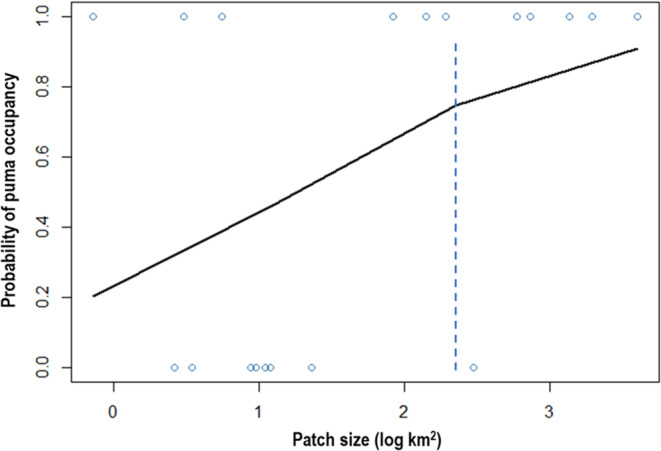
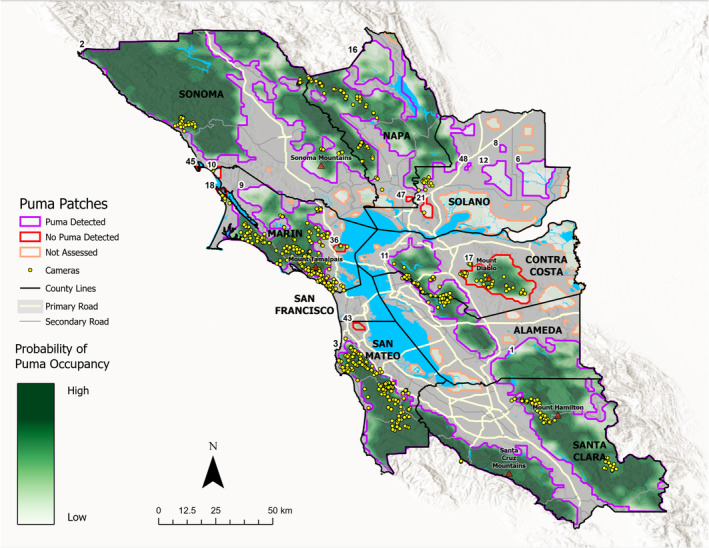
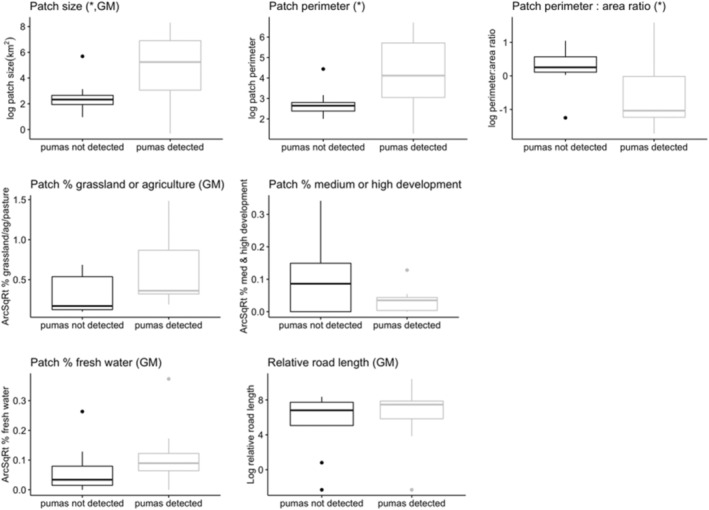
Habitat loss and fragmentation are the leading causes of species range contraction and extirpation, worldwide. Factors that predict sensitivity to fragmentation include high trophic level, large body size, and extensive spatial requirements. Pumas () exemplify these qualities, making them particularly susceptible to fragmentation and subsequent reductions in demographic connectivity. The chaparral-dominated ecosystems surrounding the greater San Francisco Bay Area encompass over 10,000 km of suitable puma habitat, but inland waterways, croplands, urban land uses, and extensive transportation infrastructure have resulted in widespread habitat fragmentation. Pumas in this region now exist as a metapopulation marked by loss of genetic diversity, collisions with vehicles, and extensive human-puma conflict. Given these trends, we conducted a photo survey from 2017 to 2021 across 19 patches of predicted habitat and compiled a dataset of >6584 puma images. We used a logistic regression analytical framework to evaluate the hypothesis that puma patch occupancy would exhibit a threshold response explained by patch size, isolation, and habitat quality. Contrary to predictions, only variables related to patch size demonstrated any power to explain occupancy. On average, occupied patches were 18× larger than those where they were not detected (825 ± 1238 vs. 46 ± 101 km). Although we observed pumas in patches as small as 1 km, logistic regression models indicated a threshold occupancy probability between 300 and 400 km, which is remarkably close to the mean male puma home range size in coastal California (~381 km). Puma populations dependent on habitats below this value may be susceptible to inbreeding depression and human-wildlife conflict, and therefore vulnerable to extirpation. For species conservation, we suggest conflicts might be ameliorated by identifying the largest, isolated patches for public education campaigns with respect to management of domestic animals, and remaining connective parcels be identified, mapped, and prioritized for targeted mitigation.
栖息地丧失和破碎化是全球物种分布范围收缩和灭绝的主要原因。预测对破碎化敏感的因素包括高营养级、大体型和广泛的空间需求。美洲狮()体现了这些特征,使其特别容易受到破碎化以及随后种群连通性下降的影响。旧金山湾区周边以丛林为主的生态系统包含超过10000公里适合美洲狮栖息的栖息地,但内陆水道、农田、城市土地利用以及广泛的交通基础设施导致了栖息地的广泛破碎化。该地区的美洲狮现在以一个集合种群的形式存在,其特征是遗传多样性丧失、与车辆碰撞以及广泛的人类与美洲狮冲突。鉴于这些趋势,我们在2017年至2021年期间对19个预测栖息地斑块进行了照片调查,并编制了一个包含超过6584张美洲狮图像的数据集。我们使用逻辑回归分析框架来评估一个假设,即美洲狮斑块占有率会呈现出一种由斑块大小、隔离度和栖息地质量所解释的阈值响应。与预测相反,只有与斑块大小相关的变量显示出有任何解释占有率的能力。平均而言,被占据的斑块比未被发现美洲狮的斑块大18倍(825±1238平方公里对46±101平方公里)。尽管我们在小至1平方公里的斑块中观察到了美洲狮,但逻辑回归模型表明,占有率阈值概率在300至400平方公里之间,这与加利福尼亚沿海地区雄性美洲狮的平均家域大小(约381平方公里)非常接近。依赖于低于这个值的栖息地的美洲狮种群可能容易受到近亲繁殖衰退和人类与野生动物冲突的影响,因此容易灭绝。为了物种保护,我们建议通过识别最大的、孤立的斑块用于关于家畜管理的公众教育活动来缓解冲突,并识别、绘制其余的连接地块并对其进行优先排序以进行有针对性的缓解。