Malathi Anitha, Iyer Ramesh P, Mohan Reji, Balakrishnan Sheila
Department of Reproductive Medicine, Medical College, Thiruvananthapuram, Kerala, India.
J Hum Reprod Sci. 2023 Apr-Jun;16(2):114-120. doi: 10.4103/jhrs.jhrs_20_23. Epub 2023 Jun 30.
Seasonal variations in semen parameters have been detected in many previous studies, mostly conducted in the West and Mediterranean countries. Located in a tropical region, we have only three seasons - summer, winter and rainy season. Literature search did not reveal studies from Indian subcontinent.
Our objective was to find if our climate produced seasonal variations in semen parameters such as sperm concentration (SC), total motile SC, morphology and vitality, which may have implications in fertility management.
This is a descriptive study, conducted at a tertiary level hospital. Semen analysis reports of male partners of all infertile couples during the 4-year period from 2019 to 2022 were analysed.
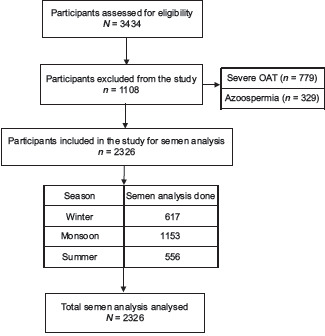
The data were collected from records of all infertile couples registered for the treatment in the department during the study period. Semen analysis reports of male partners of all infertile couples attending outpatient department of the Reproductive Medicine Department during the 4-year period from January 2019 to December 2022 were collected. The data of azoospermic and severe oligospermic (<5 million/mL) men and those receiving hormone treatment were excluded.
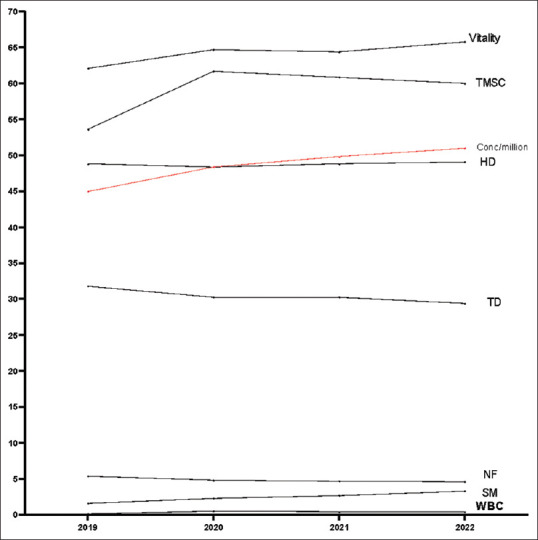
Data were analysed using SPSS 23 and variables expressed as mean and standard deviation. Changes in mean values over years and over seasons were evaluated using -test. analysis was done using Sidak method. < 5% was considered statistically significant.
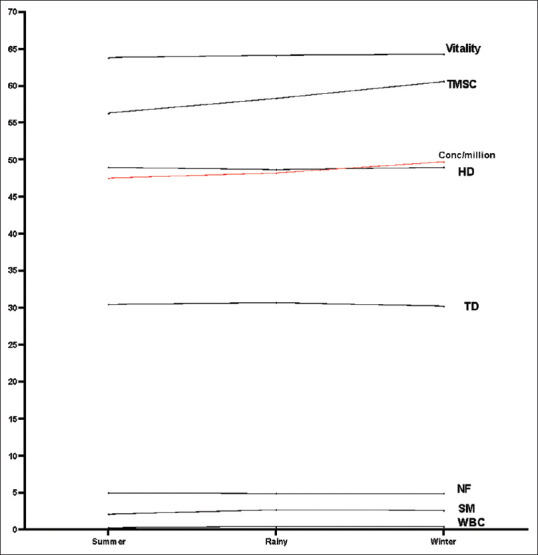
The data of 2326 patients were analysed. SC was lowest during summer but was not statistically significant. Sluggishly motile sperm per cent was maximum in rainy season ( = 0.002). analysis showed significant variations in summer samples compared to both rainy and winter seasons. Head defect (HD) and tail defects showed a significant seasonal variation ( = 0.011 and = 0.024, respectively), lowest HD seen in rainy season.
Semen parameters showed seasonal variations, with favourable features in colder climates, and may need to be considered in infertility management, especially if the male is oligospermic.
此前许多研究已检测到精液参数存在季节性变化,这些研究大多在西方和地中海国家开展。由于地处热带地区,我们只有三个季节——夏季、冬季和雨季。文献检索未发现来自印度次大陆的相关研究。
我们的目标是探究我们所处的气候是否会导致精液参数出现季节性变化,如精子浓度(SC)、总活动精子浓度、形态和活力,而这些变化可能会对生育管理产生影响。
这是一项在三级医院进行的描述性研究。对2019年至2022年这4年间所有不孕夫妇男性伴侣的精液分析报告进行了分析。
数据收集自研究期间在该科室登记接受治疗的所有不孕夫妇的记录。收集了2019年1月至2022年12月这4年间生殖医学科门诊所有不孕夫妇男性伴侣的精液分析报告。无精子症和严重少精子症(<500万/毫升)男性以及接受激素治疗者的数据被排除。
使用SPSS 23对数据进行分析,变量以均值和标准差表示。使用t检验评估多年间和各季节均值的变化。采用Sidak法进行多重比较。P<5%被认为具有统计学意义。
对2326例患者的数据进行了分析。夏季精子浓度最低,但无统计学意义。雨季时精子活动迟缓百分比最高(P=0.002)。多重比较分析显示,与雨季和冬季样本相比,夏季样本存在显著差异。头部缺陷(HD)和尾部缺陷呈现显著的季节性变化(分别为P=0.011和P=0.024),雨季时HD最低。
精液参数呈现季节性变化,在较寒冷气候下具有有利特征,在不孕治疗管理中可能需要予以考虑,尤其是男性为少精子症患者时。