Kim Yong Soo, Jeong Han-Gil, Hwang In-Chang, Kim Beom Joon, Kwon Joon-Myung, Bae Hee-Joon, Han Moon-Ku
Department of Neurology, Seoul National University Bundang Hospital, Seoul National University College of Medicine, Seongnam, Republic of Korea.
Department of Neurology, Nowon Eulji Medical Center, Eulji University School of Medicine, Seoul, Republic of Korea.
Front Cardiovasc Med. 2023 Jul 18;10:1135069. doi: 10.3389/fcvm.2023.1135069. eCollection 2023.
Tricuspid regurgitation (TR) is a common but overlooked valvular disease, and its association with the etiologic subtypes of ischemic stroke is unclear. We explored the relationship between TR and atrial fibrillation (AF) in patients with acute ischemic stroke.
This retrospective analysis of ongoing stroke registry assessed 6,886 consecutive acute ischemic stroke patients who underwent transthoracic echocardiography during their in-hospital care. Multivariable logistic regression models adjusted for age, sex, stroke characteristics, and echocardiographic indices were used to investigate the association between TR and total AF, and newly diagnosed AF during hospitalization and a 1-year follow-up period, respectively.
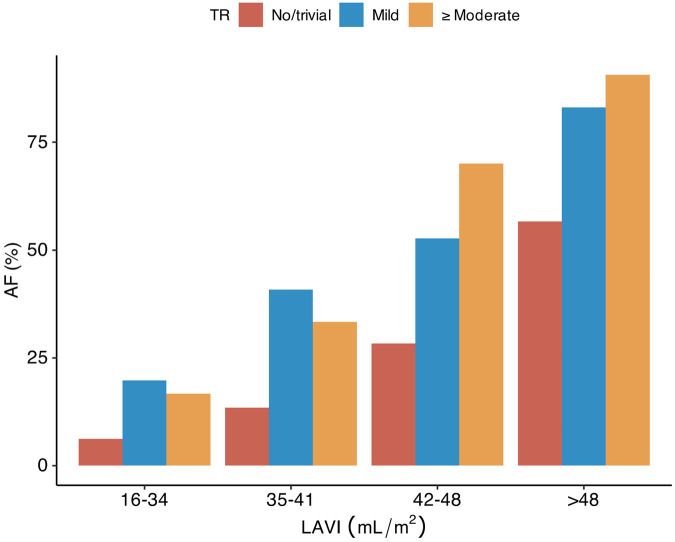
TR was present in 877 (12.7%) patients (mild, 9.9%; moderate, 2.4%; severe, 0.5%). AF was identified in 24.1% (medical history, 11.1%; first detected in the emergency room, 6.6%; newly diagnosed after admission, 6.4%). TR was associated with AF [adjusted odds ratio (aOR) 4.87 (95% confidence interval (CI), 2.63-9.03)], compared with no/trivial TR. The association between TR and AF was consistent regardless of severity (aOR [95% CI], 4.57 [2.63-7.94] for mild and 7.05 [2.57-19.31] for moderate-to-severe TR) or subtype of TR (5.44 [2.91-10.14] for isolated and 3.81 [2.00-7.28] for non-isolated TR). Among the AF-naïve patients at admission, TR was associated with newly diagnosed AF during hospitalization and a 1-year follow-up period (aOR [95% CI], 2.68 [1.81-3.97]).
TR is associated with AF in acute ischemic stroke patients regardless of severity and subtypes of TR. TR is also associated with newly diagnosed AF after stroke.
三尖瓣反流(TR)是一种常见但易被忽视的瓣膜疾病,其与缺血性卒中病因亚型的关系尚不清楚。我们探讨了急性缺血性卒中患者中TR与心房颤动(AF)之间的关系。
这项对正在进行的卒中登记研究的回顾性分析评估了6886例在住院期间接受经胸超声心动图检查的连续急性缺血性卒中患者。采用多变量逻辑回归模型,对年龄、性别、卒中特征和超声心动图指标进行调整,分别研究TR与总体AF、住院期间新诊断的AF以及1年随访期内新诊断的AF之间的关联。
877例(12.7%)患者存在TR(轻度,9.9%;中度,2.4%;重度,0.5%)。AF的检出率为24.1%(有病史,11.1%;在急诊室首次检测到,6.6%;入院后新诊断,6.4%)。与无/轻度TR相比,TR与AF相关[调整后的优势比(aOR)为4.87(95%置信区间(CI),2.63 - 9.03)]。无论严重程度(轻度TR的aOR [95% CI]为4.57 [2.63 - 7.94],中重度TR为7.05 [2.57 - 19.31])或TR亚型(孤立性TR为5.44 [2.91 - 10.14],非孤立性TR为3.81 [2.00 - 7.28])如何,TR与AF之间的关联均一致。在入院时无AF的患者中,TR与住院期间及1年随访期内新诊断的AF相关(aOR [95% CI],2.68 [1.81 - 3.97])。
在急性缺血性卒中患者中,无论TR的严重程度和亚型如何,TR均与AF相关。TR还与卒中后新诊断的AF相关。