Chu Wei-Min, Tsan Yu-Tse, Chen Pei-Yu, Chen Chia-Yu, Hao Man-Ling, Chan Wei-Chan, Chen Hong-Ming, Hsu Pi-Shan, Lin Shih-Yi, Yang Chao-Tung
Department of Family Medicine, Taichung Veterans General Hospital, Taichung, Taiwan.
Education and Innovation Center for Geriatrics and Gerontology, National Center for Geriatrics and Gerontology, Ōbu, Japan.
Front Med (Lausanne). 2023 Jul 21;10:1160013. doi: 10.3389/fmed.2023.1160013. eCollection 2023.
Predicting physical function upon discharge among hospitalized older adults is important. This study has aimed to develop a prediction model of physical function upon discharge through use of a machine learning algorithm using electronic health records (EHRs) and comprehensive geriatrics assessments (CGAs) among hospitalized older adults in Taiwan.
Data was retrieved from the clinical database of a tertiary medical center in central Taiwan. Older adults admitted to the acute geriatric unit during the period from January 2012 to December 2018 were included for analysis, while those with missing data were excluded. From data of the EHRs and CGAs, a total of 52 clinical features were input for model building. We used 3 different machine learning algorithms, XGBoost, random forest and logistic regression.
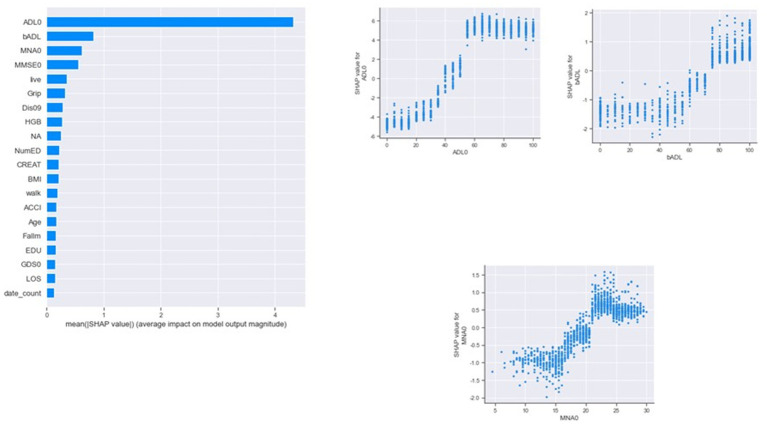
In total, 1,755 older adults were included in final analysis, with a mean age of 80.68 years. For linear models on physical function upon discharge, the accuracy of prediction was 87% for XGBoost, 85% for random forest, and 32% for logistic regression. For classification models on physical function upon discharge, the accuracy for random forest, logistic regression and XGBoost were 94, 92 and 92%, respectively. The auROC reached 98% for XGBoost and random forest, while logistic regression had an auROC of 97%. The top 3 features of importance were activity of daily living (ADL) at baseline, ADL during admission, and mini nutritional status (MNA) during admission.
The results showed that physical function upon discharge among hospitalized older adults can be predicted accurately during admission through use of a machine learning model with data taken from EHRs and CGAs.
预测住院老年人出院时的身体功能很重要。本研究旨在通过使用机器学习算法,利用台湾住院老年人的电子健康记录(EHR)和综合老年评估(CGA),开发出院时身体功能的预测模型。
数据取自台湾中部一家三级医疗中心的临床数据库。纳入2012年1月至2018年12月期间入住急性老年病房的老年人进行分析,排除数据缺失者。从EHR和CGA的数据中,共输入52个临床特征用于模型构建。我们使用了3种不同的机器学习算法,即XGBoost、随机森林和逻辑回归。
最终分析共纳入1755名老年人,平均年龄80.68岁。对于出院时身体功能的线性模型,XGBoost的预测准确率为87%,随机森林为85%,逻辑回归为32%。对于出院时身体功能的分类模型,随机森林、逻辑回归和XGBoost的准确率分别为94%、92%和92%。XGBoost和随机森林的曲线下面积(auROC)达到98%,而逻辑回归的auROC为97%。最重要的前3个特征是基线日常生活活动能力(ADL)、入院期间的ADL和入院期间的微型营养评定(MNA)。
结果表明,通过使用基于EHR和CGA数据的机器学习模型,可以在住院期间准确预测住院老年人出院时的身体功能。