Department of Neurology, University Medicine Greifswald, Greifswald, Germany.
Centre for Mathematical Cognition, School of Science, Loughborough University, Loughborough, UK.
Geroscience. 2024 Feb;46(1):1319-1330. doi: 10.1007/s11357-023-00886-3. Epub 2023 Aug 7.
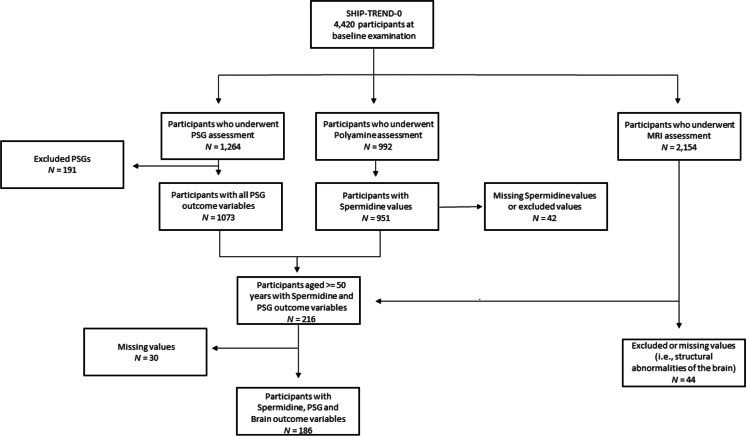
Deteriorations in slow wave sleep (SWS) have been linked to brain aging and Alzheimer's disease (AD), possibly due to its key role in clearance of amyloid-beta and tau (Aß/tau), two pathogenic hallmarks of AD. Spermidine administration has been shown to improve sleep quality in animal models. So far, the association between spermidine levels in humans and parameters of SWS physiology are unknown but may be valuable for therapeutic strategies. Data from 216 participants (age range 50-81 years) of the population-based Study of Health in Pomerania TREND were included in our analysis. We investigated associations between spermidine plasma levels, key parameters of sleep macroarchitecture and microarchitecture that were previously associated with AD pathology, and brain health measured via a marker of structural brain atrophy (AD score). Higher spermidine levels were significantly associated with lower coupling between slow oscillations and spindle activity. No association was evident for SWS, slow oscillatory, and spindle activity throughout non-rapid eye movement sleep. Furthermore, elevated spermidine blood levels were significantly associated with a higher AD score, while sleep markers revealed no association with AD score. The association between higher spermidine levels and brain health was not mediated by coupling between slow oscillations and spindle activity. We report that higher spermidine blood levels are associated not only with deteriorated brain health but also with less advantageous markers of sleep quality in older adults. Future studies need to evaluate whether sleep, spermidine, and Aß/tau deposition are interrelated and whether sleep may play a mediating role.
慢波睡眠(SWS)的恶化与大脑衰老和阿尔茨海默病(AD)有关,这可能是由于其在清除淀粉样蛋白-β和 tau(Aß/tau)中的关键作用,Aß/tau 是 AD 的两个发病特征。精脒的给药已被证明可以改善动物模型的睡眠质量。到目前为止,人类精脒水平与 SWS 生理学参数之间的关联尚不清楚,但可能对治疗策略有价值。我们的分析纳入了基于人群的波美拉尼亚健康研究 TREND 中 216 名参与者(年龄范围 50-81 岁)的数据。我们调查了精脒血浆水平与睡眠宏观结构和微观结构的关键参数之间的关联,这些参数先前与 AD 病理学有关,以及通过结构性脑萎缩标志物(AD 评分)测量的大脑健康。较高的精脒水平与慢波和纺锤波活动之间的耦合降低显著相关。在非快速眼动睡眠期间,SWS、慢振荡和纺锤波活动没有相关性。此外,精脒血液水平升高与 AD 评分显著相关,而睡眠标志物与 AD 评分无相关性。较高的精脒水平与大脑健康之间的关联不受慢波和纺锤波活动之间耦合的影响。我们报告称,较高的精脒血液水平不仅与大脑健康恶化有关,而且与老年人睡眠质量的不利标志物有关。未来的研究需要评估睡眠、精脒和 Aß/tau 沉积是否相互关联,以及睡眠是否可能发挥中介作用。