Division of Medical Sciences, University of Victoria, Victoria, British Columbia V8P 5C2, Canada
Division of Medical Sciences, University of Victoria, Victoria, British Columbia V8P 5C2, Canada.
eNeuro. 2023 Aug 11;10(8). doi: 10.1523/ENEURO.0106-23.2023. Print 2023 Aug.
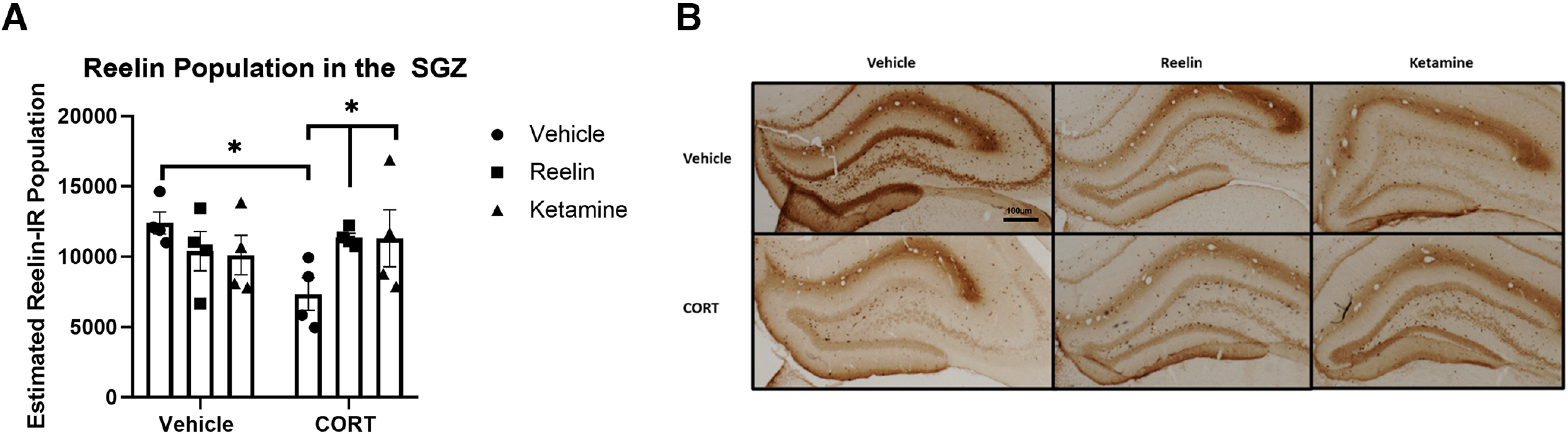
Over the past decade, ketamine, an NMDA receptor antagonist, has demonstrated fast-acting antidepressant effects previously unseen with monoaminergic-based therapeutics. Concerns regarding psychotomimetic effects limit the use of ketamine for certain patient populations. Reelin, an extracellular matrix glycoprotein, has shown promise as a putative fast-acting antidepressant in a model of chronic stress. However, research has not yet demonstrated the changes that occur rapidly after peripheral reelin administration. To address this key gap in knowledge, male Long-Evans rats underwent a chronic corticosterone (CORT; or vehicle) paradigm (40 mg/kg, 21 d). On day 21, rats were then administered an acute dose of ketamine (10 mg/kg, i.p.), reelin (3 µg, i.v.), or vehicle. Twenty-four hours after administration, rats underwent behavioral or electrophysiological testing before killing. Immunohistochemistry was used to confirm changes in hippocampal reelin immunoreactivity. Lastly, the hippocampus was microdissected from fresh tissue to ascertain whole cell and synaptic-specific changes in protein expression through Western blotting. Chronic corticosterone induced a chronic stress phenotype in the forced swim test and sucrose preference test (SPT). Both reelin and ketamine rescued immobility and swimming, however reelin alone rescued latency to immobility. electrophysiology revealed decreases in hippocampal long-term potentiation (LTP) after chronic stress which was increased significantly by both ketamine and reelin. Reelin immunoreactivity in the dentate gyrus paralleled the behavioral and electrophysiological findings, but no significant changes were observed in synaptic-level protein expression. This exploratory research supports the putative rapid-acting antidepressant effects of an acute dose of reelin across behavioral, electrophysiological, and molecular measures.
在过去的十年中,NMDA 受体拮抗剂氯胺酮已显示出快速抗抑郁作用,这是单胺能治疗药物以前未见的。由于精神拟态作用的担忧,限制了氯胺酮在某些患者群体中的使用。 Reelin 是一种细胞外基质糖蛋白,作为一种潜在的快速抗抑郁药,在慢性应激模型中显示出前景。然而,研究尚未证明外周给予 Reelin 后迅速发生的变化。为了解决这一知识空白,雄性长耳大仓鼠接受了慢性皮质酮(CORT;或载体)方案(40mg/kg,21d)。在第 21 天,大鼠随后接受了氯胺酮(10mg/kg,ip), Reelin(3μg,iv)或载体的急性剂量。给药后 24 小时,大鼠进行行为或电生理测试,然后处死。免疫组织化学用于确认海马 Reelin 免疫反应性的变化。最后,将海马从新鲜组织中微分离出来,通过 Western 印迹法确定全细胞和突触特异性蛋白表达的变化。慢性皮质酮在强迫游泳试验和蔗糖偏好试验(SPT)中诱导出慢性应激表型。 Reelin 和氯胺酮均挽救了不动和游泳,但只有 Reelin 单独挽救了不动的潜伏期。电生理学显示慢性应激后海马长时程增强(LTP)减少,而氯胺酮和 Reelin 均显著增加了 LTP。齿状回的 Reelin 免疫反应性与行为和电生理发现平行,但突触水平的蛋白表达没有观察到显著变化。这项探索性研究支持急性剂量 Reelin 在行为、电生理和分子测量方面具有快速抗抑郁作用的假设。