BillionToOne, Inc., 1035 O'Brien Drive, Menlo Park, CA, 94025, USA.
Division of Maternal-Fetal Medicine, Brigham and Women's Hospital and Harvard Medical School, Boston, MA, USA.
Sci Rep. 2023 Aug 7;13(1):12786. doi: 10.1038/s41598-023-39283-3.
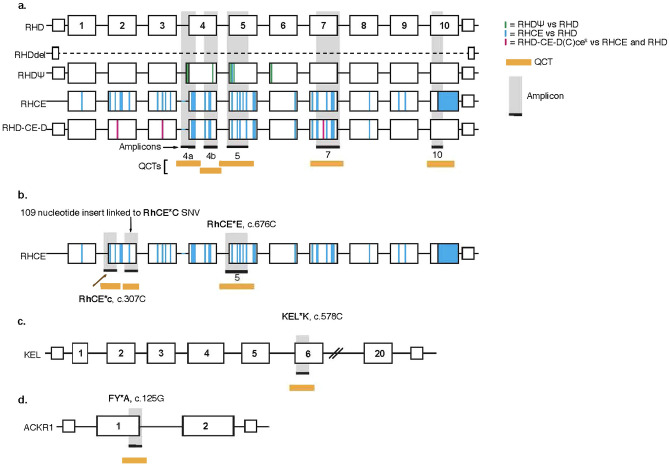
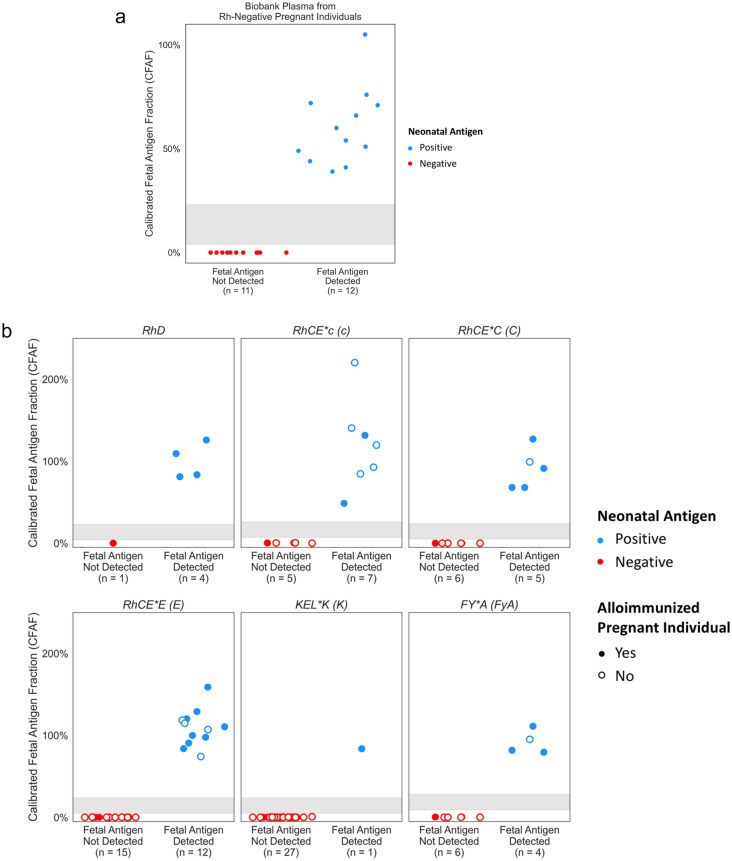
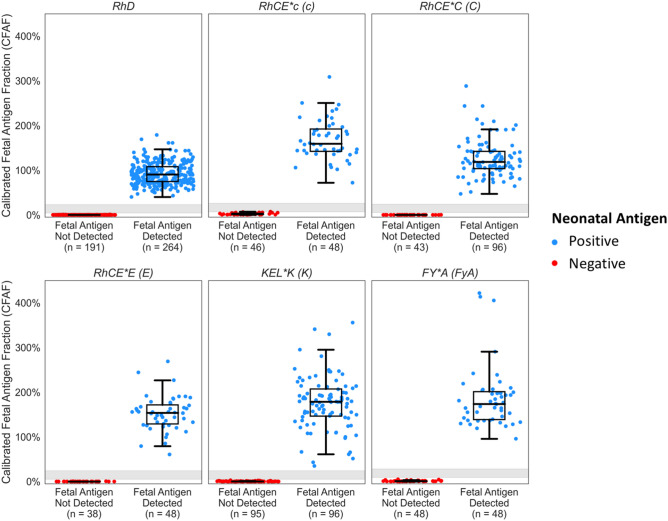
We developed and validated a next generation sequencing-(NGS) based NIPT assay using quantitative counting template (QCT) technology to detect RhD, C, c, E, K (Kell), and Fy (Duffy) fetal antigen genotypes from maternal blood samples in the ethnically diverse U.S. population. Quantitative counting template (QCT) technology is utilized to enable quantification and detection of paternally derived fetal antigen alleles in cell-free DNA with high sensitivity and specificity. In an analytical validation, fetal antigen status was determined for 1061 preclinical samples with a sensitivity of 100% (95% CI 99-100%) and specificity of 100% (95% CI 99-100%). Independent analysis of two duplicate plasma samples was conducted for 1683 clinical samples, demonstrating precision of 99.9%. Importantly, in clinical practice the no-results rate was 0% for 711 RhD-negative non-alloimmunized pregnant people and 0.1% for 769 alloimmunized pregnancies. In a clinical validation, NIPT results were 100% concordant with corresponding neonatal antigen genotype/serology for 23 RhD-negative pregnant individuals and 93 antigen evaluations in 30 alloimmunized pregnancies. Overall, this NGS-based fetal antigen NIPT assay had high performance that was comparable to invasive diagnostic assays in a validation study of a diverse U.S. population as early as 10 weeks of gestation, without the need for a sample from the biological partner. These results suggest that NGS-based fetal antigen NIPT may identify more fetuses at risk for hemolytic disease than current clinical practice, which relies on paternal genotyping and invasive diagnostics and therefore is limited by adherence rates and incorrect results due to non-paternity. Clinical adoption of NIPT for the detection of fetal antigens for both alloimmunized and RhD-negative non-alloimmunized pregnant individuals may streamline care and reduce unnecessary treatment, monitoring, and patient anxiety.
我们开发并验证了一种基于下一代测序(NGS)的 NIPT 检测方法,该方法使用定量计数模板(QCT)技术,从美国不同种族的孕妇血液样本中检测 RhD、C、c、E、K(Kell)和 Fy(Duffy)胎儿抗原基因型。定量计数模板(QCT)技术用于实现高灵敏度和特异性地定量和检测游离 DNA 中父源胎儿抗原等位基因。在分析验证中,对 1061 个临床前样本进行了胎儿抗原状态检测,其敏感性为 100%(95%CI99-100%),特异性为 100%(95%CI99-100%)。对 1683 个临床样本进行了两个重复血浆样本的独立分析,表明精密度为 99.9%。重要的是,在临床实践中,711 例 RhD 阴性非同种免疫孕妇的无结果率为 0%,769 例同种免疫孕妇的无结果率为 0.1%。在临床验证中,23 例 RhD 阴性孕妇和 30 例同种免疫孕妇的 93 例抗原评估中,NIPT 结果与相应的新生儿抗原基因型/血清学结果 100%一致。总的来说,在一项针对美国不同人群的验证研究中,该基于 NGS 的胎儿抗原 NIPT 检测方法具有较高的性能,与侵入性诊断检测方法相当,早在 10 周妊娠时即可进行,而无需来自生物学伴侣的样本。这些结果表明,基于 NGS 的胎儿抗原 NIPT 可能比目前依赖于父系基因分型和侵入性诊断的临床实践更能识别患有溶血性疾病风险的胎儿,因此,由于依从率和由于非父系而导致的错误结果,其受到限制。对于同种免疫和 RhD 阴性非同种免疫孕妇,采用 NIPT 检测胎儿抗原可能会简化护理流程,减少不必要的治疗、监测和患者焦虑。