Department of Biological Oceanography, Oceanographic Institute, University of São Paulo, Praça do Oceanográfico, 191, São Paulo, CEP: 05508-120, Brazil.
Cell and Molecular Biology Laboratory, Centre for Nuclear Energy in Agriculture, University of São Paulo, Piracicaba, Brazil.
Sci Rep. 2023 Aug 7;13(1):12782. doi: 10.1038/s41598-023-39415-9.
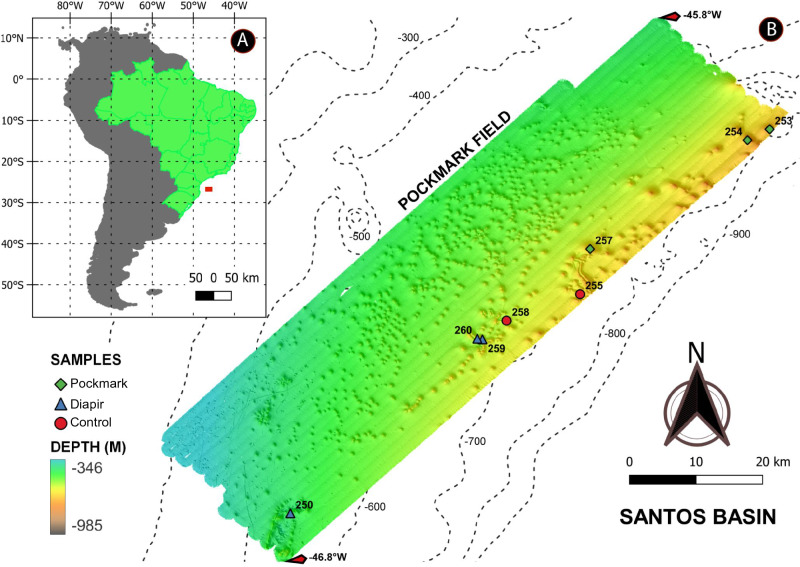
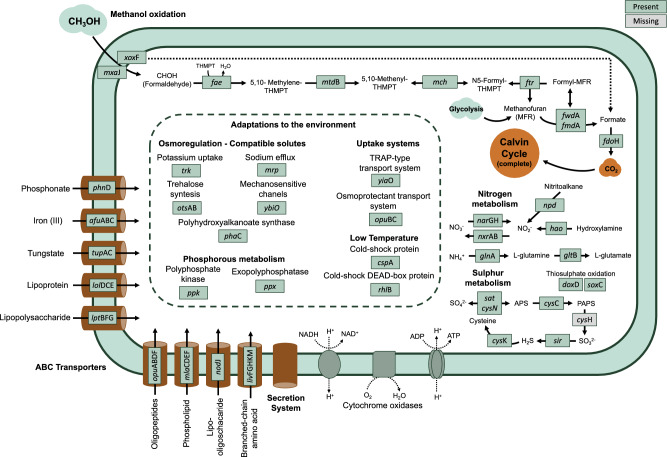
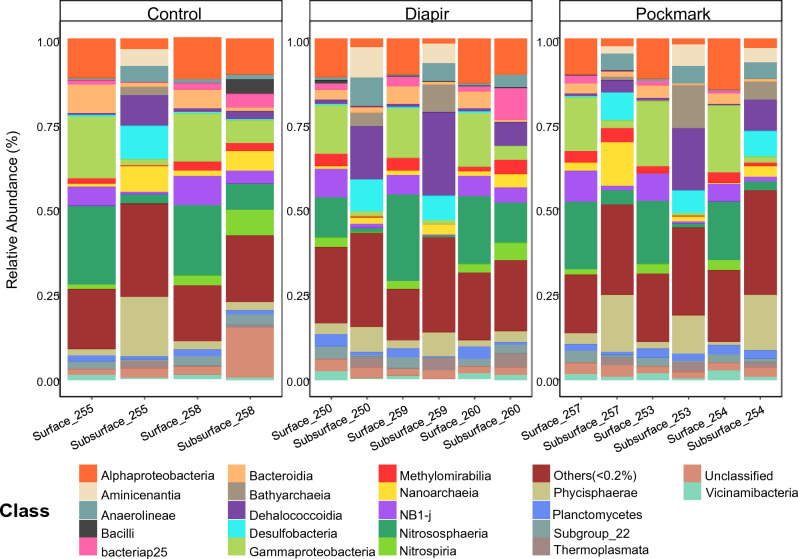
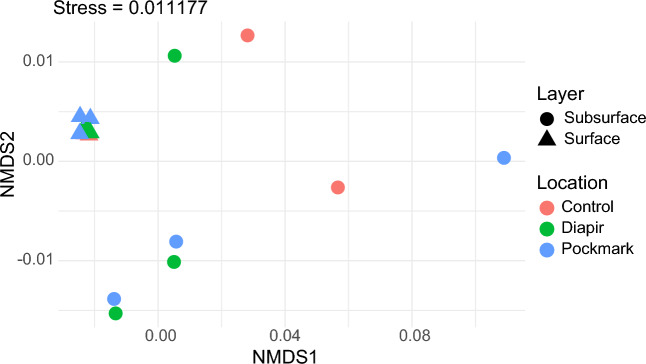
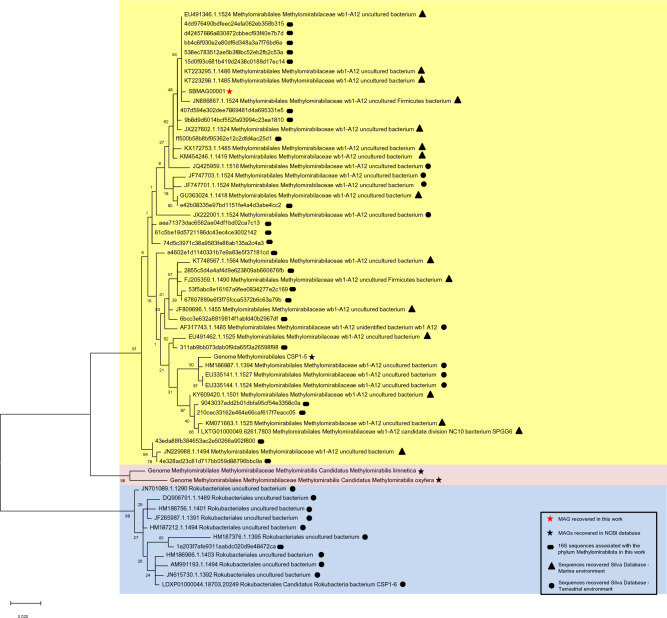
Continental slopes can play a significant contribution to marine productivity and carbon cycling. These regions can harbour distinct geological features, such as salt diapirs and pockmarks, in which their depressions may serve as natural sediment traps where different compounds can accumulate. We investigated the prokaryotic communities in surface (0-2 cm) and subsurface (18-20 or 22-24 cm) sediments from a salt diapir and pockmark field in Santos Basin, Southwest Atlantic Ocean. Metabarcoding of 16 samples revealed that surface sediments were dominated by the archaeal class Nitrososphaeria, while the bacterial class Dehalococcoidia was the most prevalent in subsurface samples. Sediment strata were found to be a significant factor explaining 27% of the variability in community composition. However, no significant difference was observed among geomorphological features. We also performed a metagenomic analysis of three surface samples and analysed the highest quality metagenome-assembled genome retrieved, which belonged to the family CSP1-5, phylum Methylomirabilota. This non-methanotrophic methylotroph contains genes encoding for methanol oxidation and Calvin Cycle pathways, along with diverse functions that may contribute to its adaptation to deep-sea habitats and to oscillating environmental conditions. By integrating metabarcoding and metagenomic approaches, we reported that CSP1-5 is prevalent in the sediment samples from Santos Basin slope, indicating the potential importance of methanol metabolism in this region. Finally, using a phylogenetic approach integrating 16S rRNA sequences assigned to Methylomirabilota in this study with those from a public database, we argued that CSP1-5 public sequences might be misclassified as Methylomirabilaceae (the methanotrophic clade) and, therefore, the role of these organisms and the methanol cycling could also be neglected in other environments.
大陆坡可以为海洋生产力和碳循环做出重要贡献。这些地区可能拥有独特的地质特征,如盐刺穿和麻坑,其凹陷处可能成为天然的沉积物陷阱,不同的化合物可以在其中积累。我们研究了南大西洋 Santos 盆地盐刺穿和麻坑区表层(0-2cm)和次表层(18-20 或 22-24cm)沉积物中的原核生物群落。对 16 个样本的代谢组学分析表明,表层沉积物主要由古菌纲 Nitrososphaeria 主导,而次表层样本中最普遍的是细菌纲 Dehalococcoidia。研究发现,沉积物地层是解释群落组成变化的 27%的重要因素。然而,在地貌特征方面没有观察到显著差异。我们还对三个表层样本进行了宏基因组分析,并分析了所获得的最高质量的宏基因组组装基因组,该基因组属于 CSP1-5 科,Methylomirabilota 门。这种非甲烷氧化甲基营养菌含有编码甲醇氧化和卡尔文循环途径的基因,以及多种可能有助于其适应深海栖息地和波动环境条件的功能。通过整合代谢组学和宏基因组学方法,我们报告了 CSP1-5 在 Santos 盆地斜坡沉积物样本中普遍存在,这表明甲醇代谢在该地区可能具有重要意义。最后,通过整合本研究中 16S rRNA 序列和公共数据库中分配给 Methylomirabilota 的序列的系统发育方法,我们认为 CSP1-5 的公共序列可能被错误地归类为 Methylomirabilaceae(甲烷氧化菌分支),因此,这些生物的作用以及甲醇循环在其他环境中也可能被忽视。