Department of Global Health, School of Public Health, Peking University, 38 Xue Yuan Road, Haidian District, Beijing, 100191, China.
Institute for Global Health and Development, Peking University, Beijing, China.
Int J Equity Health. 2023 Aug 7;22(1):149. doi: 10.1186/s12939-023-01974-8.
Inequity in maternal-child health services is a challenge to global health as it hinders the achievement of Sustainable Development Goals (SDGs) and Universal Health Coverage. Though the Association of Southeast Asian Nations (ASEAN) has made remarkable achievements in maternal-child health, there remain gaps in reaching global goals. This study aimed to compare and investigate the inequity in maternal-child health (MCH) services in ASEAN member states to help guide policy decisions to improve equitable health services in the SDG era and beyond.
Using the WHO Health Inequality Monitor, we identified inequity summary measures for five MCH services in ASEAN member states from 1993 to 2021: antenatal care, births attended by skilled health personnel, diphtheria, tetanus and pertussis (DTP3) immunization, measles immunization, and polio immunization. We divided the analysis dimension of inequity into urban-rural inequity, economic status inequity, and sub-regional inequity. Trends of absolute and relative inequity in every dimension of MCH services in ASEAN member states were examined with the principal component analysis (PCA).
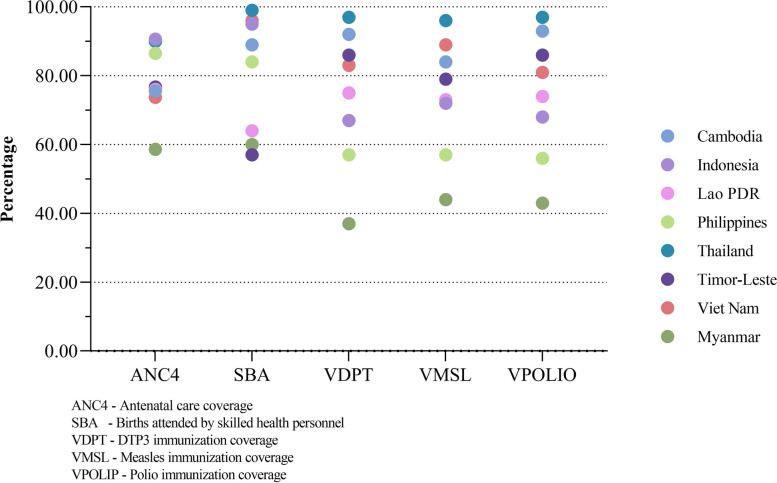
The mean coverages of MCH services are 98.80% (Thailand), 86.72% (Cambodia), 84.54% (Viet Nam), 78.52 (Indonesia), 76.94% (Timor-Leste), 72.40% (Lao PDR), 68.10% (Philippines) and 48.52% (Myanmar) in 2021. Thailand have the lowest MCH services absolute inequity indexes of -1.945, followed by Vietnam (-1.449). Lao PDR and Myanmar have relatively higher MCH services absolute inequity indexes of 0.852 and 0.054 respectively. The service in Cambodia, Indonesia, and the Philippines is pro-specific regions (with subnational region absolute inequity indexes of -0.02, 0.01, and 1.01 respectively). The service in Myanmar is pro-rich (with economic status absolute inequity index of 0.43). The service in Lao PDR and Timor-Leste is pro-urban areas, pro-rich, and pro-specific regions.
The inequity of MCH services in ASEAN persists but is in a declining trend. Thailand and Vietnam have performed well in ensuring MCH services equity, while Laos and Myanmar are still facing serious inequity dilemmas. The progress of MCH service equity in Myanmar, Cambodia, the Philippines, and Indonesia is uneven. It is acceptable to learn from the successful experiences of Thailand and Vietnam to improve the equities in other ASEAN countries. Policies should be developed according to the specific types of MCH inequity in member states to improve equity levels.
孕产妇和儿童健康服务的不平等是对全球健康的挑战,因为它阻碍了可持续发展目标(SDGs)和全民健康覆盖的实现。尽管东南亚国家联盟(ASEAN)在孕产妇和儿童健康方面取得了显著成就,但在实现全球目标方面仍存在差距。本研究旨在比较和调查东盟成员国孕产妇和儿童健康(MCH)服务的不平等情况,以帮助指导决策,改善 SDG 时代及以后的公平卫生服务。
使用世界卫生组织卫生不平等监测工具,我们从 1993 年到 2021 年确定了东盟成员国的五项 MCH 服务的不平等综合衡量标准:产前护理、熟练卫生人员接生、白喉、破伤风和百日咳(DTP3)免疫、麻疹免疫和小儿麻痹症免疫。我们将不平等的分析维度分为城乡不平等、经济地位不平等和次区域不平等。使用主成分分析(PCA)检查了东盟成员国各维度 MCH 服务中绝对和相对不平等的趋势。
2021 年,MCH 服务的平均覆盖率分别为泰国 98.80%、柬埔寨 86.72%、越南 84.54%、印度尼西亚 78.52%、东帝汶 76.94%、老挝人民民主共和国 72.40%、菲律宾 68.10%和缅甸 48.52%。泰国的 MCH 服务绝对不平等指数最低,为-1.945,其次是越南(-1.449)。老挝人民民主共和国和缅甸的 MCH 服务绝对不平等指数相对较高,分别为 0.852 和 0.054。柬埔寨、印度尼西亚和菲律宾的服务偏向特定地区(次国家地区绝对不平等指数分别为-0.02、0.01 和 1.01)。缅甸的服务偏向富裕地区(经济地位绝对不平等指数为 0.43)。老挝人民民主共和国和东帝汶的服务偏向城市地区、富裕地区和特定地区。
东盟的孕产妇和儿童健康服务不平等仍然存在,但呈下降趋势。泰国和越南在确保孕产妇和儿童健康服务公平方面表现良好,而老挝和缅甸仍面临严重的不平等困境。缅甸、柬埔寨、菲律宾和印度尼西亚在孕产妇和儿童健康服务公平方面的进展不平衡。可以借鉴泰国和越南的成功经验,提高其他东盟国家的公平性。应根据成员国的孕产妇和儿童健康不平等具体类型制定政策,以提高公平水平。