Adesoye Taiwo, Liao Kai-Ping, Peterson Susan, Li Liang, Zorzi Daria, Holmes Holly M, Chavez-MacGregor Mariana, Giordano Sharon H
Department of Breast Surgical Oncology, The University of Texas MD Anderson Cancer Center, Houston, Texas, USA.
Department of Health Services Research, The University of Texas MD Anderson Cancer Center, Houston, Texas, USA.
Cancer Med. 2023 Sep;12(17):17740-17752. doi: 10.1002/cam4.6394. Epub 2023 Aug 8.
Little is known about long-term treatment-related symptoms in older breast cancer survivors. We characterized long-term patient-reported symptoms and examined factors associated with the presence and severity of symptoms, and symptom interference with daily activities.
Texas Cancer Registry (TCR) Medicare linkage data was used to identify breast cancer patients age 65 and older with local/regional stage disease diagnosed between 2012-2013. Symptom burden was assessed using breast-specific items from the Patient-Reported Outcomes version of the Common Terminology Criteria for Adverse Events (PRO-CTCAE™). Demographic and clinical data also were collected. Logistic regression models were used to assess the association between symptom burden and respondent sociodemographic and clinical characteristics.
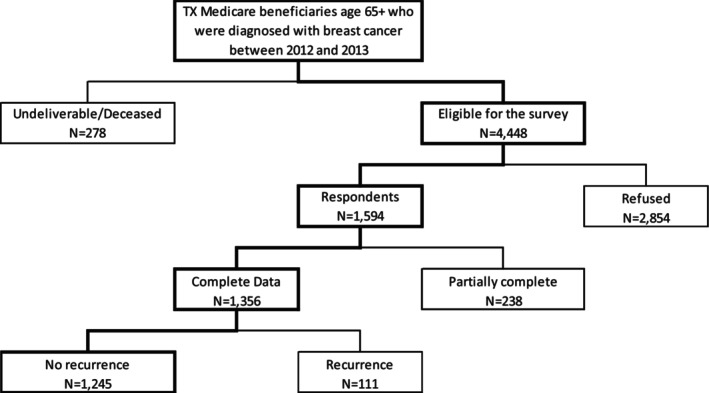
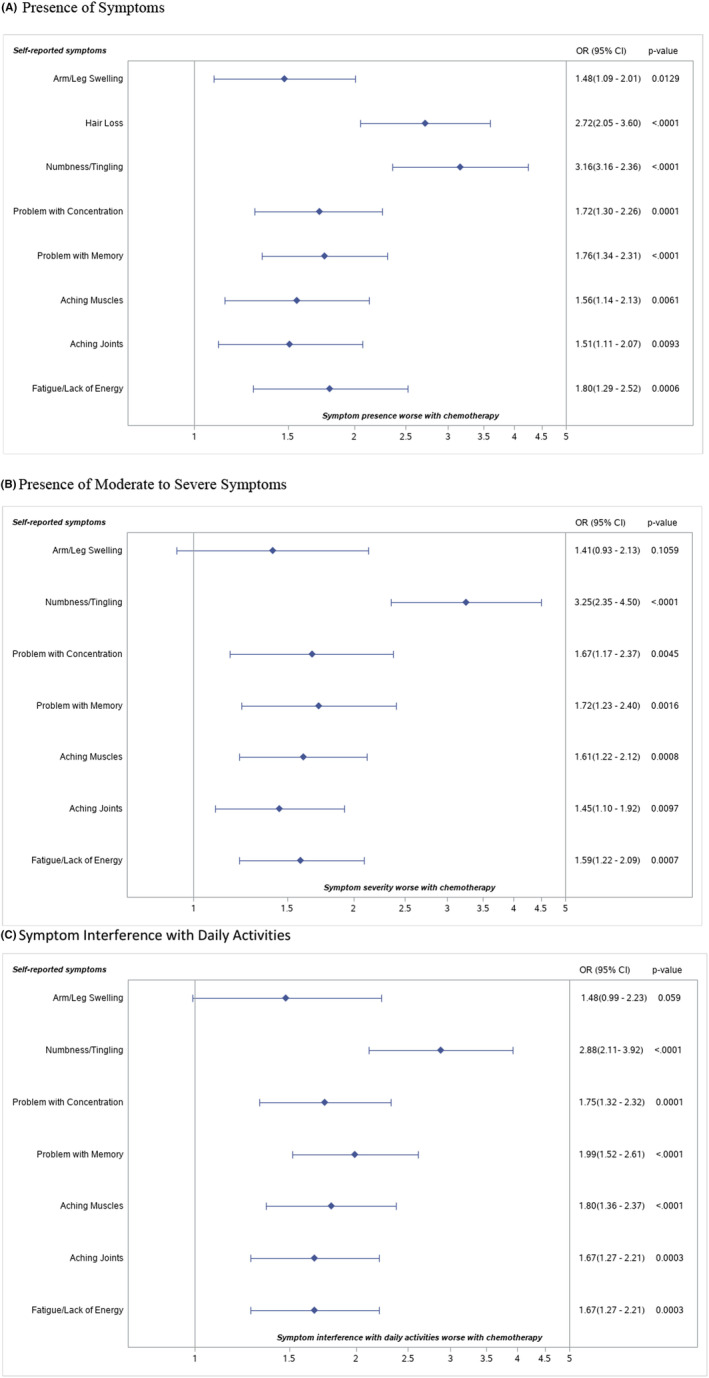
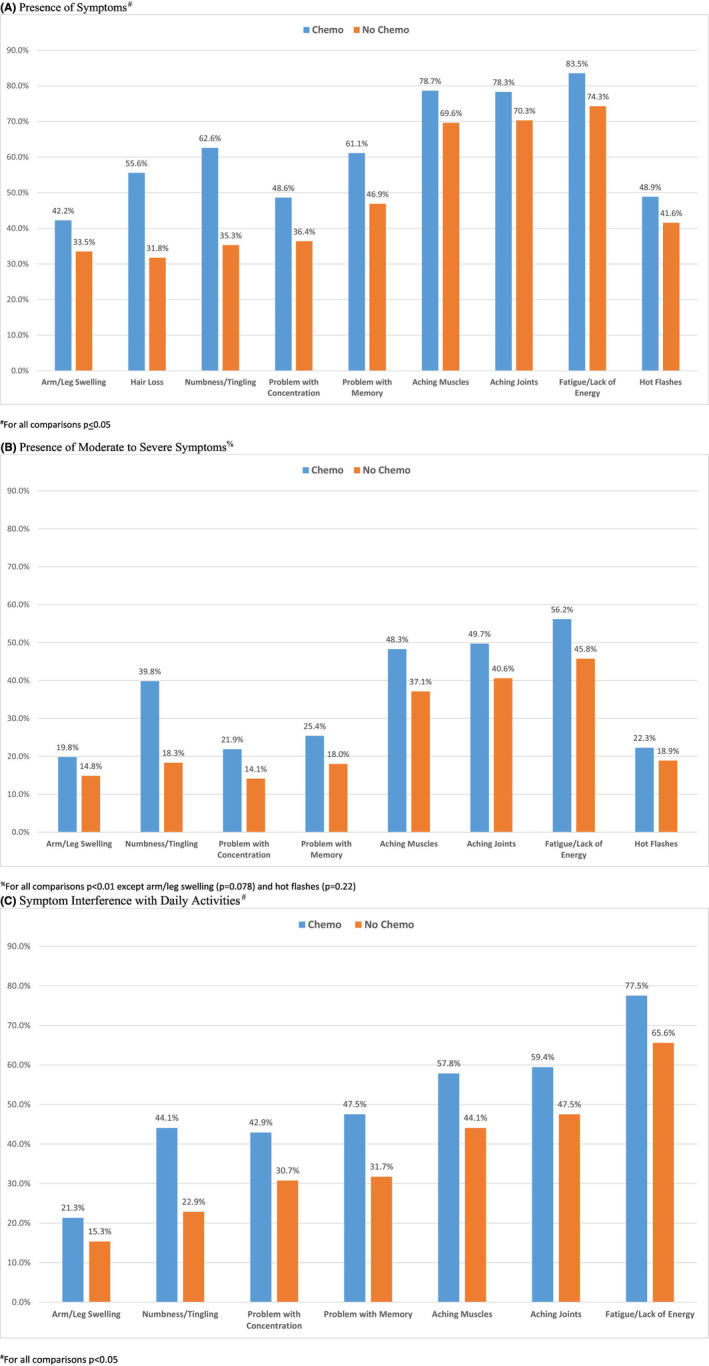
Of 4448 eligible patients, 1594 (response-rate 35.8%) completed questionnaires. Of these, 1245 eligible respondents were included in the analysis based on self-reported data. Median time from diagnosis to survey completion was 68 months (IQR: 62-73). Most frequently reported symptoms were fatigue/lack of energy (76.8%), aching muscles (72.1%) and aching joints (72.5%). Receipt of chemotherapy was associated with higher symptom burden. Patients treated with adjuvant chemotherapy had higher risk of numbness/tingling (OR: 3.16; 95% CI: 2.36-4.24), hair loss (OR: 2.72; 95% CI: 2.05-3.60), and fatigue/lack of energy (OR: 1.80; 95% CI: 1.29-2.52). Similarly, patients who received chemotherapy were more likely to report the majority of symptoms as moderate to severe and as interfering with daily activities.
Receipt of chemotherapy is associated with significant symptom burden more than 5 years after breast cancer treatment. Long-term chemotherapy impact should be discussed with patients in a shared-decision making process and approaches to symptom management during survivorship care are needed.
对于老年乳腺癌幸存者与长期治疗相关的症状,我们了解甚少。我们对患者报告的长期症状进行了特征描述,并研究了与症状的存在、严重程度以及症状对日常活动的干扰相关的因素。
利用德克萨斯癌症登记处(TCR)与医疗保险的关联数据,识别出2012年至2013年间诊断为局部/区域期疾病的65岁及以上乳腺癌患者。使用不良事件通用术语标准患者报告结局版(PRO-CTCAE™)中特定于乳腺的项目评估症状负担。还收集了人口统计学和临床数据。使用逻辑回归模型评估症状负担与受访者社会人口统计学和临床特征之间的关联。
在4448名符合条件的患者中,1594名(回复率35.8%)完成了问卷调查。其中,根据自我报告数据,1245名符合条件的受访者被纳入分析。从诊断到调查完成的中位时间为68个月(四分位间距:62 - 73)。最常报告的症状是疲劳/精力不足(76.8%)、肌肉酸痛(72.1%)和关节疼痛(72.5%)。接受化疗与更高的症状负担相关。接受辅助化疗的患者出现麻木/刺痛(比值比:3.16;95%置信区间:2.36 - 4.24)、脱发(比值比:2.72;95%置信区间:2.05 - 3.60)以及疲劳/精力不足(比值比:1.80;95%置信区间:1.29 - 2.52)的风险更高。同样,接受化疗的患者更有可能报告大多数症状为中度至重度,且会干扰日常活动。
乳腺癌治疗5年多后,接受化疗与显著的症状负担相关。应在共同决策过程中与患者讨论化疗的长期影响,并且在生存护理期间需要采取症状管理方法。