Gastroenterology, Royal Devon University Healthcare NHS Foundation Trust, Exeter, UK.
Exeter Inflammatory Bowel Disease and Pharmacogenetics Research Group, University of Exeter, Exeter, UK.
J Crohns Colitis. 2024 Aug 14;18(8):1190-1201. doi: 10.1093/ecco-jcc/jjad133.
Anti-tumour necrosis factor [TNF] treatment failure in patients with inflammatory bowel disease [IBD] is common and frequently related to low drug concentrations. In order to identify patients who may benefit from dose optimisation at the outset of anti-TNF therapy, we sought to define epigenetic biomarkers in whole blood at baseline associated with anti-TNF drug concentrations at week 14.
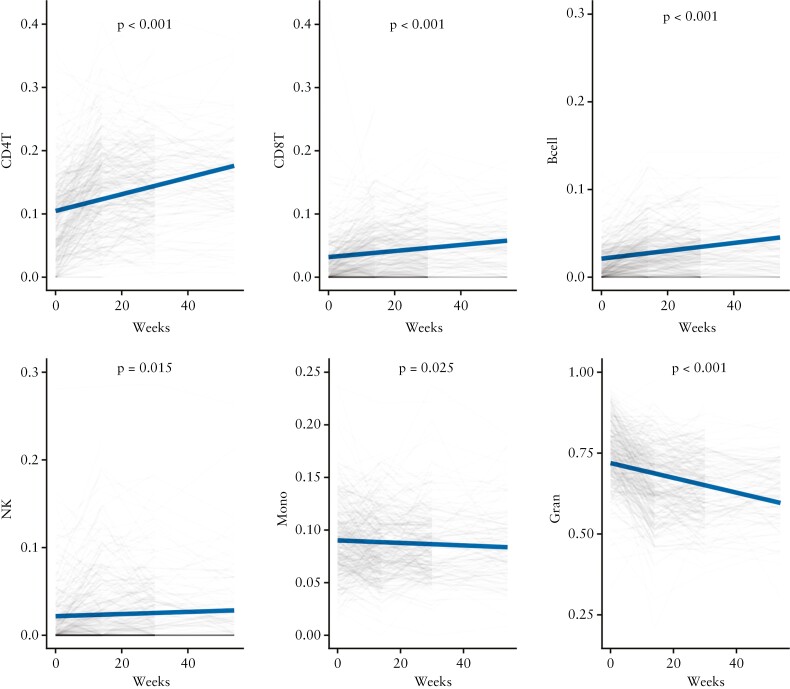
DNA methylation from 1104 whole blood samples from 385 patients in the Personalised Anti-TNF Therapy in Crohn's disease [PANTS] study were assessed using the Illumina EPIC Beadchip [v1.0] at baseline and weeks 14, 30, and 54. We compared DNA methylation profiles in anti-TNF-treated patients who experienced primary non-response at week 14 if they were assessed at subsequent time points and were not in remission at week 30 or 54 [infliximab n = 99, adalimumab n = 94], with patients who responded at week 14 and when assessed at subsequent time points were in remission at week 30 or 54 [infliximab n = 99, adalimumab n = 93].
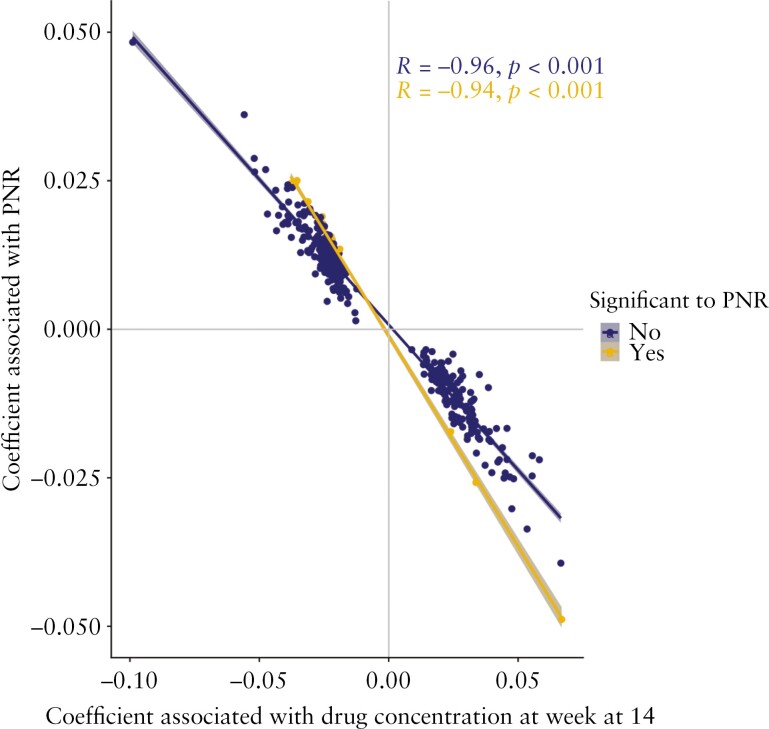
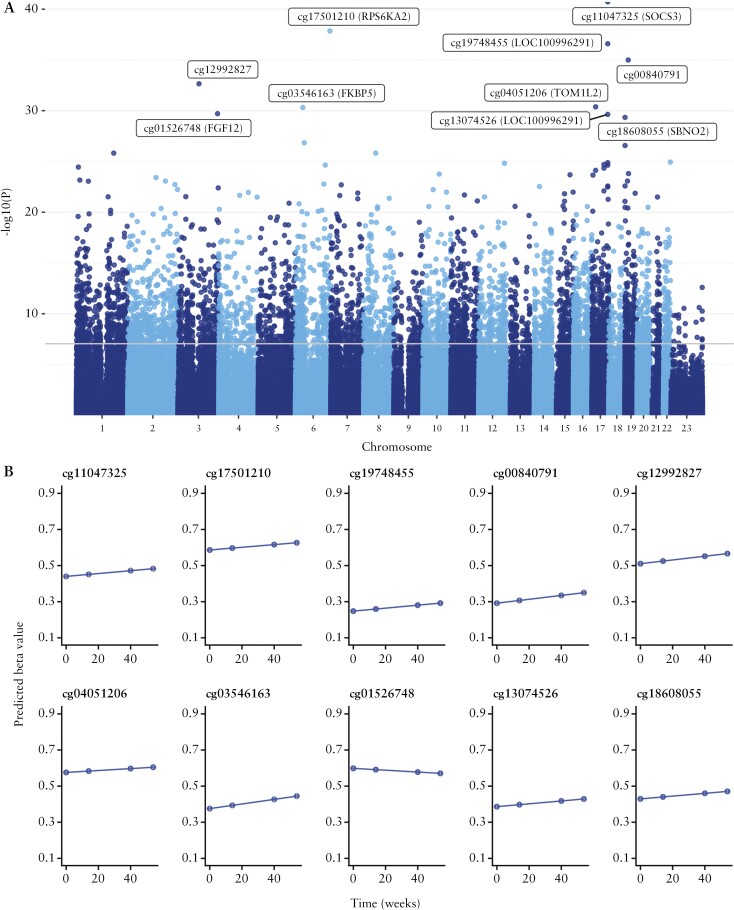
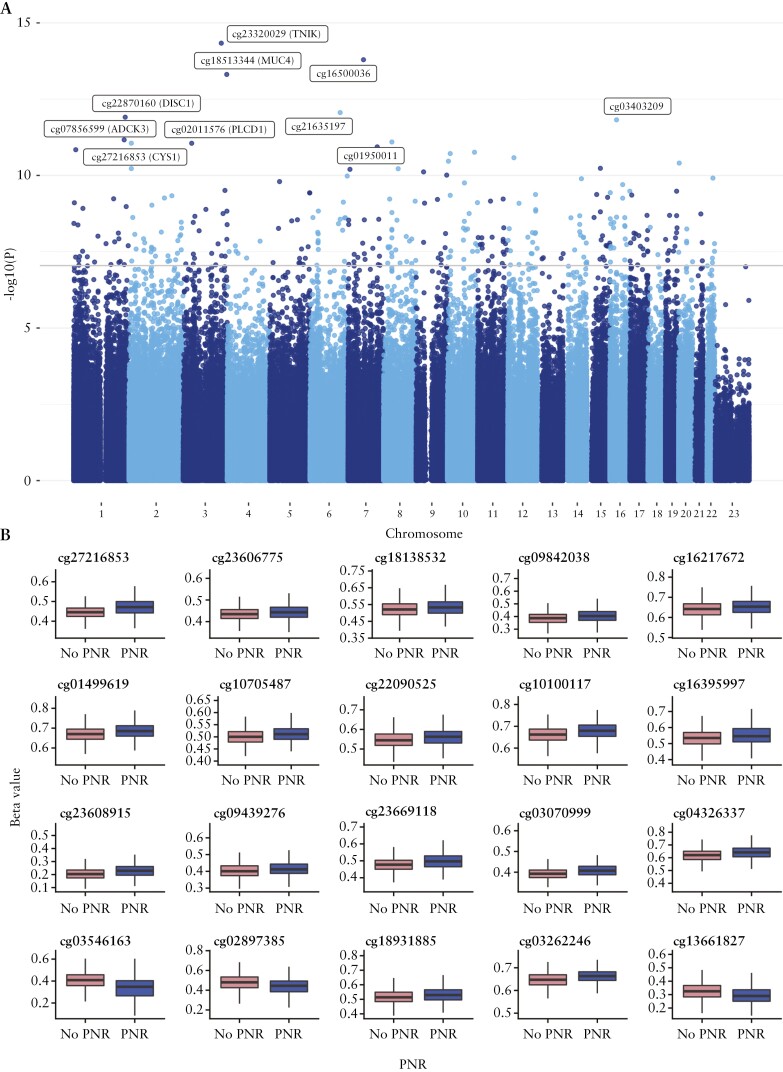
Overall, between baseline and week 14, we observed 4999 differentially methylated positions [DMPs] annotated to 2376 genes following anti-TNF treatment. Pathway analysis identified 108 significant gene ontology terms enriched in biological processes related to immune system processes and responses. Epigenome-wide association [EWAS] analysis identified 323 DMPs annotated to 210 genes at baseline associated with higher anti-TNF drug concentrations at Week 14. Of these, 125 DMPs demonstrated shared associations with other common traits [proportion of shared CpGs compared with DMPs] including body mass index [23.2%], followed by C-reactive protein [CRP] [11.5%], smoking [7.4%], alcohol consumption per day [7.1%], and IBD type [6.8%]. EWAS of primary non-response to anti-TNF identified 20 DMPs that were associated with both anti-TNF drug concentration and primary non-response to anti-TNF with a strong correlation of the coefficients [Spearman's rho = -0.94, p <0.001].
Baseline DNA methylation profiles may be used as a predictor for anti-TNF drug concentration at week 14 to identify patients who may benefit from dose optimisation at the outset of anti-TNF therapy.
炎症性肠病(IBD)患者使用抗肿瘤坏死因子(TNF)治疗失败较为常见,且常与药物浓度较低有关。为了在抗 TNF 治疗开始时确定可能从剂量优化中获益的患者,我们试图在基线时确定与第 14 周抗 TNF 药物浓度相关的全血中的表观遗传生物标志物。
使用 Illumina EPIC Beadchip [v1.0]在基线和第 14、30 和 54 周评估来自 385 例患者的 1104 例全血样本的 DNA 甲基化。我们比较了在第 14 周评估时出现原发性无应答且在第 30 或 54 周未缓解的抗 TNF 治疗患者(英夫利昔单抗 n = 99,阿达木单抗 n = 94)与在第 14 周和后续时间点有反应且在第 30 或 54 周缓解的患者(英夫利昔单抗 n = 99,阿达木单抗 n = 93)的 DNA 甲基化谱。
总体而言,在基线和第 14 周之间,我们观察到抗 TNF 治疗后有 4999 个差异甲基化位置(DMP)注释到 2376 个基因。通路分析确定了 108 个与免疫系统过程和反应相关的生物学过程中富含的显著基因本体术语。全基因组关联分析(EWAS)确定了在第 14 周与较高抗 TNF 药物浓度相关的 323 个 DMPs,这些 DMPs注释到 210 个基因。其中,125 个 DMPs与其他常见特征(与 DMP 相比,CpG 的共享比例)具有共享关联,包括体重指数 [23.2%],其次是 C 反应蛋白 [CRP] [11.5%]、吸烟 [7.4%]、每日饮酒量 [7.1%]和 IBD 类型 [6.8%]。对原发性抗 TNF 无反应的 EWAS 确定了 20 个 DMPs,这些 DMPs与抗 TNF 药物浓度和原发性抗 TNF 无反应均相关,系数之间具有很强的相关性[Spearman's rho = -0.94,p <0.001]。
基线 DNA 甲基化谱可用作第 14 周抗 TNF 药物浓度的预测因子,以确定可能从抗 TNF 治疗开始时的剂量优化中获益的患者。