Gastroenterology Section, Temple University, Philadelphia, Pennsylvania, United States.
Gastroenterology Section, Department of Epidemiology, Johns Hopkins University, Baltimore, Maryland, United States.
Am J Physiol Gastrointest Liver Physiol. 2023 Nov 1;325(5):G407-G417. doi: 10.1152/ajpgi.00065.2023. Epub 2023 Aug 8.
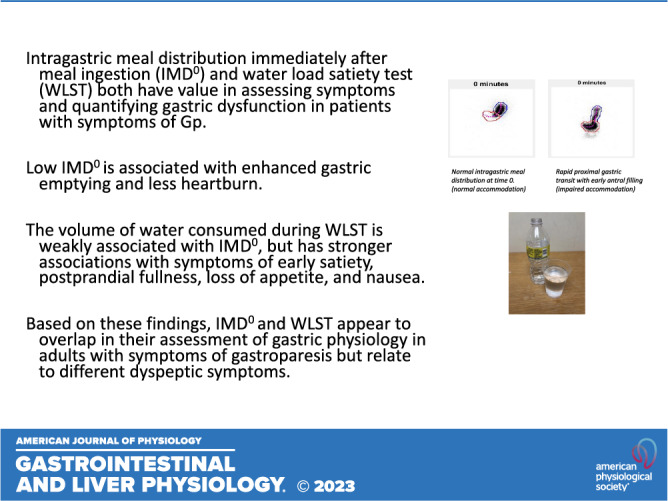
Gastric emptying scintigraphy (GES) measures total gastric retention after a solid meal and can assess intragastric meal distribution (IMD). Water load satiety test (WLST) measures gastric capacity. Both IMD immediately after meal ingestion [ratio of proximal gastric counts after meal ingestion to total gastric counts at (IMD)] and WLST (volume of water ingested over 5 min) are indirect measures of gastric accommodation. In this study, IMD and WLST were compared with each other and to symptoms of gastroparesis to gauge their clinical utility for assessing patients with symptoms of gastroparesis. Patients with symptoms of gastroparesis underwent GES to obtain gastric retention and IMD, WLST, and filled out patient assessment of upper GI symptoms. A total of 234 patients with symptoms of gastroparesis were assessed (86 patients with diabetes, 130 idiopathic, 18 postfundoplication) and 175 (75%) delayed gastric emptying. Low IMD <0.568 suggesting initial rapid transit to the distal stomach was present in 8% and correlated with lower gastric retention, less heartburn, and lower volumes consumed during WLST. Low WLST volume (<238 mL) was present in 20% and associated with increased severity of early satiety, postprandial fullness, loss of appetite, and nausea. Low IMD is associated with less gastric retention and less heartburn. Volume of water consumed during WLST, while associated with IMD, has associations with early satiety, postprandial fullness, loss of appetite, and nausea. Thus, IMD and WLST appear to overlap somewhat in their assessment of gastric physiology in adults with symptoms of gastroparesis but relate to different dyspeptic symptoms. IMD and WLST were assessed for their clinical utility in assessing patients with symptoms of gastroparesis. Low IMD is associated with less gastric retention and less heartburn. Volume of water consumed during WLST, while associated with IMD0, has associations with early satiety, postprandial fullness, loss of appetite, and nausea. IMD and WLST appear to overlap somewhat in their assessment of gastric physiology in adults with symptoms of gastroparesis but relate to different dyspeptic symptoms.
胃排空闪烁显像术(GES)测量固体餐后的总胃残留量,并可评估胃内餐分布(IMD)。水负荷饱腹感试验(WLST)测量胃容量。IMD 立即在餐后测量(餐后摄入后近端胃计数与胃总计数之比)和 WLST(5 分钟内摄入的水量)均为胃顺应性的间接测量。在这项研究中,IMD 和 WLST 相互比较,并与胃轻瘫症状进行比较,以评估它们在评估胃轻瘫症状患者中的临床应用。有胃轻瘫症状的患者接受 GES 以获得胃残留量和 IMD、WLST,并填写上消化道症状患者评估。共评估了 234 例有胃轻瘫症状的患者(86 例糖尿病患者,130 例特发性患者,18 例胃底折叠术后患者),其中 175 例(75%)存在胃排空延迟。低 IMD <0.568 提示初始快速转运至远端胃,占 8%,与较低的胃残留量、较少的烧心和 WLST 期间消耗的较少量相关。低 WLST 量(<238mL)占 20%,与早饱、餐后饱胀、食欲下降和恶心的严重程度增加相关。低 IMD 与较少的胃残留量和较少的烧心相关。WLST 期间消耗的水量与 IMD 相关,但与早饱、餐后饱胀、食欲下降和恶心相关。因此,IMD 和 WLST 在评估有胃轻瘫症状的成人的胃生理方面似乎有一定的重叠,但与不同的消化不良症状相关。评估 IMD 和 WLST 在评估胃轻瘫症状患者中的临床应用。低 IMD 与较少的胃残留量和较少的烧心相关。WLST 期间消耗的水量与 IMD0 相关,但与早饱、餐后饱胀、食欲下降和恶心相关。IMD 和 WLST 在评估有胃轻瘫症状的成人的胃生理方面似乎有一定的重叠,但与不同的消化不良症状相关。