National Confidential Inquiry into Suicide and Safety in Mental Health (NCISH), Centre for Mental Health and Safety, School of Health Sciences, University of Manchester, Manchester, United Kingdom.
Armed Forces Team, NHS England, London, United Kingdom.
PLoS Med. 2023 Aug 8;20(8):e1004273. doi: 10.1371/journal.pmed.1004273. eCollection 2023 Aug.
There are comparatively few international studies investigating suicide in military veterans and no recent UK-wide studies. This is important because the wider context of being a UK Armed Forces (UKAF) veteran has changed in recent years following a period of intensive operations. We aimed to investigate the rate, timing, and risk factors for suicide in personnel who left the UKAF over a 23-year period.
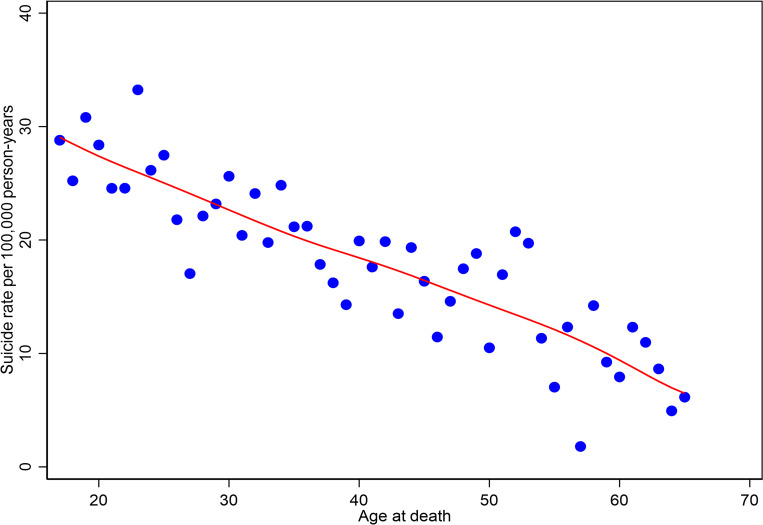
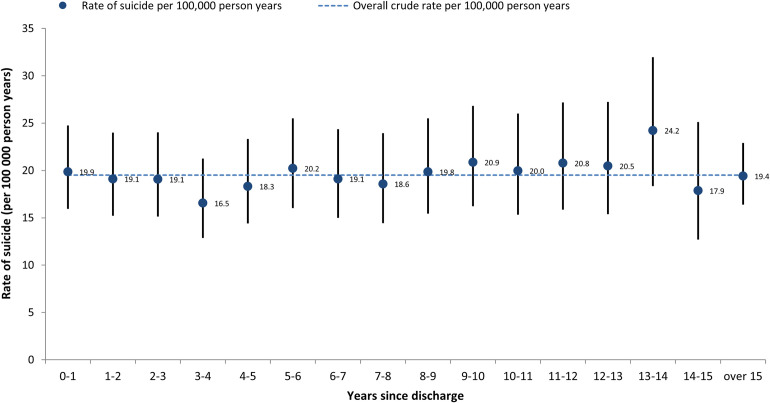
We carried out a retrospective cohort study of suicide in personnel who left the regular UKAF between 1996 and 2018 linking national databases of discharged personnel and suicide deaths, using survival analysis to examine the risk of suicide in veterans compared to the general population and conditional logistic regression to investigate factors most strongly associated with suicide after discharge. The 458,058 individuals who left the UKAF accumulated over 5,852,100 person years at risk, with a median length of follow-up of 13 years, were mostly male (91%), and had a median age of 26 years at discharge. 1,086 (0.2%) died by suicide. The overall rate of suicide in veterans was slightly lower than the general population (standardised mortality ratio, SMR [95% confidence interval, CI] 94 [88 to 99]). However, suicide risk was 2 to 3 times higher in male and female veterans aged under 25 years than in the same age groups in the general population (age-specific mortality ratios ranging from 160 to 409). Male veterans aged 35 years and older were at reduced risk of suicide (age-specific mortality ratios 47 to 80). Male sex, Army service, discharge between the ages of 16 and 34 years, being untrained on discharge, and length of service under 10 years were associated with higher suicide risk. Factors associated with reduced risk included being married, a higher rank, and deployment on combat operations. The rate of contact with specialist NHS mental health services (273/1,086, 25%) was lowest in the youngest age groups (10% for 16- to 19-year-olds; 23% for 20- to 24-year-olds). Study limitations include the fact that information on veterans was obtained from administrative databases and the role of pre-service vulnerabilities and other factors that may have influenced later suicide risk could not be explored. In addition, information on contact with support services was only available for veterans in contact with specialist NHS mental health services and not for those in contact with other health and social care services.
In this study, we found suicide risk in personnel leaving the UKAF was not high but there are important differences according to age, with higher risk in young men and women. We found a number of factors which elevated the risk of suicide but deployment was associated with lower risk. The focus should be on improving and maintaining access to mental health care and social support for young service leavers, as well as implementing general suicide prevention measures for all veterans regardless of age.
国际上针对退伍军人自杀的研究相对较少,英国也没有最近的研究。这很重要,因为在经历了一段时间的密集行动后,作为英国武装部队(UKAF)退伍军人的背景已经发生了变化。我们旨在调查在过去 23 年期间离开 UKAF 的人员中自杀的发生率、时间和风险因素。
我们对 1996 年至 2018 年间离开正规 UKAF 的人员进行了一项关于自杀的回顾性队列研究,将退役人员和自杀死亡的国家数据库联系起来,使用生存分析来比较退伍军人和普通人群的自杀风险,并使用条件逻辑回归来调查与退役后自杀最相关的因素。458058 名离开 UKAF 的人员积累了超过 5852100 人年的风险,中位随访时间为 13 年,大多数为男性(91%),中位退役年龄为 26 岁。1086 人(0.2%)自杀身亡。退伍军人的总体自杀率略低于普通人群(标准化死亡率比[SMR] 94[88 至 99])。然而,与普通人群相同年龄组相比,25 岁以下的男性和女性退伍军人的自杀风险高 2 至 3 倍(特定年龄死亡率比范围为 160 至 409)。35 岁及以上的男性退伍军人自杀风险降低(特定年龄死亡率比为 47 至 80)。男性、陆军服役、16 至 34 岁退役、退役时未接受训练以及服役时间不到 10 年与更高的自杀风险相关。与降低风险相关的因素包括已婚、更高的军衔和参与作战行动。与专科 NHS 心理健康服务的接触率(1086 人中的 273 人,25%)在最年轻的年龄组中最低(16 至 19 岁为 10%;20 至 24 岁为 23%)。研究的局限性包括退伍军人的信息是从行政数据库中获得的,以及兵役前的脆弱性和其他可能影响以后自杀风险的因素的作用无法被探索。此外,仅为与专科 NHS 心理健康服务有联系的退伍军人提供有关与支持服务联系的信息,而不为与其他卫生和社会保健服务有联系的退伍军人提供信息。
在这项研究中,我们发现离开 UKAF 的人员的自杀风险不高,但根据年龄存在重要差异,年轻男性和女性的风险更高。我们发现了一些增加自杀风险的因素,但部署与较低的风险相关。重点应放在改善和维持年轻退伍军人获得心理健康护理和社会支持上,同时为所有退伍军人实施一般的自杀预防措施,无论其年龄大小。