Department of Biomedical Engineering, Cornell University, Ithaca, NY, USA.
Centre for Mathematical Medicine and Biology, School of Mathematical Sciences, University of Nottingham, Nottingham, UK.
Europace. 2023 Aug 2;25(9). doi: 10.1093/europace/euad243.
Human-induced pluripotent stem cell-derived cardiomyocytes (iPSC-CMs) have become an essential tool to study arrhythmia mechanisms. Much of the foundational work on these cells, as well as the computational models built from the resultant data, has overlooked the contribution of seal-leak current on the immature and heterogeneous phenotype that has come to define these cells. The aim of this study is to understand the effect of seal-leak current on recordings of action potential (AP) morphology.
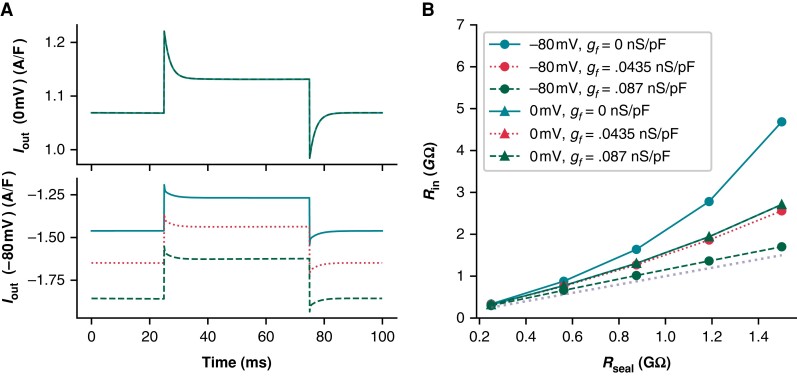
Action potentials were recorded in human iPSC-CMs using patch clamp and simulated using previously published mathematical models. Our in silico and in vitro studies demonstrate how seal-leak current depolarizes APs, substantially affecting their morphology, even with seal resistances (Rseal) above 1 GΩ. We show that compensation of this leak current is difficult due to challenges with obtaining accurate measures of Rseal during an experiment. Using simulation, we show that Rseal measures (i) change during an experiment, invalidating the use of pre-rupture values, and (ii) are polluted by the presence of transmembrane currents at every voltage. Finally, we posit that the background sodium current in baseline iPSC-CM models imitates the effects of seal-leak current and is increased to a level that masks the effects of seal-leak current on iPSC-CMs.
Based on these findings, we make recommendations to improve iPSC-CM AP data acquisition, interpretation, and model-building. Taking these recommendations into account will improve our understanding of iPSC-CM physiology and the descriptive ability of models built from such data.
人诱导多能干细胞衍生的心肌细胞(iPSC-CMs)已成为研究心律失常机制的重要工具。这些细胞的许多基础工作,以及从这些数据构建的计算模型,都忽略了密封泄漏电流对不成熟和异质表型的贡献,而这种表型已经成为这些细胞的定义特征。本研究旨在了解密封泄漏电流对动作电位(AP)形态记录的影响。
使用膜片钳技术在人 iPSC-CMs 中记录动作电位,并使用先前发表的数学模型进行模拟。我们的体内和体外研究表明,密封泄漏电流如何使 AP 去极化,这对其形态有很大影响,即使密封电阻(Rseal)高于 1 GΩ。我们表明,由于在实验中难以获得准确的 Rseal 测量值,因此很难补偿这种泄漏电流。通过模拟,我们表明 Rseal 测量值(i)在实验过程中会发生变化,从而使使用破裂前的值变得无效,以及(ii)会受到跨膜电流在每个电压下存在的污染。最后,我们假设背景钠电流在基线 iPSC-CM 模型中模拟了密封泄漏电流的影响,并且增加到足以掩盖密封泄漏电流对 iPSC-CMs 影响的水平。
基于这些发现,我们提出了改进 iPSC-CM AP 数据采集、解释和建模的建议。考虑到这些建议,将提高我们对 iPSC-CM 生理学的理解以及从这些数据构建的模型的描述能力。