Department of Surgery, Diakonhjemmet Hospital, Oslo, Norway.
The Intervention Center, Oslo University Hospital, Rikshospitalet, Oslo, Norway.
Langenbecks Arch Surg. 2023 Aug 8;408(1):300. doi: 10.1007/s00423-023-02958-6.
The optimal operative treatment for umbilical and epigastric hernia, i.e., primary midline ventral hernia (PMVH), is debatable. The most common techniques are the primary suture and open repair with mesh, while laparoscopic approach using intraperitoneally placed onlay mesh (IPOM) is less frequent. The aim of this study was to examine the outcomes of IPOM in PMVH. Perioperative results, recurrence, pain, and functional status were studied.
This single-center prospective cohort study included consecutive patients with PMVH operated between September 2006 and December 2015. Systematic follow-up was conducted 6 months and 2 and 5 years postoperatively.
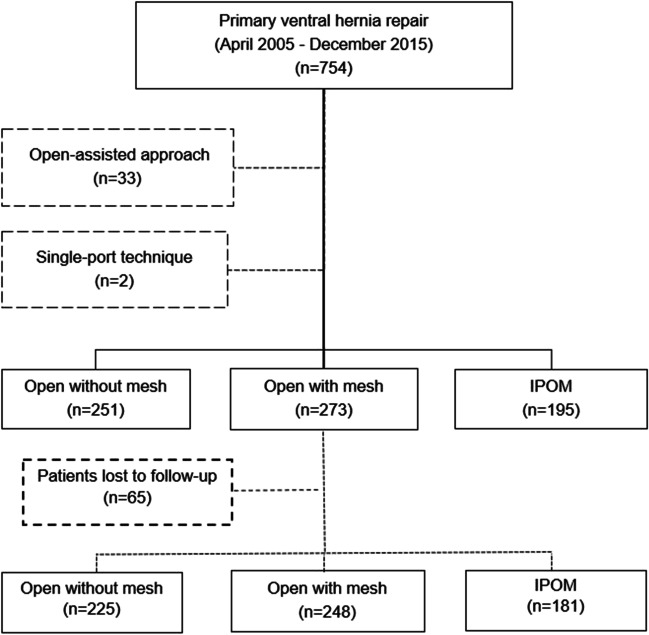
Seven hundred fifty-four patients underwent PMVH repair. Open repair without mesh, open repair with mesh, and IPOM were performed in 251 (34.9%), 273 (38%), and 195 (27.1%) patients, respectively. In the unmatched cohort, the incidence of postoperative complications was similar except postoperative seroma, which was more frequent after IPOM. The latter was also associated with longer length of stay. Open repair with mesh was associated with significantly lower recurrence compared with open repair without mesh and IPOM (5.2 vs 18.2 vs 13.8%, p=0.001, respectively). No differences were seen between the groups in terms of visual analog scale used for registering postoperative pain. These observations persisted after applying propensity score matching. In the multivariable analysis, open repair without mesh and IPOM significantly correlated with recurrence.
In PMVH, open repair with mesh is associated with lower recurrence compared with open repair without mesh and IPOM. Pain, postoperative complications (except for seroma), and functional status are similar.
脐疝和上腹部疝的最佳手术治疗方法,即原发性中线腹前壁疝(PMVH),仍存在争议。最常见的技术是原发缝合和开放式修补加网片,而腹腔镜经腹腔内补片置入术(IPOM)则较少应用。本研究旨在探讨 IPOM 在 PMVH 中的应用效果。研究了围手术期结果、复发、疼痛和功能状态。
这是一项单中心前瞻性队列研究,纳入了 2006 年 9 月至 2015 年 12 月间连续接受 PMVH 手术的患者。术后 6 个月、2 年和 5 年进行系统随访。
754 例患者接受了 PMVH 修复。未使用网片的开放式修复、使用网片的开放式修复和 IPOM 分别在 251 例(34.9%)、273 例(38%)和 195 例(27.1%)患者中进行。在未匹配的队列中,除术后血清肿外,各组术后并发症发生率相似,但 IPOM 后血清肿更为常见。后者还与住院时间延长有关。与未使用网片的开放式修复和 IPOM 相比,使用网片的开放式修复与显著较低的复发率相关(5.2%比 18.2%比 13.8%,p=0.001)。各组在记录术后疼痛的视觉模拟量表上无差异。在应用倾向评分匹配后,这些观察结果仍然存在。多变量分析显示,未使用网片的开放式修复和 IPOM 与复发显著相关。
在 PMVH 中,与未使用网片的开放式修复和 IPOM 相比,使用网片的开放式修复与较低的复发率相关。疼痛、术后并发症(除血清肿外)和功能状态相似。