Laboratory of Vaccine Materials and Laboratory of Gut Environmental System, Microbial Research Center for Health and Medicine, National Institutes of Biomedical Innovation, Health and Nutrition (NIBIOHN), 7-6-8 Asagi Saito, Ibaraki-city, Osaka, 567-0085, Japan.
Graduate School of Pharmaceutical Sciences, Osaka University, Osaka, Japan.
BMC Complement Med Ther. 2023 Aug 8;23(1):281. doi: 10.1186/s12906-023-04106-5.
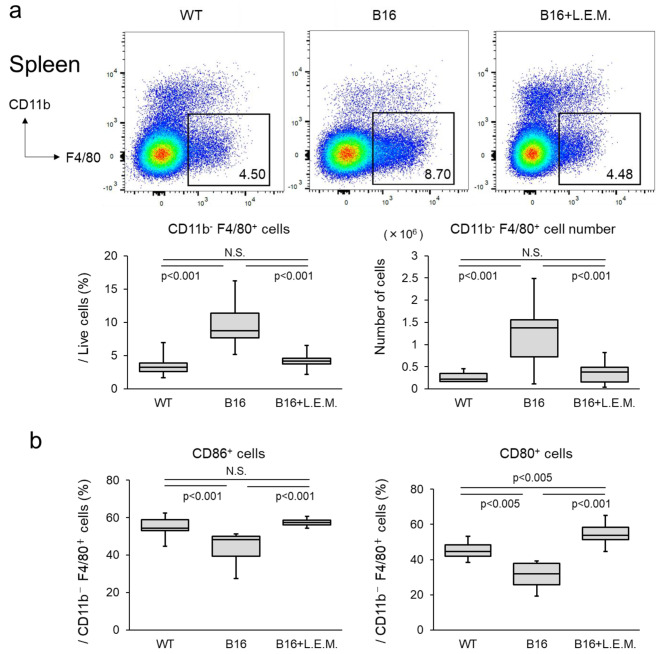
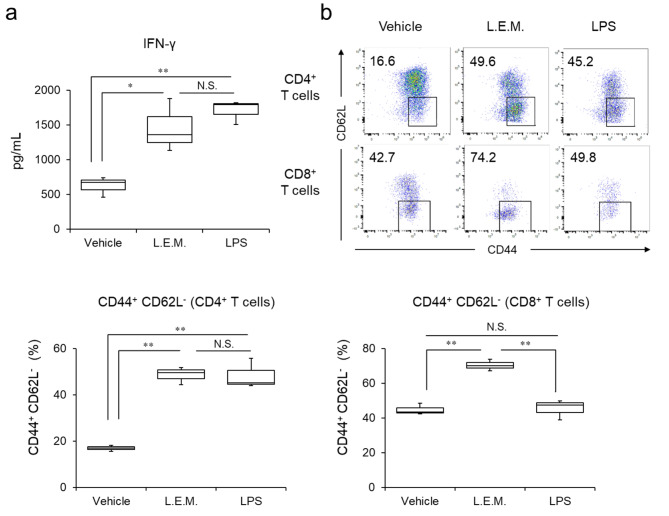
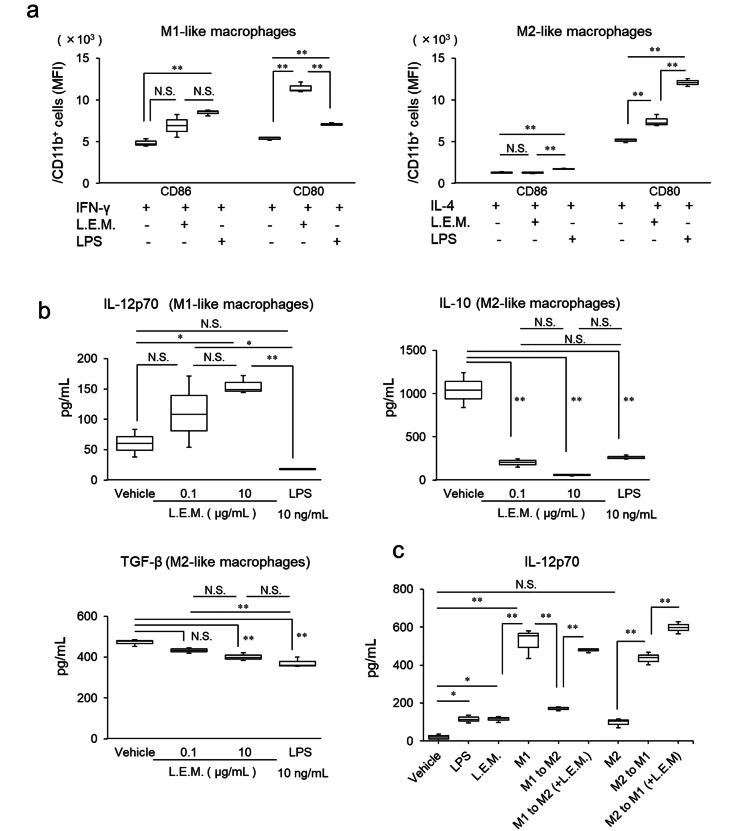
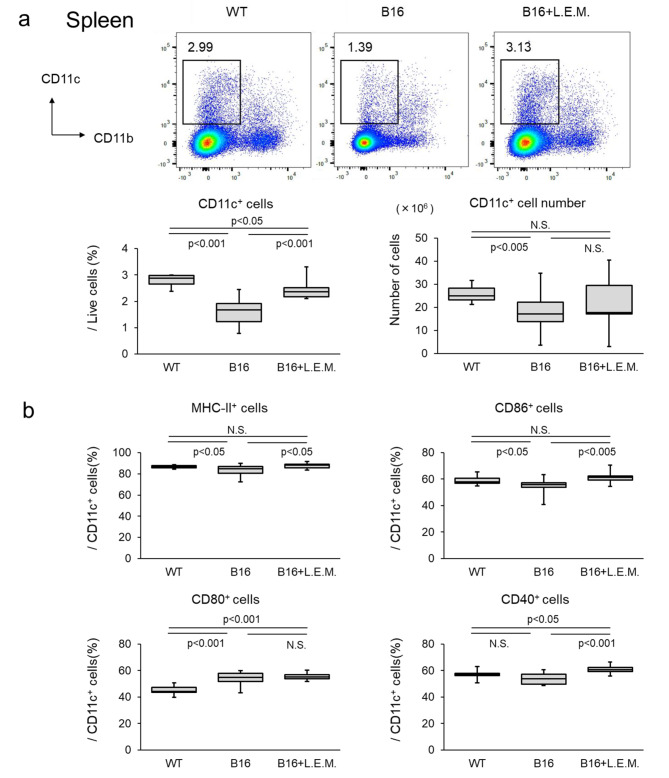
Immune cell activation is essential for cancer rejection; however, the tumor microenvironment leads to deterioration of immune function, which enables cancer cells to survive and proliferate. We previously reported that oral ingestion of Lentinula Edodes Mycelia (L.E.M.) extract enhances the tumor antigen-specific T-cell response and exerts an antitumor effect in a tumor-bearing mouse model. In this study, we focused on antigen-presenting cells (APCs) located upstream of the immune system, induced a T-cell response, then examined the impact of L.E.M. extract on the APCs. L.E.M. extract enhanced the expression of MHC-I, MHC-II, CD86, CD80, and CD40 in bone marrow-derived dendritic cells (DCs) and strongly induced the production of IL-12. L.E.M.-stimulated DCs enhanced IFN-γ production from CD8 T cells and induced their differentiation into effector cells. Furthermore, L.E.M. extract promoted IL-12 production and suppressed the production of IL-10 and TGF-β by transforming bone marrow-derived macrophages into M1-like macrophages. Furthermore, in a B16F10 melanoma inoculation model, DCs in the spleen were decreased and their activation was suppressed by the presence of cancer; however, ingestion of L.E.M. extract prevented this functional deterioration of DCs. In the spleen of cancer-bearing mice, the number of CD11b F4/80 macrophages in a hypoactivated state was also increased, whereas L.E.M. extract suppressed the increase of such macrophages. These findings suggest that L.E.M. extract may exhibit an antitumor immune response by regulating the function of APCs to induce cytotoxic T lymphocytes, as well as by suppressing the decline in antigen-presenting cell activity caused by the presence of cancer.
免疫细胞的激活对于癌症的排斥至关重要;然而,肿瘤微环境导致免疫功能恶化,使癌细胞得以存活和增殖。我们之前曾报道过,口服香菇菌丝体提取物(L.E.M.)可增强肿瘤抗原特异性 T 细胞反应,并在荷瘤小鼠模型中发挥抗肿瘤作用。在本研究中,我们专注于免疫系统上游的抗原呈递细胞(APCs),诱导 T 细胞反应,然后研究 L.E.M.提取物对 APCs 的影响。L.E.M.提取物增强了骨髓来源树突状细胞(DCs)中 MHC-I、MHC-II、CD86、CD80 和 CD40 的表达,并强烈诱导 IL-12 的产生。L.E.M.刺激的 DCs 增强了 CD8 T 细胞产生 IFN-γ,并诱导其分化为效应细胞。此外,L.E.M.提取物促进 IL-12 的产生,并抑制转化为 M1 样巨噬细胞的骨髓来源巨噬细胞产生 IL-10 和 TGF-β。此外,在 B16F10 黑色素瘤接种模型中,脾脏中的 DCs 因癌症的存在而减少且其激活受到抑制;然而,摄入 L.E.M.提取物可防止 DCs 的这种功能恶化。在荷瘤小鼠的脾脏中,处于低激活状态的 CD11b F4/80 巨噬细胞的数量也增加了,而 L.E.M.提取物则抑制了这种巨噬细胞的增加。这些发现表明,L.E.M.提取物可能通过调节 APC 的功能来诱导细胞毒性 T 淋巴细胞,从而发挥抗肿瘤免疫反应,同时抑制癌症引起的抗原呈递细胞活性下降。