Department of Life Science & Institute of Bioinformatics and Structural Biology, National Tsing Hua University, Hsinchu, Taiwan.
Institute of Population Health Sciences, National Health Research Institutes, 35 Keyan Road, Zhunan, Miaoli County, 350, Taiwan.
BMC Public Health. 2023 Aug 8;23(1):1500. doi: 10.1186/s12889-023-16419-8.
Mathematical and statistical models are used to predict trends in epidemic spread and determine the effectiveness of control measures. Automatic regressive integrated moving average (ARIMA) models are used for time-series forecasting, but only few models of the 2019 coronavirus disease (COVID-19) pandemic have incorporated protective behaviors or vaccination, known to be effective for pandemic control.
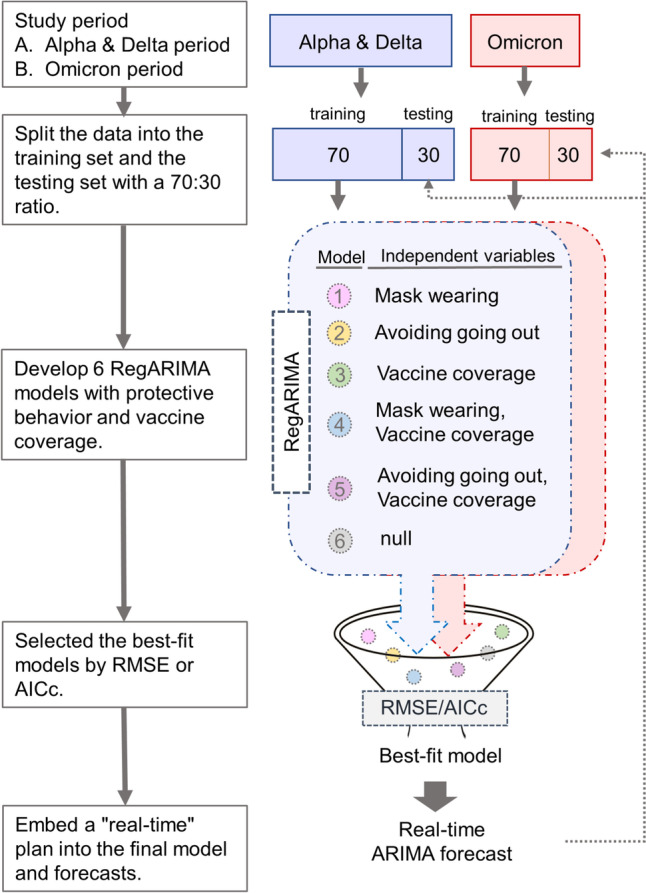
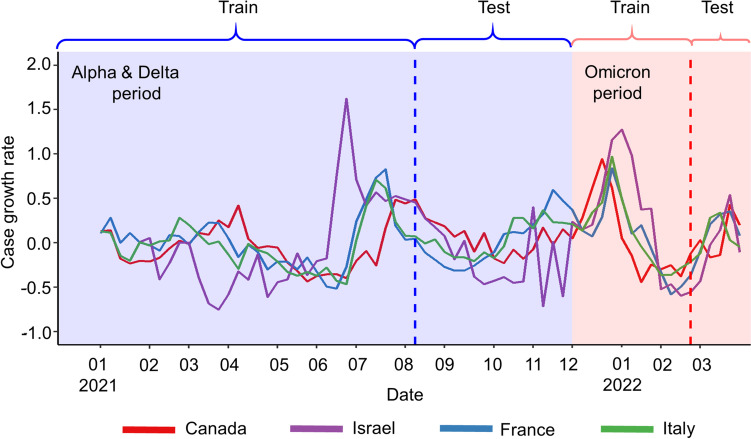
To improve the accuracy of prediction, we applied newly developed ARIMA models with predictors (mask wearing, avoiding going out, and vaccination) to forecast weekly COVID-19 case growth rates in Canada, France, Italy, and Israel between January 2021 and March 2022. The open-source data was sourced from the YouGov survey and Our World in Data. Prediction performance was evaluated using the root mean square error (RMSE) and the corrected Akaike information criterion (AICc).
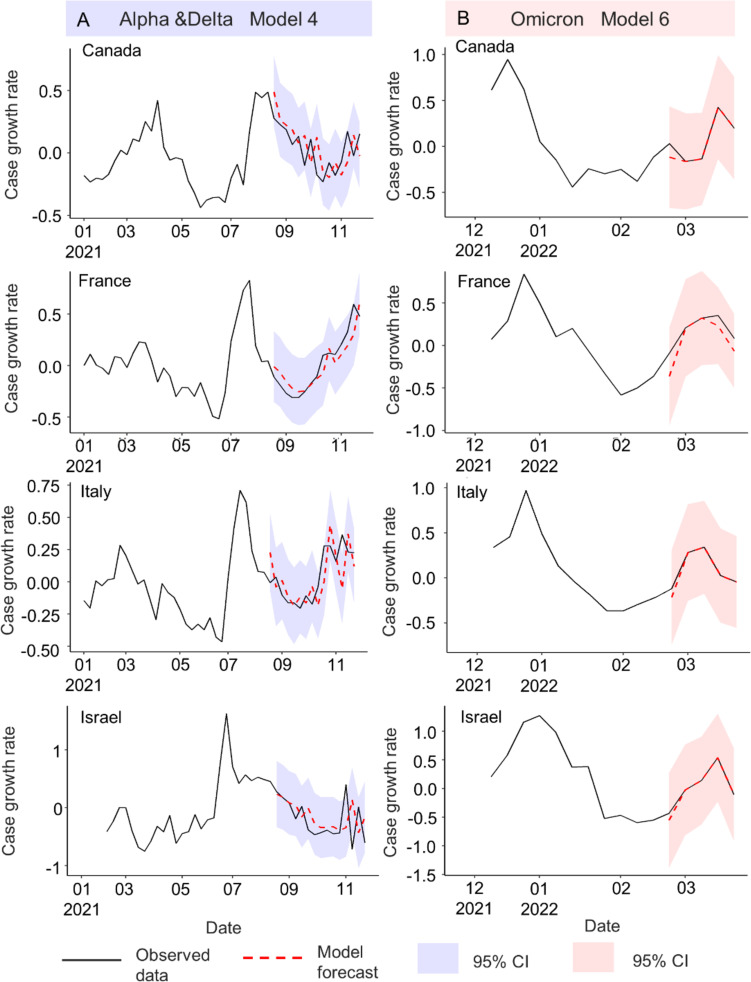
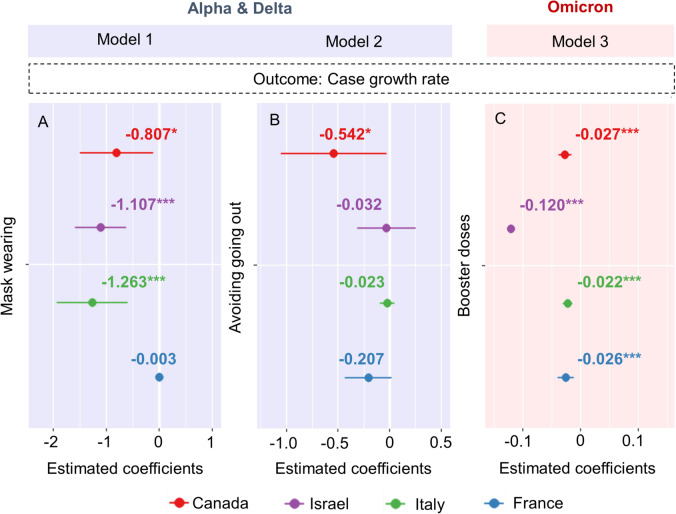
A model with mask wearing and vaccination variables performed best for the pandemic period in which the Alpha and Delta viral variants were predominant (before November 2021). A model using only past case growth rates as autoregressive predictors performed best for the Omicron period (after December 2021). The models suggested that protective behaviors and vaccination are associated with the reduction of COVID-19 case growth rates, with booster vaccine coverage playing a particularly vital role during the Omicron period. For example, each unit increase in mask wearing and avoiding going out significantly reduced the case growth rate during the Alpha/Delta period in Canada (-0.81 and -0.54, respectively; both p < 0.05). In the Omicron period, each unit increase in the number of booster doses resulted in a significant reduction of the case growth rate in Canada (-0.03), Israel (-0.12), Italy (-0.02), and France (-0.03); all p < 0.05.
The key findings of this study are incorporating behavior and vaccination as predictors led to accurate predictions and highlighted their significant role in controlling the pandemic. These models are easily interpretable and can be embedded in a "real-time" schedule with weekly data updates. They can support timely decision making about policies to control dynamically changing epidemics.
数学和统计学模型用于预测疫情传播趋势,并确定控制措施的有效性。自回归综合移动平均(ARIMA)模型用于时间序列预测,但只有少数 2019 冠状病毒病(COVID-19)大流行模型纳入了被认为对大流行控制有效的保护行为或疫苗接种。
为了提高预测的准确性,我们应用新开发的带有预测因子(戴口罩、避免外出和接种疫苗)的 ARIMA 模型,对 2021 年 1 月至 2022 年 3 月期间加拿大、法国、意大利和以色列每周 COVID-19 病例增长率进行预测。开源数据来自 YouGov 调查和 Our World in Data。使用均方根误差(RMSE)和修正赤池信息量准则(AICc)评估预测性能。
在 Alpha 和 Delta 病毒变体占主导地位的大流行期间(2021 年 11 月之前),一个包含口罩佩戴和疫苗接种变量的模型表现最佳。在 Omicron 期间(2021 年 12 月之后),一个仅使用过去病例增长率作为自回归预测因子的模型表现最佳。这些模型表明,保护行为和疫苗接种与 COVID-19 病例增长率的降低有关,在 Omicron 期间,加强针疫苗接种覆盖率发挥了特别重要的作用。例如,在加拿大的 Alpha/Delta 期间,口罩佩戴和避免外出每增加一个单位,病例增长率分别显著降低 0.81 和 0.54(均 p < 0.05)。在 Omicron 期间,加拿大、以色列、意大利和法国每增加一剂加强针,病例增长率均显著降低(分别为 -0.03、-0.12、-0.02 和-0.03;均 p < 0.05)。
本研究的主要发现是将行为和疫苗接种作为预测因子纳入其中,可实现准确预测,并强调了它们在控制大流行方面的重要作用。这些模型易于解释,可以嵌入到每周数据更新的“实时”计划中。它们可以支持及时制定控制动态变化的传染病的政策。