Institute of Zoonosis, College of Public Health, Zunyi Medical University, Zunyi, Guizhou, China.
Institute of Toxicology and Pharmacology, University Medical School Schleswig-Holstein, Kiel, Germany.
PeerJ. 2023 Aug 4;11:e15777. doi: 10.7717/peerj.15777. eCollection 2023.
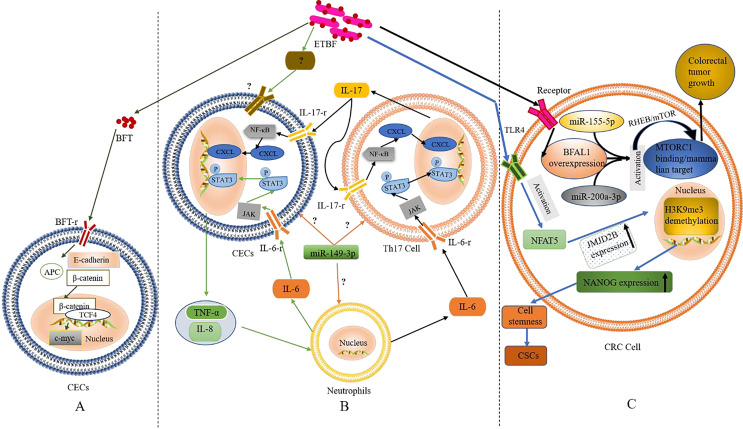
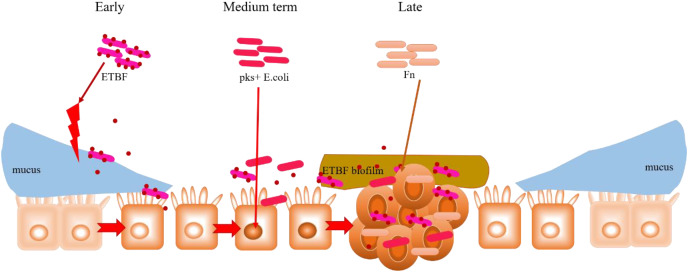
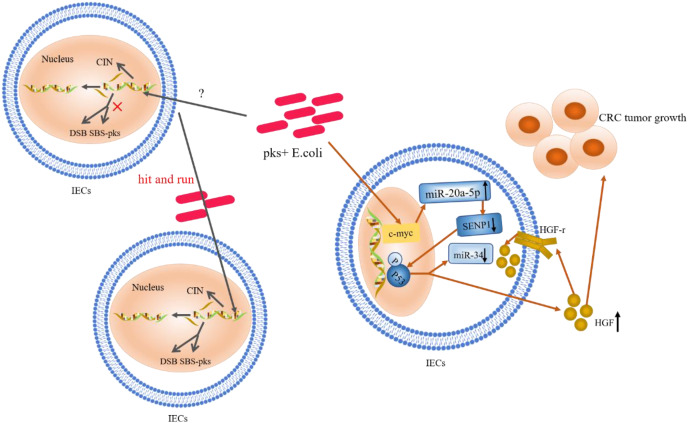
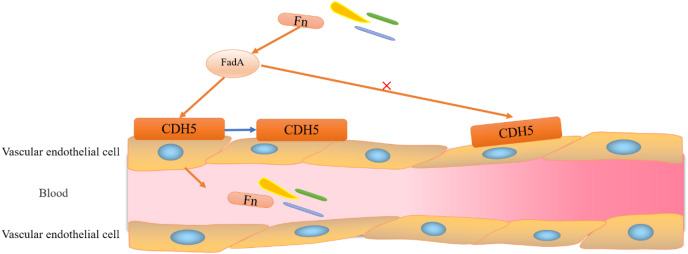
Colorectal cancer (CRC), which develops from the gradual evolution of tubular adenomas and serrated polyps in the colon and rectum, has a poor prognosis and a high mortality rate. In addition to genetics, lifestyle, and chronic diseases, intestinal integrity and microbiota (which facilitate digestion, metabolism, and immune regulation) could promote CRC development. For example, enterotoxigenic , genotoxic , and , members of the intestinal microbiota, are highly correlated in CRC. This review describes the roles and mechanisms of these three bacteria in CRC development. Their interaction during CRC initiation and progression has also been proposed. Our view is that in the precancerous stage of colorectal cancer, ETBF causes inflammation, leading to potential changes in intestinal ecology that may provide the basic conditions for pks+ colonization and induction of oncogenic mutations, when cancerous intestinal epithelial cells can further recruit to colonise the lesion site and may contribute to CRC advancement by primarily the development of cancer cells, stemization, and proliferation, which could create new and tailored preventive, screening and therapeutic interventions. However, there is the most dominant microbiota in each stage of CRC development, not neglecting the possibility that two or even all three bacteria could be engaged at any stage of the disease. The relationship between the associated gut microbiota and CRC development may provide important information for therapeutic strategies to assess the potential use of the associated gut microbiota in CRC studies, antibiotic therapy, and prevention strategies.
结直肠癌(CRC)是从结肠和直肠的管状腺瘤和锯齿状息肉逐渐演变而来的,其预后不良,死亡率高。除了遗传、生活方式和慢性疾病外,肠道完整性和微生物群(有助于消化、代谢和免疫调节)也可能促进 CRC 的发展。例如,肠产毒性、遗传毒性和 pks+ 大肠杆菌在 CRC 中高度相关。本综述描述了这三种细菌在 CRC 发展中的作用和机制。还提出了它们在 CRC 起始和进展过程中的相互作用。我们的观点是,在结直肠癌的癌前阶段,ETBF 引起炎症,导致肠道生态可能发生潜在变化,这可能为 pks+ 定植和致癌基因突变的诱导提供基本条件,此时癌变的肠道上皮细胞可以进一步招募 定植病变部位,并且 通过主要促进癌细胞的发展、干细胞化和增殖,可能有助于 CRC 的进展,这可能为新的、定制的预防、筛查和治疗干预措施创造条件。然而,在 CRC 发展的每个阶段都有最占优势的微生物群,不能忽视在疾病的任何阶段两种甚至三种细菌都可能参与的可能性。相关肠道微生物群与 CRC 发展之间的关系可能为治疗策略提供重要信息,以评估相关肠道微生物群在 CRC 研究、抗生素治疗和预防策略中的潜在用途。