Nature Research Centre, Akademijos 2, Vilnius, 08412, Lithuania.
Wildlife Ecology and Health group (WE&H) and Servei d'Ecopatologia de Fauna Salvatge (SEFaS), Departament de Medicina i Cirurgia Animals, Facultat de Veterinària, Universitat Autònoma de Barcelona, Bellaterra, Barcelona, 08193, Spain.
Vet Res Commun. 2024 Feb;48(1):541-546. doi: 10.1007/s11259-023-10191-1. Epub 2023 Aug 9.
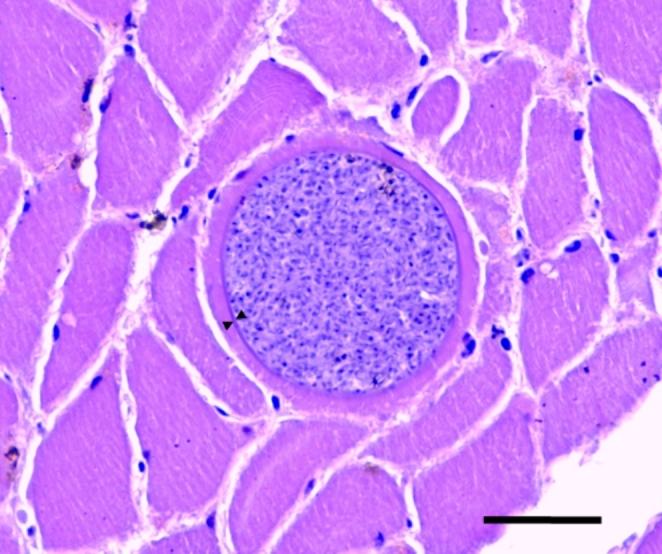
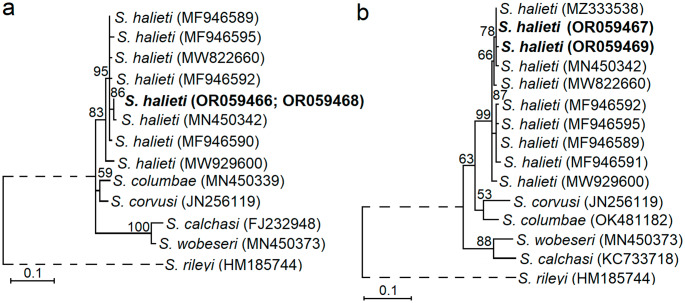
At least three Sarcocystis species (S. falcatula, S. halieti and S. wobeseri-like) have been detected infecting raptorial birds. By histopathology and PCR-sequencing of the ITS1 marker, S. halieti was detected in a bearded vulture (Gypaetus barbatus) and a black kite (Milvus migrans) from the Catalonia region in North Spain. The 241 bp-long sequences obtained from the Sarcocystis organisms detected in both raptors showed 97.5-99.6% and 97.9-100% similarity with those of previously identified S. halieti; also, the phylogenetic trees generated placed the identified sequences together with other sequences of S. halieti available in GenBank. In sum, the description of the bearded vulture as a new intermediate host for S. halieti adds new insights on the complex epidemiology of the genus involving avian hosts.
至少有三种肉孢子虫物种(Sarcocystis falcatula、S. halieti 和 S. wobeseri-like)已被检测到感染猛禽。通过组织病理学和 ITS1 标记物的 PCR 测序,在来自西班牙北部加泰罗尼亚地区的髯鹫(Gypaetus barbatus)和黑鸢(Milvus migrans)中检测到 S. halieti。从两种猛禽中检测到的 Sarcocystis 生物获得的 241 bp 长序列与先前鉴定的 S. halieti 具有 97.5-99.6%和 97.9-100%的相似性;此外,生成的系统发育树将鉴定出的序列与 GenBank 中其他可用的 S. halieti 序列放在一起。总之,描述髯鹫为 S. halieti 的新中间宿主增加了关于涉及禽宿主的该属复杂流行病学的新见解。